Louise Carter CEO On Everyday Jewelry For Active Women
Active women lose more jewelry to gym clasps and chlorine than to almost anything else. Qirra, founder of Louise Carter, built a technical fix and rethought what heirloom-worthy actually means.
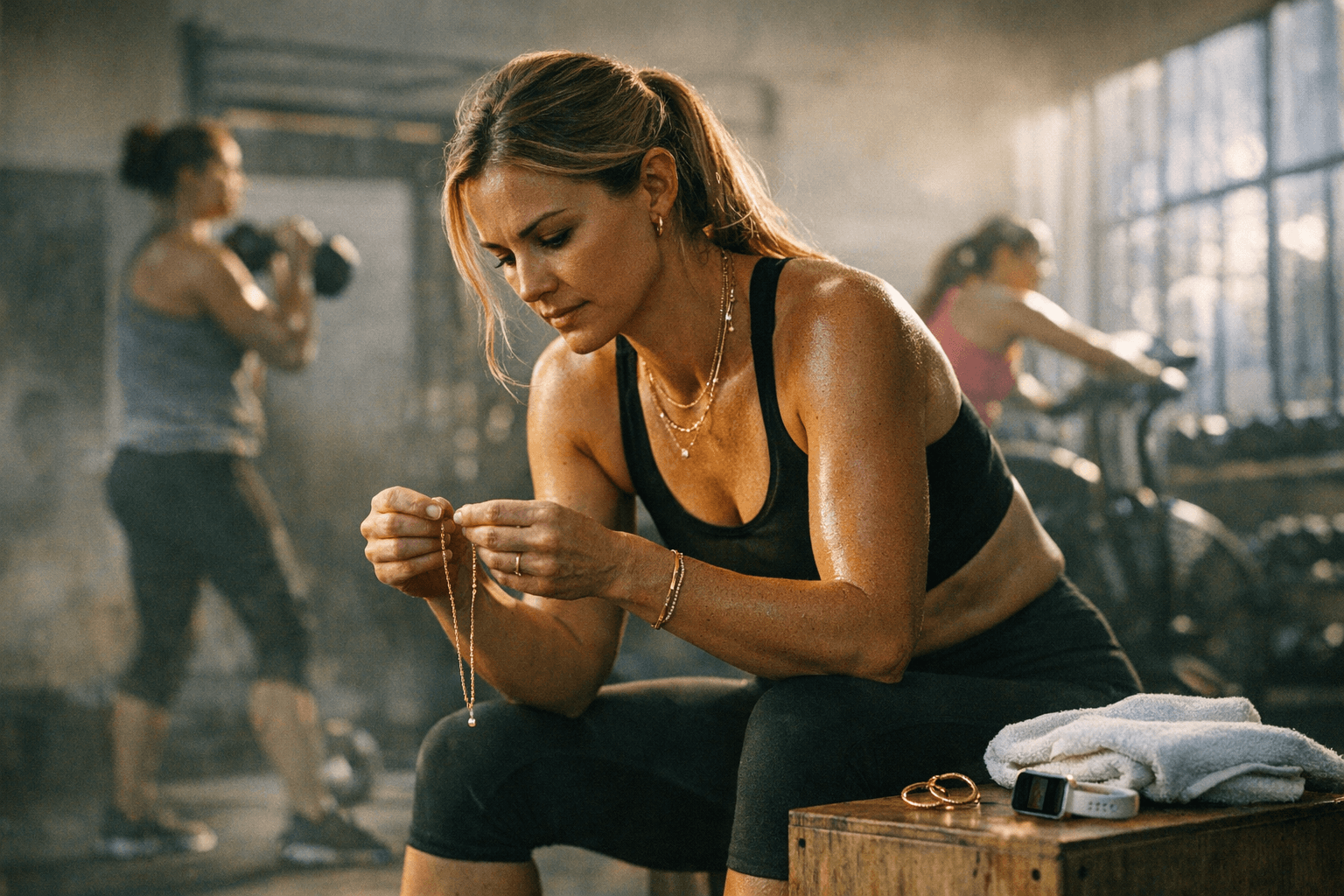
The piece that mattered most was usually the first one lost. Anyone who has ended a surf session to find a chain pooled in their palm, or reached for an earring mid-flight only to discover one missing, understands the particular grief of losing jewelry you actually loved. For generations, the conventional answer was pragmatic and unsatisfying in equal measure: take everything off before you do anything interesting. Louise Carter, the Hawaii-based brand founded in 2023 by Qirra, was built on the specific frustration of that advice.
"I always felt stuck between two choices," Qirra says. "Either spend a lot of money on solid gold and worry about losing it, or buy something cheaper that wouldn't last." That bind is more common than fine jewelry marketing typically admits, and solving it required thinking like an engineer as much as a designer.
What Actually Breaks, and Why
Before getting to solutions, it helps to understand the failure modes. For active wearers, they are consistent across price points and brands.
Clasps go first. Lobster clasps and spring-ring closures, standard on most necklaces and bracelets, are designed for occasional wear, not the daily torque of a wetsuit sleeve, a gym bag drawstring, or repeated saltwater immersion. Thin-gauge clasps in particular are prone to metal fatigue, and a clasp that fails once rarely holds reliably afterward.
Prong settings follow. The four or six metal prongs that hold a stone in place are elegant in a vitrine but vulnerable in a yoga class. Prong tips catch on sports bras, activewear seams, and neoprene, and each snag gradually widens the setting until the stone shifts or disappears. This is not a matter of quality, it is a matter of geometry.
Plating is the third culprit. Most affordable gold jewelry is electroplated, meaning a micron-thin layer of gold is deposited over a base metal using electrical current. That layer is real gold, but it is also thin enough that chlorine, sweat, and friction wear through it in months. The tarnish that follows is the base metal oxidizing.
PVD Bonding: The Technology Behind Louise Carter
Louise Carter's answer to all three problems starts at the material level. The brand uses physical vapor deposition (PVD) to bond 14k gold over surgical-grade stainless steel. The process, long established in luxury watchmaking and aerospace manufacturing for its exceptional wear resistance, works by vaporizing gold in a vacuum chamber and depositing it onto the metal substrate at the atomic level. Where electroplated gold sits on a surface the way paint sits on a wall, PVD gold bonds into the substrate at a molecular level, creating a finish that is meaningfully harder and more wear-resistant.
The stainless steel base is equally important to the performance claim. Surgical-grade stainless steel is non-reactive to saltwater, chlorine, and sweat. It does not corrode, tarnish, or leach metals the way sterling silver, brass, or alloy bases do, and it is hypoallergenic by composition: no nickel, no lead, no green-finger chemistry. The practical result is a piece that can move from a morning swim to an evening out without any visible degradation.
Louise Carter backs this with a lifetime color guarantee, a commitment that reflects both confidence in the PVD process and an understanding that the brand's customers intend to wear their jewelry continuously, not carefully. That said, "waterproof" in jewelry deserves scrutiny regardless of brand. The claim is most meaningful when applied to PVD-bonded stainless steel or solid gold, both of which handle saltwater and chlorine reliably. Gold vermeil (thicker plating over sterling silver) and standard gold-filled pieces are more water-sensitive and should be evaluated individually rather than assumed equivalent.
The Permanent Bracelet: Removing the Weakest Link
The most design-forward expression of Louise Carter's philosophy is its permanent bracelet kits, designed for friends, couples, and families. A permanent bracelet is welded shut at the wrist rather than closed with a traditional clasp, creating a continuous circle with no mechanical failure point. You choose it once, put it on, and it stays until you decide otherwise.
The ritual dimension is deliberate. A bracelet chosen and welded during a trip to Oahu does not come off for your morning swim. It does not end up on a hotel nightstand. It accumulates the experience of wherever you wore it. In the context of meaningful jewelry, this is a significant reframe: the piece is not a keepsake stored in a box between occasions. It is the occasion, worn continuously and visibly, through everything.
For friends and families specifically, the kits create a shared mark without the sentimentality of traditional charm bracelets. The aesthetic is clean and modern; the meaning is in the commitment to keep it on.
Why 300,000 Customers Agree
Louise Carter has attracted more than 300,000 customers and over 45,000 reviews since its 2023 founding, a trajectory that reflects something broader than brand loyalty. Gold jewelry purchases rose 26% in a single recent year as consumers sought both aesthetic investment and perceived value stability. At the same time, frustration with the maintenance demands of traditional fine jewelry, the polishing, the storing, the removing before every activity, has grown alongside that purchasing surge. Louise Carter sits at the intersection of those two trends: pieces that look like fine jewelry, perform like industrial-grade accessories, and are priced accessibly enough to layer and stack without anxiety.
"Women today are incredibly active," Qirra notes. "They're working, traveling, exercising, raising families. Jewelry shouldn't be something you have to babysit." That framing names something real. For a generation that treats jewelry as part of a daily identity stack rather than a special-occasion marker, a piece that requires removal before the gym is, increasingly, a piece that stays in the drawer.
A Checklist for Shopping Activity-Proof Jewelry Across Any Brand
The principles behind Louise Carter translate into practical questions worth asking before buying from any jeweler. Use this as a filter:
- Metal construction: Solid 14k or 18k gold, or PVD-bonded gold over 316L surgical-grade stainless steel, are the most reliable choices for continuous wear. Electroplated pieces are not equivalent; the plating layer is thinner and will degrade faster with regular water and sweat exposure.
- Setting style: Bezel settings, which wrap the stone in a full metal rim, offer the most protection for active wear. Prong settings, while classic, are better suited to pieces worn less frequently. Flush and channel settings are ideal for rings.
- Clasp type: For pieces that will see real activity, look for heavier-gauge lobster clasps or spring rings. Magnetic closures are convenient but can open during physical movement. Permanent-style closures eliminate the failure point entirely and are worth considering for pieces with emotional significance.
- Waterproof specificity: Ask brands whether their waterproof claim covers saltwater, chlorine, and sustained submersion, or only splash resistance. The distinction matters for swimmers and surfers specifically.
- Warranty terms: A lifetime color guarantee is meaningful for PVD pieces. For solid gold, look for policies that cover prong repair, stone replacement, and clasp service, because even indestructible materials need maintenance.
- Hypoallergenic materials: Nickel-free and lead-free construction is essential for 24/7 wear. Surgical-grade stainless steel and solid gold are generally safe for sensitive skin; mixed alloys and brass bases are not.
What "Heirloom-Worthy" Means Now
The old rule about removing jewelry before activity was, at its core, a rule about protecting precious objects from real life. Louise Carter's founding argument, refined in a Hawaii environment where ocean living shapes every daily routine, is that a piece worn through everything accumulates a different kind of value than one kept safe in a box. The most meaningful bracelet is not the one stored carefully for thirty years. It is the one welded shut at the wrist in Oahu, worn through every workout, every swim, every ordinary Tuesday since. As PVD technology matures and more brands adopt durable construction as a baseline rather than a differentiator, that redefinition of heirloom-worthy looks less like a marketing position and more like the obvious direction the industry was always heading.
This article was produced by Prism’s automated news system from verified source data, official records, and press releases, then run through automated quality and moderation checks before publishing. The system is built and supervised by the people who set the standards it runs under. Read our full AI policy.
Did this article answer your question?