Sotheby's to Auction One of the World’s Rarest, Purest Diamonds (The Jwaneng)
A 28.88-carat Type IIa diamond from Botswana's richest mine heads to Sotheby's Hong Kong on April 23 with a $2.8 million estimate, and a grading report that proves what rarity really means.
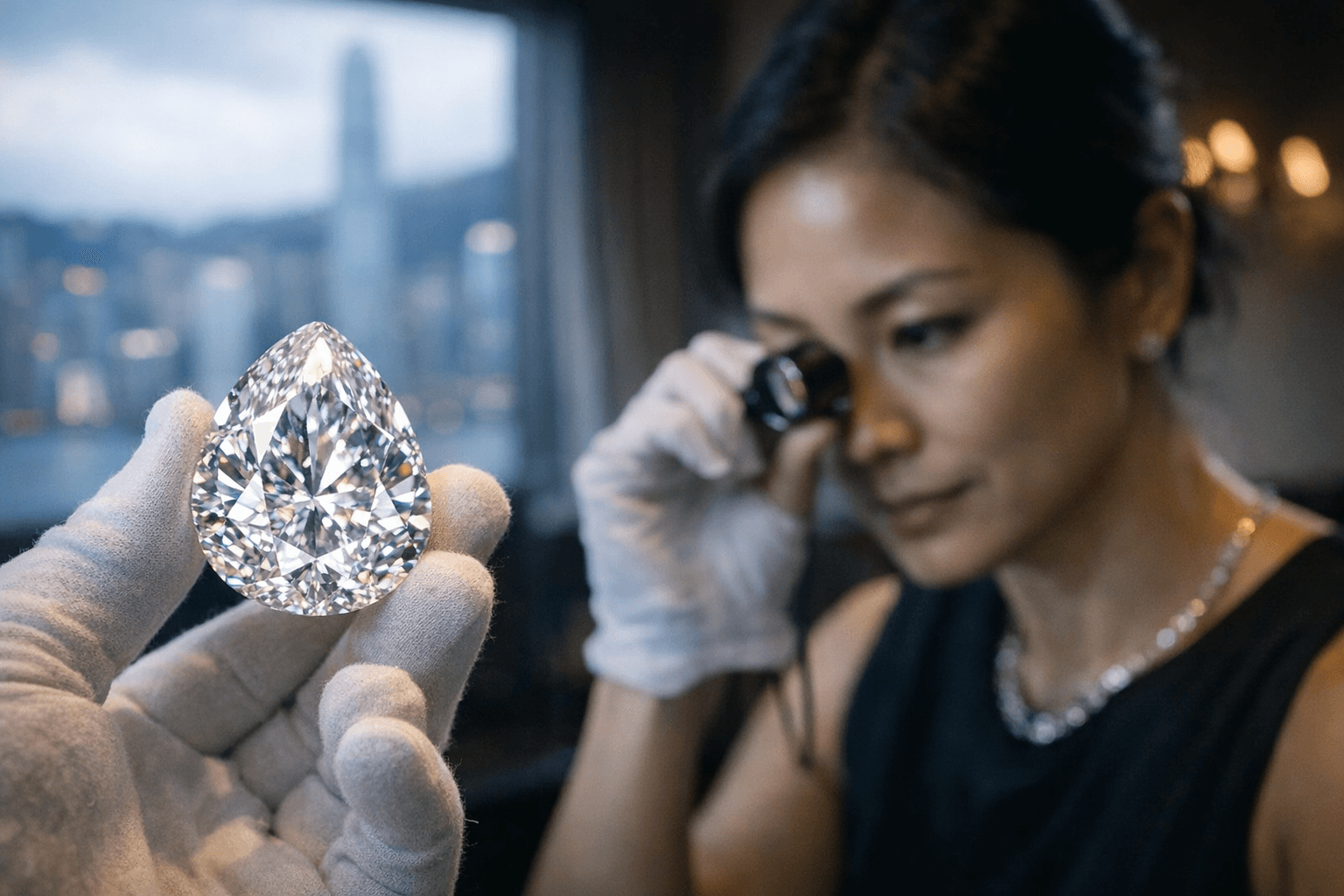
Most objects described as rare are not. The word gets attached to limited editions, seasonal releases, and stones that simply happen to be large. True rarity, in gemology, is a measurable condition. The Jwaneng 28.88, heading to Sotheby's Hong Kong on April 23, meets every threshold the profession has.
The stone weighs 28.88 carats, grades D in color and internally flawless in clarity, and is classified as Type IIa, the triumvirate of superlatives that defines the absolute ceiling of what a colorless diamond can be. Sotheby's has placed an estimate of $2.2 million to $2.8 million on it for its Live High Jewelry sale. The upper figure is not incidental. In many Asian cultures, eight is the number of prosperity and good fortune, and a stone whose carat weight and estimated ceiling both peak at 8 arrives in Hong Kong practically designed for the room.
The diamond began as a 114.83-carat rough recovered from the Jwaneng mine in Botswana, operated by Debswana, the 50/50 joint venture between De Beers and the government of Botswana. De Beers specialists spent months studying the rough before committing to a cut, ultimately choosing a round brilliant: the most optically efficient form a diamond can take, engineered to return light directly through its table facet. To arrive at 28.88 polished carats from 114.83 rough is to sacrifice nearly three-quarters of the original material in pursuit of geometric and optical precision. That is not waste. That is the work.
Jwaneng, nicknamed "the Prince of Mines," is widely considered the richest diamond mine in the world by value. Located about 170 kilometers southwest of Gaborone, in the Kalahari Desert of southern Botswana, it has been operational since 1982. The mine's name means "a place of small stones" in Setswana. There is an almost pointed irony in that translation. De Beers and Sotheby's unveiled the diamond at Maison Assouline in London, timing the event to coincide with the release of the book "A Diamond Is Forever: The Making of a Cultural Icon, 1926–2026." "The Jwaneng 28.88 is a vanishingly rare feat of nature combined with a masterclass in diamond cutting and polishing," said Quig Bruning, Sotheby's head of jewels Americas and EMEA. The stone will be auctioned alongside additional De Beers diamonds sourced from the same mine, framing the April 23 sale as a coherent argument for Botswanan provenance at the very top tier of the market.
That argument is being made during an uncomfortable stretch for mined diamonds. The natural diamond price index fell 11.5 percent between March 2025 and March 2026 and has not registered positive monthly growth since June 2025, according to research by 77 Diamonds. The pressure comes largely from the lab-grown sector, which continues to deliver high technical quality at a fraction of the price. Against that backdrop, the Jwaneng 28.88 represents the industry's clearest counter-argument: a stone that is, by documented and verifiable measure, a product of geological time and specific geography that cannot be manufactured.
What This Auction Teaches You
Understanding what makes the Jwaneng 28.88 genuinely exceptional, rather than just expensive, requires reading its grading report with some precision. Three grades matter here: Type IIa, D-color, and internally flawless. Each one represents a measurable physical fact rather than marketing language.
Type IIa is a classification reserved for fewer than 2% of all natural diamonds, prized for its extraordinary chemical purity and remarkable optical transparency. Most diamonds contain nitrogen atoms embedded in their crystal lattice; nitrogen absorbs some blue light, which gives the stone a faint yellow tint and slightly reduces its transparency. Type IIa diamonds contain virtually no nitrogen, making them optically clear to an extraordinary degree and allowing them to conduct heat more efficiently than other diamonds. A laboratory tests for this using infrared or ultraviolet spectroscopy; the result appears on the grading report as a confirmed material property. The Cullinan, the largest gem-quality rough diamond ever found, was a Type IIa. So are some of the most celebrated pink and blue diamonds in auction history.
Here is where a critical correction becomes necessary, particularly for buyers now navigating the lab-grown market: the majority of lab-grown diamonds are also classified as Type IIa. Because they are synthesized under controlled conditions without nitrogen contamination, they share the same chemical classification as the rarest natural stones. A grading report listing Type IIa does not, by itself, confirm a natural diamond. What confirms natural origin is a GIA Natural Diamond grading report, which includes origin determination as a separate assessed characteristic. When evaluating any significant stone sold as rare on the basis of its Type IIa classification, verify that the origin determination is present on the report.
D-color is the top of the GIA's 23-point color scale, which runs from D at the colorless extreme to Z, indicating light yellow or brown. A D-grade stone is evaluated under controlled lighting against calibrated master comparison stones; it is the grade at which absolutely no body color is detectable by a trained grader. One step lower, E, is distinguishable only by an expert with a master set in hand. For buyers shopping in the D-through-H range, the practical visual difference once a stone is set in white gold or platinum diminishes quickly. What D represents at auction is a superlative on paper, one that collectors and institutional buyers recognize and assign value to precisely because it cannot be approximated.
Internally flawless, noted as IF on a grading report, means a GIA grader found no inclusions visible under 10x magnification. The grade above it, flawless (FL), means neither inclusions nor surface blemishes are present. For almost all practical purposes, an IF stone and an FL stone are indistinguishable to the naked eye. The distinction matters at auction, where grading precision determines price at the margin.
One specification that buyers consistently overlook on grading reports is fluorescence. The GIA grades a diamond's response to ultraviolet light on a scale from None to Very Strong, with blue being the most common color of emission. Strong blue fluorescence can improve the apparent whiteness of a slightly lower-color stone, making it look brighter face-up, but it can introduce a hazy or oily appearance in high-color stones, particularly those in the D-to-E range. For a D-color stone of this magnitude, fluorescence is a detail worth confirming before bidding. On any significant purchase, that column of the report is the one most commonly skipped.
The Jwaneng mine's name comes from a language that describes the modest. What comes out of it is anything but. The April 23 sale at Sotheby's Hong Kong is, among other things, a demonstration that provenance, documentation, and verifiable geological specificity remain the most durable foundations of value in a market that has found ways to replicate almost everything else about a diamond. The number 28.88 may be lucky by cultural convention. What the laboratory report behind it contains is not luck. It is evidence.
This article was produced by Prism’s automated news system from verified source data, official records, and press releases, then run through automated quality and moderation checks before publishing. The system is built and supervised by the people who set the standards it runs under. Read our full AI policy.
Did this article answer your question?