How to Choose Couple Jewelry That Feels Genuinely Meaningful in 2026
Couple jewelry works best when it's worn daily, not displayed occasionally — here's how to match piece type, material, and design to the relationship moment you're marking.

The most meaningful piece of couple jewelry is the one that never comes off. Not because it's soldered to your wrist, but because it's comfortable enough, considered enough, and personal enough that taking it off would feel like a small loss. That distinction — between a piece worn and a piece stored — is where the real buying decision lives.
Define the role before you choose the piece
Before metal, before stone, before setting: what is this jewelry supposed to do? The answer shapes every subsequent choice. A piece marking a milestone, say a first anniversary or a move across the country together, calls for something with permanence: precious metal, a stone, a design that reads as deliberate. A token of long-distance reassurance has different requirements entirely. It needs to be lightweight, unobtrusive, and sturdy enough to survive the daily physicality of someone who misses you from three time zones away. A low-stakes everyday signifier, worn simply because you want a quiet reminder of each other, might be nothing more than a cord bracelet or a slender gold band.
Getting the purpose wrong produces jewelry that feels ceremonial rather than intimate. A heavy, elaborate locket is a beautiful gift; it is not a piece most people wear on a Tuesday commute. Honest self-assessment about wearability, at the outset, prevents the most common failure in couple jewelry: the piece that lives in a drawer.
Promise rings and couple rings: commitment without the proposal
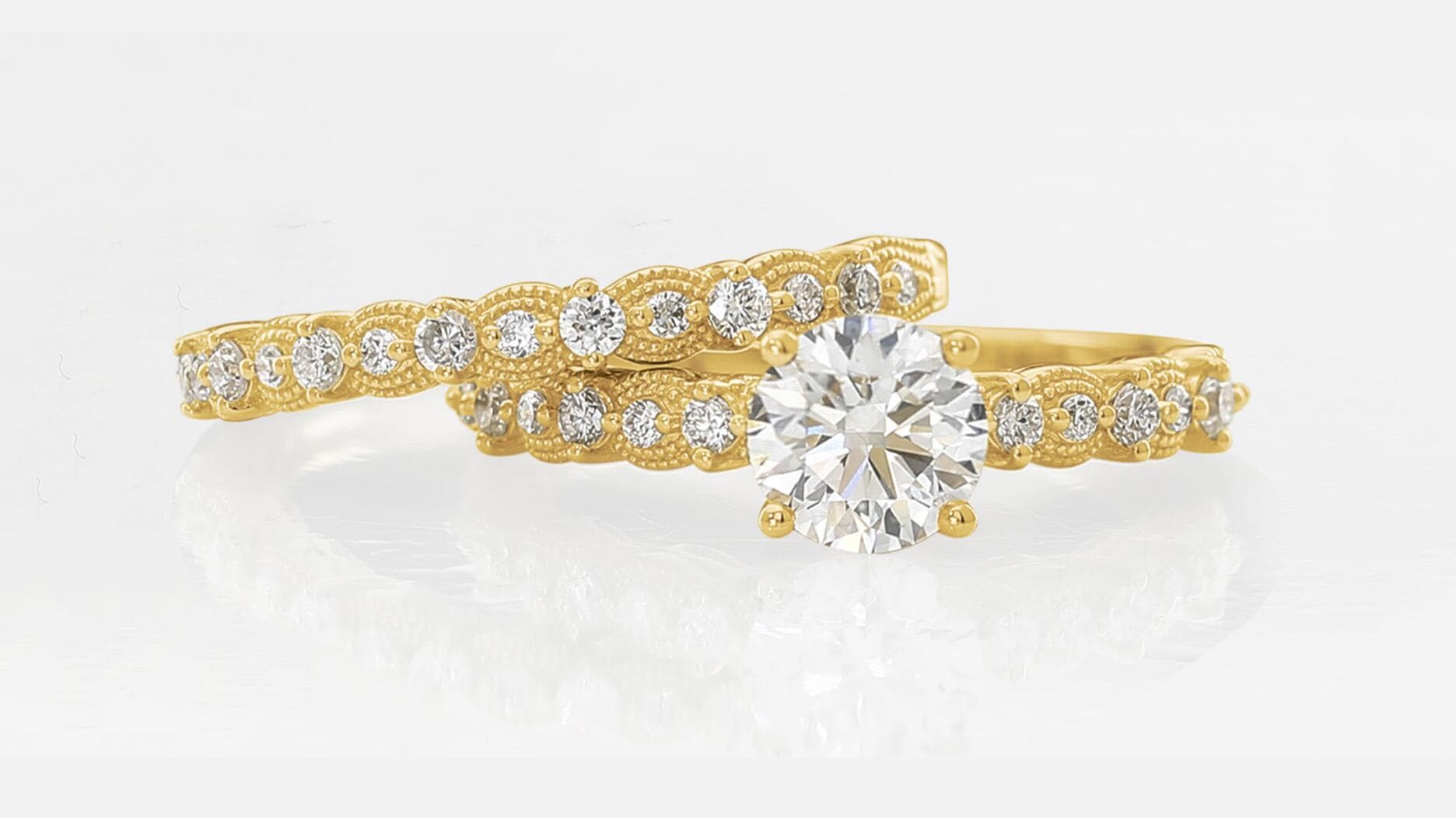
The promise ring occupies a specific emotional register: it says more than a casual gift but less than an engagement ring. According to recent industry data, promise rings typically cost between $100 and $1,000, while engagement rings average $5,000 to $7,500 — and the gap reflects not just materials but the weight of intention. A promise ring is a flexible symbol. It can mark loyalty, a future engagement, or simply the decision that this relationship is serious and exclusive.
For a ring worn daily, setting choice matters enormously. A bezel setting, in which the stone is encircled by a low wall of metal, offers considerably more protection than a prong setting, where four or six metal claws grip the stone and leave it exposed to snagging and impact. Bezel-set stones require less upkeep, don't catch on fabrics, and suit active wearers. Prong settings, conversely, allow more light to pass through the stone and maximize brilliance — the right call when sparkle is a priority and the wearer has a less physical daily life. For couple rings with no center stone, consider the width and profile of the band: a flat, low-profile band in 14-karat gold or sterling silver will wear more comfortably long-term than a high-domed or heavily textured design that catches on everything.
Matching necklaces and lockets: shared motif, individual expression
The most wearable coordinated necklaces tend to avoid the trap of perfect symmetry. Identical pendants on identical chains can feel like a uniform rather than a choice. A more considered approach: choose a shared visual motif executed differently for each wearer. If the motif is celestial, one partner might wear a crescent moon pendant while the other wears a constellation. If the design language is geometric, one piece might carry the full shape while the other holds a fragment. The pieces speak to each other without speaking in unison.
Lockets occupy their own category. A locket is essentially a vessel, and its meaning is entirely determined by what it holds: a photograph, a folded note, a pressed flower. Sterling silver lockets are the most accessible entry point; 14- or 18-karat gold elevates the piece significantly in both durability and visual weight. For a couple separated by distance, the locket functions as an intimate, private object in a way no other jewelry form quite matches.
Puzzle-style necklaces, where two pendants interlock to form a complete shape, have their own appeal as a literal metaphor for partnership. They work best when the separated pendants are still independently interesting objects rather than visually incomplete without their counterpart.

Bracelets and cord pieces: the casual register
Not every relationship moment calls for gold. The cord bracelet or textile friendship-style piece has a long, legitimate history as a low-stakes symbol of connection, particularly in long-distance relationships where something tactile and always-present matters more than something valuable. These pieces tend to work precisely because they are not precious: they can be worn swimming, working out, sleeping. Wearability is the entire point.
For couples who want something slightly more considered, coordinated metal bracelets in sterling silver or gold fill offer a middle register between casual and fine. Matching finishes are not required; complementary ones often feel more authentic. Rose gold for one partner and white gold for the other is a pairing with its own internal logic, distinct metals that share a design language. Engraving, whether coordinates of a significant location, an anniversary date, or a short phrase, transforms a simple cuff or chain bracelet into a genuinely personal object.
Coordinated watches: functional and symbolic
A watch is the one piece of jewelry that announces itself as useful first and beautiful second, which makes it an unusual but compelling choice for couples who want a symbolic piece without the self-consciousness of purely decorative jewelry. Coordinated watches do not need to be identical; they need only share a design sensibility. Two watches from the same house, or with the same case shape and dial palette but different sizes, read as intentional without being matchy.
The symbolic dimension of a watch is particular: it measures time, and time is what relationships are made of. That layering of function and meaning is not sentimental abstraction. It is a practical reason why a coordinated watch can become more meaningful over years than a pendant that never moves from the jewelry box.
The principle of complementary over identical
Across every category, the guidance holds: complementary coordination tends to wear better than exact matching, both aesthetically and emotionally. Identical pieces can feel like costumes; pieces that share a motif, a metal, or a design language while remaining individual feel like a considered choice. The goal is for each piece to be something each partner would choose for themselves, even in the absence of the other.
A shared precious metal palette is the simplest version of this principle. Committing to yellow gold across all pieces, or to sterling silver, creates visual coherence without demanding that every object be a twin. Layer from there: a shared stone type, a recurring geometric form, an engraved phrase that means something only to the two people wearing it.
The jewelry that becomes genuinely meaningful is almost never the most expensive piece in the collection. It is the piece worn so consistently that it begins to carry an impression of the skin beneath it — the one that, after years, feels less like something added and more like something that was always there.
This article was produced by Prism’s automated news system from verified source data, official records, and press releases, then run through automated quality and moderation checks before publishing. The system is built and supervised by the people who set the standards it runs under. Read our full AI policy.
Did this article answer your question?