Why the 2026 U.S. Dime Makes a Compelling Coin Jewelry Candidate
The 2026 dime's one-year Emerging Liberty design packs revolutionary symbolism and workable copper-nickel alloy into 17.91mm of circulating history worth far more as a ring or pendant.
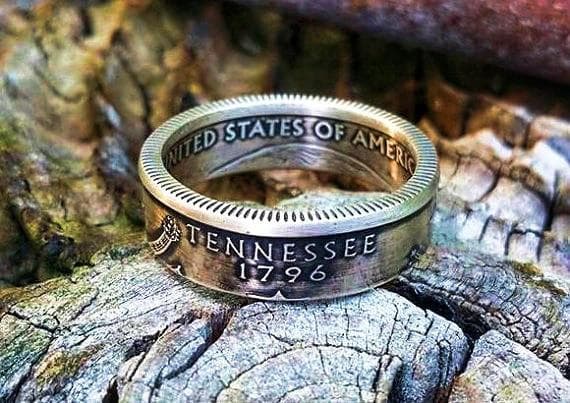
There is a quiet art to looking at a coin and seeing something other than currency. For coin jewelry artisans, every detail matters: the relief of a portrait, the legibility of lettering under magnification, the way a particular alloy responds when heat and pressure coax it into a ring band. By those measures, the 2026 U.S. dime is one of the more compelling raw materials to enter circulation in decades.
The reason is specific to this year. For the first time in eighty years, the dime is not wearing Franklin Roosevelt's profile. In honor of America's Semiquincentennial, 250 years since independence, the U.S. Mint issued a one-year-only redesign called the Emerging Liberty. In 2027, Roosevelt returns. That narrow window makes the 2026 dime not just a craft material but a document of a particular national moment, and that historical singularity is exactly what separates meaningful jewelry from mere metalwork.
A Design Built for Narrative
The imagery on the 2026 Emerging Liberty dime is unusually dramatic for a circulating coin. The obverse portrays a determined Liberty, her hair loose in what the Mint describes as "the winds of revolution," her cap bearing stars and stripes in a deliberate nod to early American coinage. She faces forward with what the Mint calls "steadfast resolve," confronting the tyranny of the British monarchy. The reverse abandons the torch, olive branch, and oak branch composition that Roosevelt dimes carried since 1946 in favor of an eagle in flight, arrows clutched in its talons, with the inscription "LIBERTY OVER TYRANNY" arcing around the design. The obverse was conceived by Esao Andrews, a designer within the U.S. Mint's Artistic Infusion Program.
For a jeweler forming a ring or pendant, this iconography transforms from numismatic trivia into wearable symbolism. A liberty cap references a tradition of freedom that stretches back through Roman coinage and early American currency. An eagle bearing arrows is not ornamental; it is martial, purposeful, historically grounded. When those images curve around a finger or hang from a chain, the wearer carries a compressed history of American founding ideals. That is the kind of layered narrative that distinguishes heirloom jewelry from decorative objects.
What the Metal Can Do
The 2026 dime is composed of a copper core clad on both faces with an alloy of 75% copper and 25% nickel. This combination was adopted by the U.S. Mint as a practical alternative to silver, but it delivers real advantages for the jewelry maker. The copper-nickel exterior resists corrosion and tarnish more reliably than many precious metals at a fraction of the cost, and the alloy's hardness, measuring approximately Rockwell B 50 to 55, sits in a workable range: firm enough to hold the stamped surface detail through shaping, soft enough to be formed without industrial equipment.
The metal also work-hardens progressively as it is shaped, meaning that a skilled artisan can control the final stiffness of a ring band by managing how aggressively the coin is worked. Anneal too little and the metal may crack under extreme forming; work it carefully and you end up with a band that holds its geometry without needing solder reinforcement. For pendants, the clad construction provides another benefit: the distinct copper core visible at a cut edge becomes an incidental design element, a cross-section that reveals the coin's layered history as clearly as a geological sample reveals strata.
The Practicalities of the Dime's Dimensions
At 17.91mm in diameter, the dime is the smallest of the commonly used U.S. coin jewelry candidates. That measurement dictates how the piece translates to the finger. A dime ring will not suit a large hand; the diameter maps most naturally to smaller fingers or pinky rings, where the proportions read as delicate rather than diminished. For artisans accustomed to working with quarters or half dollars, the dime demands a finer touch and more precise hole-punching to maintain an even band width during folding.
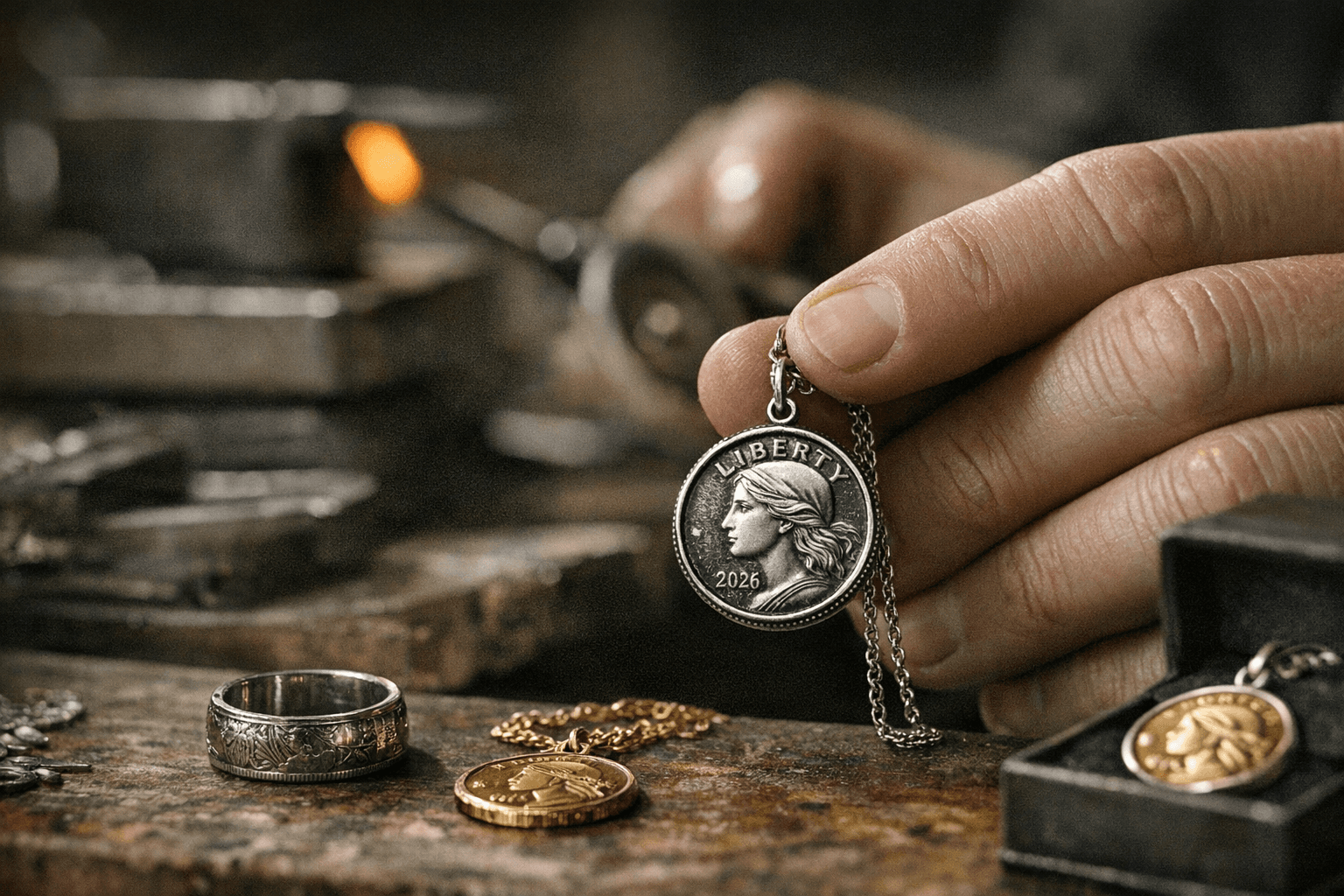
The same size constraint that limits ring sizing is an asset in pendant design. The 17.91mm face is substantial enough to display the Emerging Liberty portrait or the eagle-and-arrows reverse in readable detail, while remaining proportionate on a chain. Bezel settings suit the coin well here, encasing the perimeter in gold- or silver-filled wire that frames the imagery without obscuring it. A simple bail soldered to the bezel's crown positions the portrait upright, and the resulting piece has the visual weight and specificity that distinguishes a considered pendant from a novelty.
Craft Considerations and Finishing
The longevity of surface detail in a coin ring depends heavily on finishing discipline. The Emerging Liberty design's high-relief portraiture and the crisp lettering of "LIBERTY OVER TYRANNY" will survive the folding process on a well-executed piece, but aggressive polishing can flatten precisely the features that make the coin worth wearing. A light hand with a polishing cloth and a final treatment with a jeweler's wax or Renaissance Wax preserves the low-relief shadows that give the design its three-dimensional character.
Wear comfort on a dime ring relates directly to edge finishing. The raw interior of a folded coin band can carry micro-burrs from the punching process; these need to be filed smooth and progressively sanded through grits before the ring is wearable. The exterior reeded edge of the dime, the fine milled ridging around the coin's circumference, often survives the forming process on the ring's outer face and becomes a textural detail that sets coin rings apart from conventional bands.
Why Provenance Changes the Equation
Coin jewelry occupies a specific territory in the broader landscape of meaningful jewelry: it begins with an object that already has a life. A circulating dime has passed through hands, crossed state lines, sat in jars and pockets. That history is unverifiable and precisely that ambiguity is part of its appeal. When a 2026 dime is formed into a ring, it carries the date of America's 250th anniversary as a permanent mark, a year that cannot be buffed out or reset. The piece becomes a record of a specific national celebration, made wearable.
The coin jewelry tradition draws on a long history of transformation: mourning jewelry that incorporated hair, Victorian pieces set with found stones, love tokens made from hammered coins. What connects those traditions is the deliberate act of taking an object with one kind of meaning and giving it another without erasing the first. A 2026 dime ring is still a 2026 dime. It simply refuses to stay in a pocket.
For an artisan or a buyer interested in jewelry that carries genuine provenance rather than manufactured nostalgia, the timing here is worth noting. The Emerging Liberty design circulates for one year only. By 2027, the dime reverts to Roosevelt, and this particular combination of imagery, metalwork, and historical context becomes fixed. A piece made now from a circulating 2026 dime will always be exactly that: a coin from the year America turned 250, shaped by hand into something meant to last considerably longer.
This article was produced by Prism’s automated news system from verified source data, official records, and press releases, then run through automated quality and moderation checks before publishing. The system is built and supervised by the people who set the standards it runs under. Read our full AI policy.
Did this article answer your question?