Marie Lichtenberg turns sports pennants into heirloom talisman jewelry
Marie Lichtenberg’s Fanions turn sports pennants into intimate talismans, making fandom feel precious, personal, and heirloom-worthy.
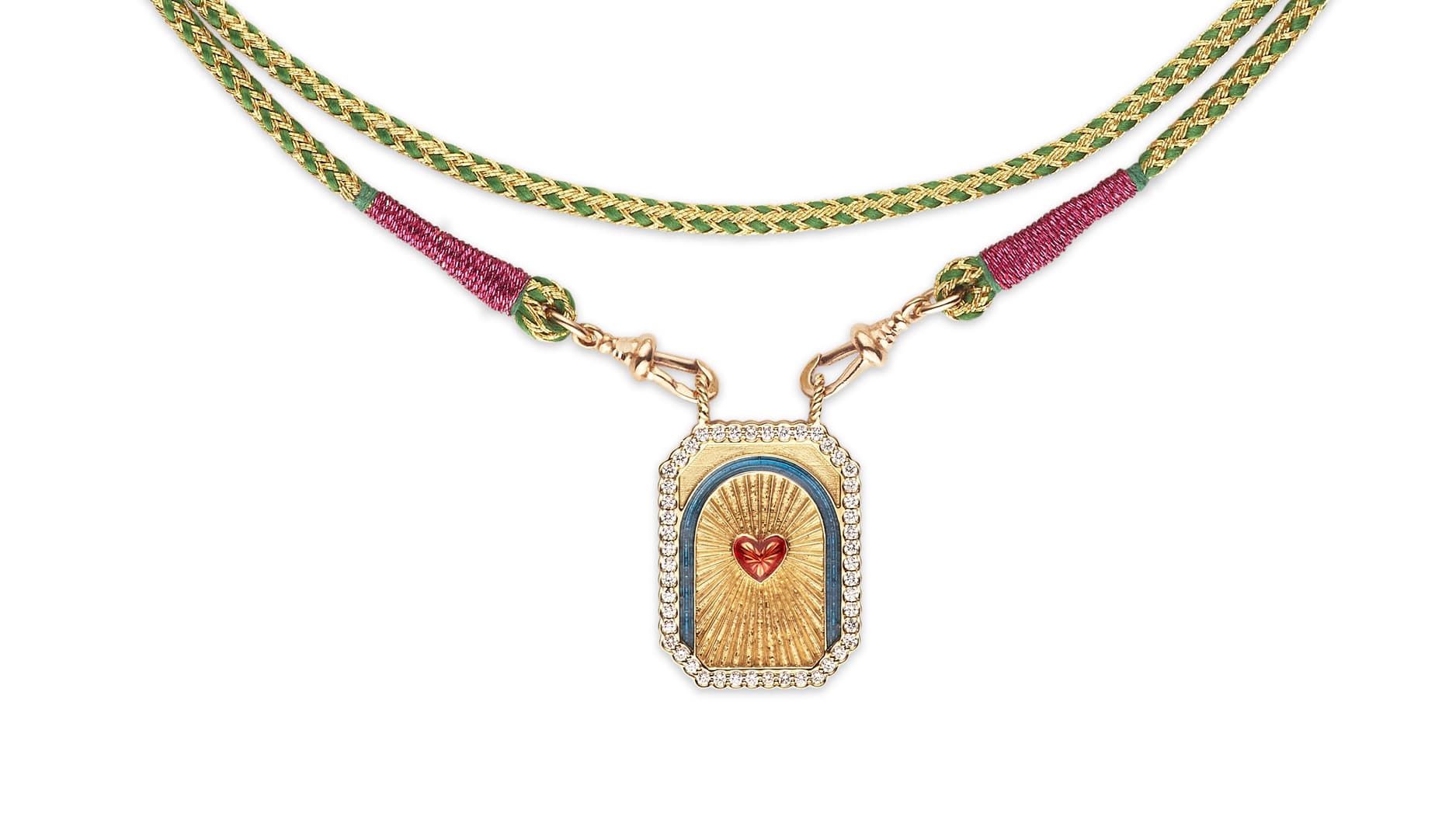
From fanion to fine-jewelry talisman
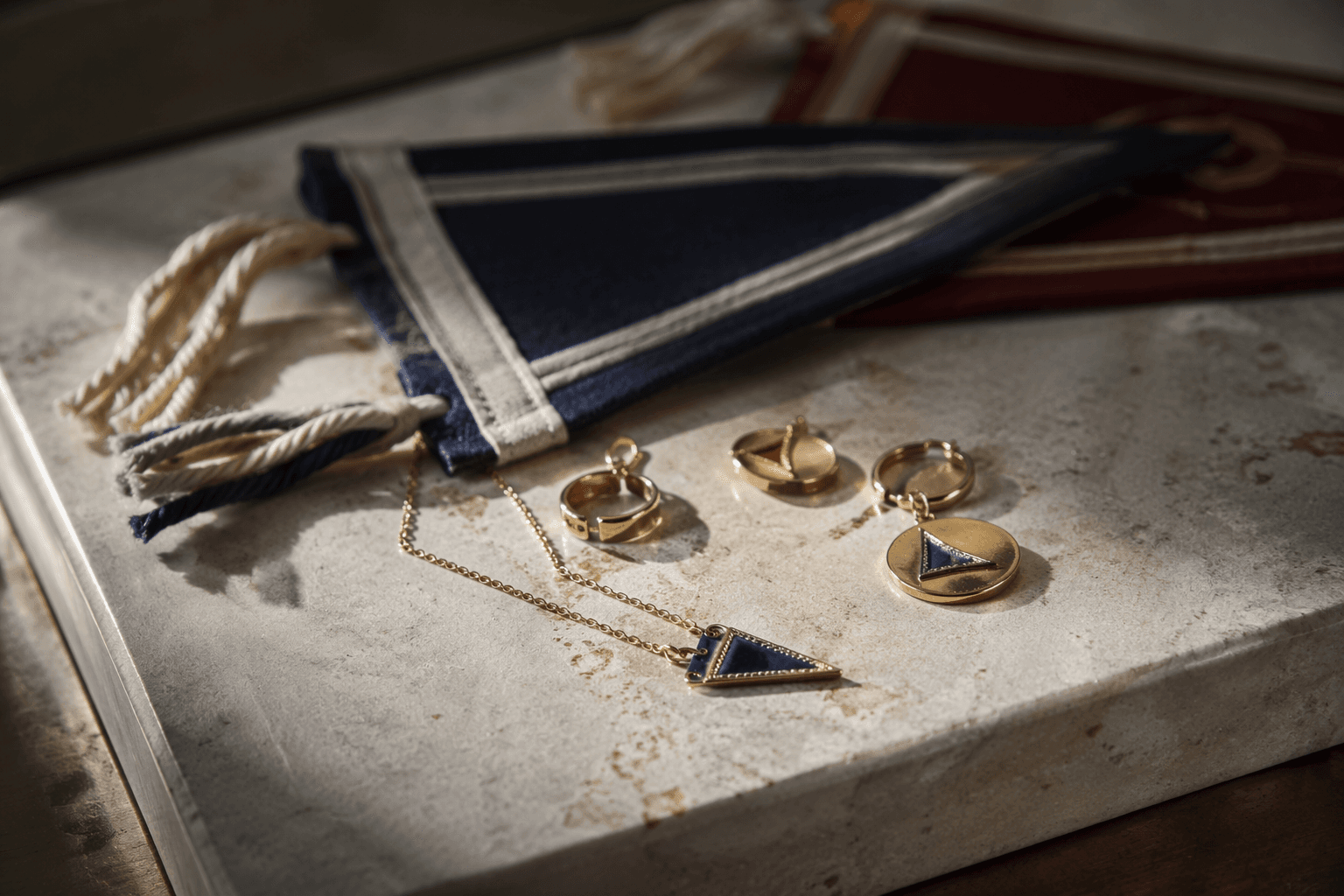
Marie Lichtenberg takes one of sport’s most recognizable symbols, the pennant, and recasts it as a jewel with the poise of a keepsake and the charge of a private emblem. Her Fanions, unveiled at Couture, are miniature flags in precious metal, a translation that feels clever on first glance and emotionally durable on the second. The word fanion is French for pennant, and that linguistic shift matters: it moves the object out of the stadium and into the vocabulary of fine jewelry, where memory, allegiance, and sentiment can be made permanent.
A Fanion pendant in 18k yellow gold with sapphire sets the tone. The material choice is crucial because it keeps the design from drifting into novelty. Gold gives the piece its authority, while sapphire introduces a disciplined flash of color that reads as polished and intentional rather than playful in a disposable way. In other iterations, the collection leans into ceramic, sapphire, ruby, and symbolic messages such as hope and amour, which pushes the pendants deeper into talisman territory. They feel less like memorabilia and more like tiny banners for an inner life.
Why this symbolism lands now
Sports iconography has become a compelling visual shorthand in fashion, but Lichtenberg’s version is sharper than simple trend-following. She understands that a pennant already carries built-in meaning: team loyalty, memory of a place, a moment of shared intensity. By shrinking that language into fine jewelry, she gives the wearer something more intimate than a logo and more specific than a birthstone. A birthstone can signal identity in a broad, familiar way. A pennant-shaped pendant says something more particular: where your allegiance lies, what you hold dear, what you choose to carry close.
That is why the Fanions feel heirloom-worthy. The strongest identity jewelry does not rely on sentiment alone, it gives that sentiment a structure. Here, the structure is the crisp geometry of a flag translated into precious material, with stone accents and hand-finished surfaces doing the work of refinement. The result is jewelry that can sit beside a vintage locket or a chain worn every day, because it has the same emotional clarity and the same potential to gather meaning over time.
Lichtenberg’s use of messages such as hope and amour keeps the collection personal even as it nods to Americana and team graphics. The pieces are not trying to imitate sports merchandise, nor are they content to be abstract charms. They occupy a more interesting middle ground, where iconography becomes intimate. That balance is exactly what makes the collection resonate with buyers looking for identity jewelry that feels sharper, stranger, and more self-authored than a generic initial pendant.
A brand built on irreverence and inheritance
Lichtenberg’s own background helps explain why this translation feels so assured. Paris-based and trained as an editor, she has a natural instinct for reading culture and converting it into form. She formally started her brand in 2019 after going to India and setting up her manufacturing relationships, a detail that matters because it points to a maker who is as serious about production as she is about ideas. In jewelry, a good concept can collapse quickly without the right hands to execute it. Her line has the discipline of a real workshop behind it.
The brand’s own language is telling. One of its guiding phrases is, “irreverence is our path to excellence,” a compact statement that captures the tension at the heart of her work. The pieces are playful, but they are not casual. They are emotionally legible, but they do not flatten into sentimentality. That tension is what gives the jewelry its charge. It can reference the spirit of the United States while still feeling distinctly Parisian in its wit and restraint.
The brand’s story begins with a locket passed from mother to daughter, and that origin remains central to how the pieces behave. Lichtenberg presents jewelry not as decoration alone, but as an heirloom designed to carry sentiment forward. That is the deeper appeal of the Fanions. They are not simply about where you have been or who you root for. They are about what you want preserved, and what you want to become part of your family’s visual memory.
The wider language of lucky objects
Fanions do not stand alone in Lichtenberg’s world. The pendant-and-charm assortment also includes dice, hearts, stars, and letter pieces, all of which reinforce the idea that this is a designer building a vocabulary of symbolic objects. Each motif works like a different register of expression. Dice suggest chance, hearts suggest attachment, stars suggest aspiration, letters suggest naming and self-definition. Together they form a coherent grammar of luck, identity, and affection.
That broader language makes the Fanions feel less like a one-off and more like a chapter in a larger narrative. The same instinct appears in other designs, including lockets with sapphires and diamonds, where symbolism is anchored by real gem weight and fine construction. Lichtenberg’s One Diamond Pendant, meanwhile, looks to the American one-dollar bill for inspiration and is framed by the brand as a symbol of singularity, uniqueness, and certainty. It is a useful counterpart to the Fanions because it shows how consistently she mines American imagery for ideas about selfhood rather than spectacle.
For collectors, that consistency is part of the attraction. A brand can make a novelty; it is harder to make a private mythology that feels coherent across styles. Lichtenberg’s work does that by keeping the emotional register steady while varying the symbols. The result is a body of jewelry that can hold both whimsy and gravity, both cultural reference and personal meaning.
What makes the piece worth the attention
The Fanions earn their place in the conversation because they solve a familiar problem in modern jewelry: how to wear identity without defaulting to the expected. Initials can feel generic, birthstones can feel overused, and many symbolic pendants settle for easy sentiment. Lichtenberg offers a more idiosyncratic answer, one that borrows the immediacy of sports branding and refines it into something that feels intimate enough to keep for decades.
The price on request approach suits that ambition. It signals a piece positioned as crafted, not casual, and it aligns with the handmade nature of the line. In a market crowded with charm jewelry that shouts for attention, Lichtenberg’s pendants do something more difficult. They whisper allegiance, memory, and luck in a visual language that feels both borrowed from culture and deeply personal. That is what turns a pennant into a talisman, and a talisman into an heirloom.
This article was produced by Prism’s automated news system from verified source data, official records, and press releases, then run through automated quality and moderation checks before publishing. The system is built and supervised by the people who set the standards it runs under. Read our full AI policy.
Know something we missed? Have a correction or additional information?
Submit a Tip