Meet the Three Gem Award Nominees Redefining Fine Jewelry Design in 2026
Three very different visions of fine jewelry — a Brazilian marquetry master, a narrative locket maker, and a Paris-based brooch designer — competed for the 2026 Gem Award.
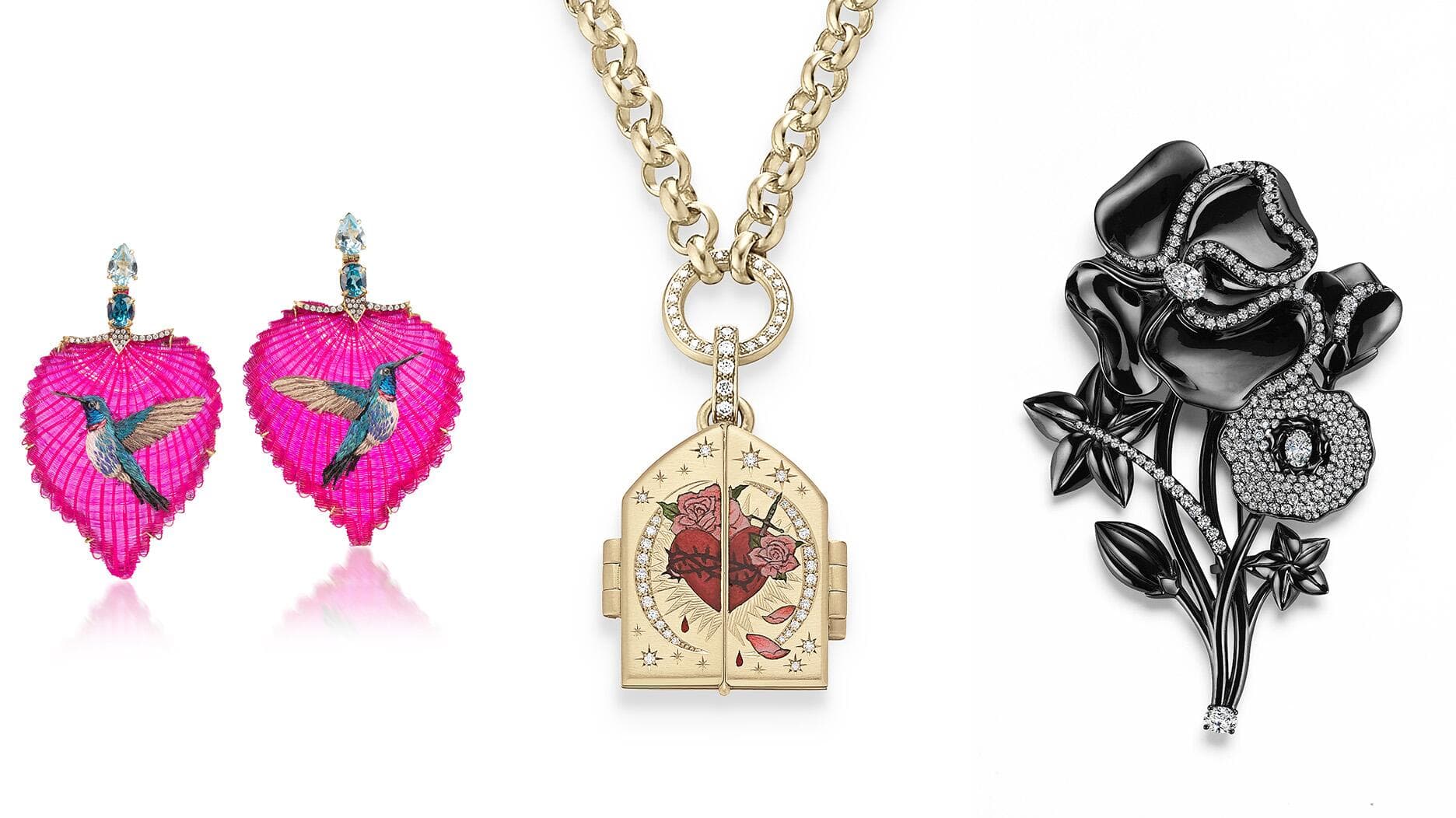
The 2026 Gem Award for Jewelry Design brought together three designers whose practices share almost nothing in common except a refusal to treat jewelry as mere ornament. When Jewelers of America announced its nominees on October 28, 2025, the shortlist read like a deliberate survey of what fine jewelry can be in the current moment: wearable sculpture rooted in craft heritage, intimate narrative objects, and architectural forms drawn from the natural world. The winners were announced live on March 13, 2026, at Cipriani 42nd Street in New York City, the same evening National Jeweler's "Pieces of the Week" spotlighted one signature work from each of the three contenders. Taken together, those three pieces tell you everything about why this particular category generated such anticipation.
Silvia Furmanovich and the Horse Mane Earrings
To understand the Horse Mane Earrings, you first need to understand the lineage behind them. Silvia Furmanovich is a Brazilian designer descended from Italian goldsmiths; her great-grandfather crafted ornaments for the Vatican, and that deep reverence for the handmade runs through everything her São Paulo atelier produces. She launched her namesake brand in 1998, and today she works alongside her three sons, a detail that speaks to how seriously she treats continuity of craft.
What distinguishes Furmanovich from her contemporaries is her insistence on blending disciplines that fine jewelry rarely entertains: marquetry, lacquer, miniature painting, and natural materials including bamboo, silk, and wood sit alongside precious gems in her work. The result is jewelry that feels more closely related to decorative arts than to anything you would find in a conventional vitrine. Institutions have taken notice. She has partnered with The Met and MFA Houston, her work has entered museum collections in New York and Minneapolis, and she has earned four Couture Design Awards alongside a 2019 GEM Award nomination — making this year's nod a return to the shortlist she has clearly earned a place on.
The Horse Mane Earrings, her nominated piece, are characteristic of that approach. The title alone suggests movement arrested in metal, the kind of organic dynamism that marquetry and layered natural materials can capture in a way that cast gold rarely can. For a designer whose entire practice is built on the idea that jewelry should carry cultural memory and material intelligence simultaneously, an earring that evokes the physical texture of a living creature is not a decorative choice — it is a philosophical one.
Cece Fein-Hughes and the Underworld Triptych Necklace
Where Furmanovich reaches toward the natural world, Cece Fein-Hughes reaches inward. The London-based designer working under the Cece Jewellery name has built a practice around jewelry as private narrative, and the Underworld Triptych Necklace is the most literal expression of that impulse. It is a locket in the truest sense: a container for something meant to be seen only when the wearer chooses to open it. When the doors of this triptych piece swing apart, they reveal an illustration flanked by the words "Sacred Love" engraved on the inner panels.
The language of the triptych is borrowed from devotional painting — altarpieces that folded shut in transit and opened to reveal sacred imagery. Fein-Hughes applies that grammar to something worn against the body, making the act of opening the necklace feel genuinely ceremonial. "Sacred Love" is not incidental copy; it is the piece's entire argument, a declaration that what we carry closest to us deserves the same reverence once reserved for religious objects.
This kind of conceptual density in a wearable object is precisely what the Gem Award for Jewelry Design exists to recognize. The category, as presented by Jewelers of America, honors work that raises the visibility and status of fine jewelry — and few pieces in recent memory have made a stronger case for jewelry as a vehicle for meaning than a locket that opens like a miniature altarpiece.
Catherine Sarr and the Invictus Flower Brooch
Catherine Sarr's Almasika is perhaps the most architecturally rigorous of the three nominated practices. The Invictus Flower Brooch, her nominated piece, takes its title from the Latin word for unconquered, which is a choice that immediately signals intent. A flower brooch, in the conventional sense, is among the most traditional forms in the fine jewelry canon — Cartier, Van Cleef, Boucheron have all staked claims on the genre across more than a century. To name yours "Invictus" is to announce that you are not simply continuing that tradition but challenging it.
Sarr's work under the Almasika name has consistently pursued this kind of reclamation: classical forms reimagined with an eye toward what they can mean when stripped of their original cultural assumptions and rebuilt from a different point of view. A brooch is also, importantly, a format that rewards bold proportions and graphic clarity in a way that rings and earrings do not — it is jewelry designed to be read across a room, which makes the choice of the flower motif and the title together a statement about visibility and resilience rather than decoration.
The Gem Awards in Context
The GEM Awards, presented by Jewelers of America, have functioned as the industry's most prominent recognition gala for years, and the 2026 edition carried particular weight. Mark and Candy Udell of London Jewelers received the GEM Award for Lifetime Achievement at the same ceremony, adding institutional gravity to an already competitive evening. Proceeds from the event directly benefit programs aligned with Jewelers of America's mission to strengthen consumer confidence in fine jewelry and watches — which makes the Design category more than a creative prize; it is a statement about what the industry believes is worth investing in.
That investment, in this particular year, went to three designers who share a conviction that fine jewelry should carry more weight than its materials alone. A São Paulo atelier blending marquetry with precious gems, a London studio making lockets that open like devotional objects, and a Paris-based practice reimagining the brooch as a form of personal declaration: the 2026 shortlist for Jewelry Design made a persuasive case that the category is in exceptionally good hands.
This article was produced by Prism’s automated news system from verified source data, official records, and press releases, then run through automated quality and moderation checks before publishing. The system is built and supervised by the people who set the standards it runs under. Read our full AI policy.
Did this article answer your question?