Museum-Grade Conservation Tips Help Owners Protect Meaningful Heirloom Jewelry
Museum conservators' best-kept secrets for protecting heirloom jewelry are now within reach of every owner who wants beauty to outlast a lifetime.
The brooch your grandmother wore on her wedding day. The signet ring passed down through three generations. The strand of natural pearls that traveled across continents before landing in your jewelry box. These pieces carry weight that no appraisal can fully capture, and yet most of us store, handle, and clean them with the same casual indifference we give a fast-fashion accessory. The Institute of Conservation, known as ICON, has compiled collections-care resources that change that equation entirely, bringing museum-grade preventive conservation guidance out of the climate-controlled vault and into the hands of the people who need it most: owners of meaningful and heirloom jewelry.
Why museum conservation principles matter for personal jewelry
Museums do not simply lock treasures behind glass. Their conservation departments operate on a philosophy of preventive care, the idea that thoughtful, consistent habits protect objects far more effectively than reactive repair. A gold-and-enamel brooch treated with that same discipline at home will outlast decades of careless handling that no amount of professional restoration can fully reverse. ICON's guidance applies this institutional rigor to personal collections, translating the language of conservators into short, actionable primers that any jewelry owner can follow without specialist training. The result is a practical framework for anyone whose pieces have sentimental, historical, or financial value worth protecting.
Safe handling: the first line of defense
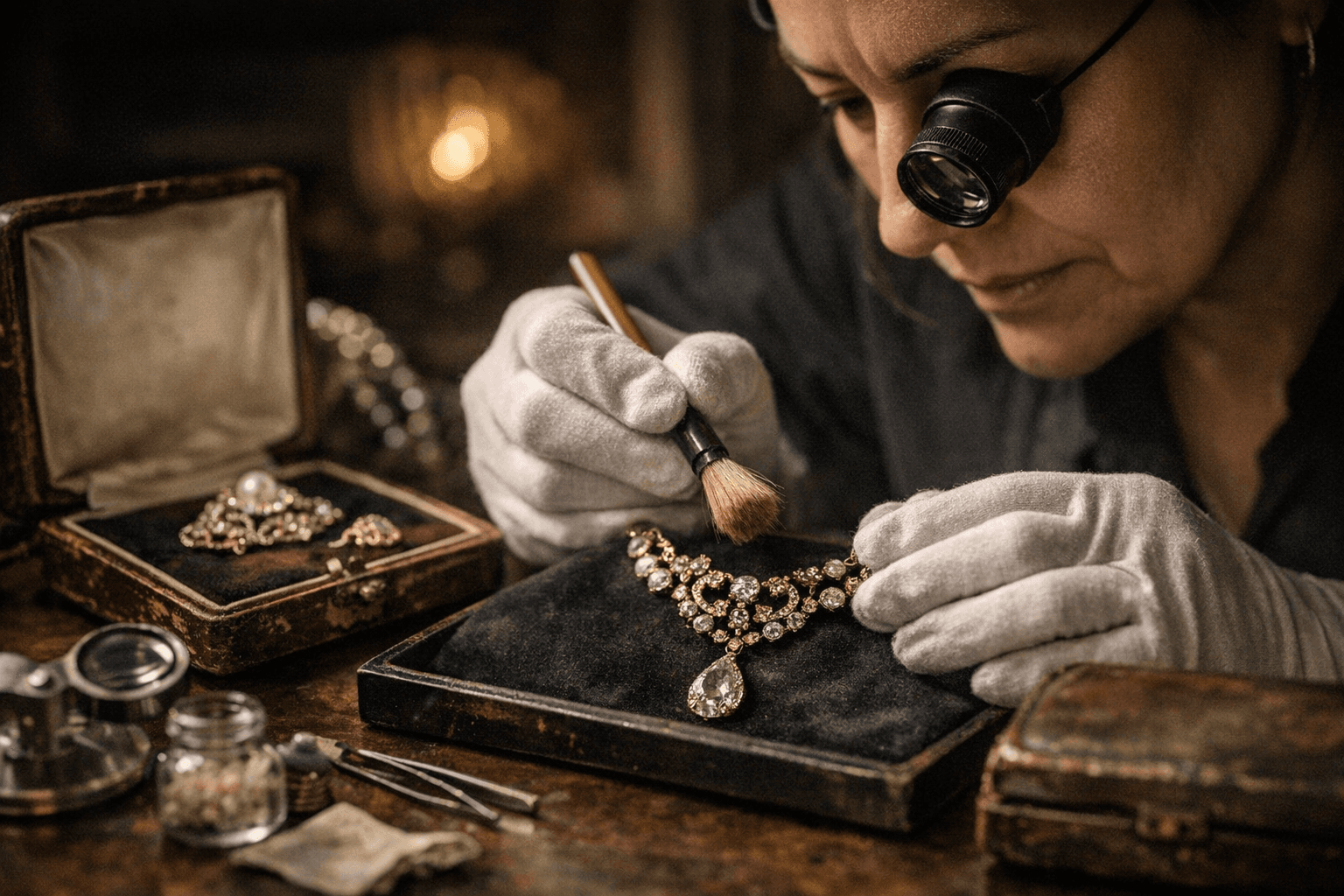
Before storage conditions or cleaning methods even enter the conversation, how you physically handle a piece determines much of its fate. Museum conservators treat handling as a formal act: clean hands or cotton gloves, a padded surface beneath the object, full attention on the task. For jewelry, this translates directly. Oils from skin accelerate tarnish on sterling silver and can etch the surface of certain gemstones over time. Settings, particularly older ones with hand-fabricated prongs or bezel work, are vulnerable to the torque applied when a piece is picked up carelessly or twisted open with force. ICON's preventive care primers emphasize that minimizing unnecessary contact is not overcaution; it is the foundation of long-term preservation.
Practical handling habits worth adopting immediately:
- Place a folded cloth or padded tray on your dressing table before handling any heirloom piece
- Never apply perfume, hairspray, or lotion while wearing jewelry; these compounds degrade organic materials like pearls, coral, and amber
- Remove rings before any activity involving water, chemicals, or physical impact
- When examining a piece closely, hold it over a soft surface rather than at arm's length above a hard floor
Storage environments: what your jewelry box may be doing wrong
The standard jewelry box, with its velvet-lined compartments and brass hinges, feels like the appropriate home for treasured pieces. In reality, many are made from materials that off-gas compounds harmful to metals and gemstones. Certain woods, particularly oak and acidic fruit woods, release organic acids that accelerate tarnish on silver and corrode metals over time. Adhesives and dyes used in fabric linings can transfer to delicate surfaces. ICON's guidance on storage environments asks owners to think about the same variables a museum registrar would assess: temperature stability, relative humidity, light exposure, and the chemical neutrality of storage materials.
Ideal conditions for most jewelry fall within a moderate, stable humidity range, roughly 45 to 55 percent relative humidity, with temperatures that do not swing dramatically between seasons. Attics and basements, the two most common places heirlooms end up in long-term storage, represent exactly the wrong environments: one runs hot and dry in summer, the other damp and cold in winter. A climate-controlled interior room, a dedicated archival box made from acid-free materials, or a home safe with humidity control are all significantly better options than a velvet-lined wooden chest tucked under the eaves.
Individual wrapping matters as well. Pieces stored together will scratch each other, and certain metals react chemically when in prolonged contact. Silver wrapped in Pacific cloth or acid-free tissue, gold pieces kept separate from softer stones like opal or turquoise, and strands of pearls laid flat rather than hung to prevent the silk from stretching: these are the specific habits that separate casual storage from genuine conservation.
Light and environmental exposure
Ultraviolet light is one of the most underappreciated threats to organic gem materials. Pearls, amber, tortoiseshell, coral, and ivory all degrade and discolor with sustained UV exposure, a process that is largely irreversible once it begins. Even some colored gemstones, including certain amethysts and topazes, can fade with prolonged light exposure. Museum display cases use UV-filtering glazing precisely because of this risk. At home, the equivalent is simply keeping meaningful pieces away from windowsills, sunny display shelves, and lighting that includes significant UV output. A closed drawer in an interior room provides better protection than a beautiful glass-topped display box on a sunlit console table.
Cleaning: less intervention, not more
The instinct to clean jewelry before returning it to storage is not wrong, but the method matters enormously. Museum conservators operate on the principle of minimal intervention: do the least possible to achieve the desired result, and never use a treatment that cannot be undone. For most heirloom pieces, this means a soft, lint-free cloth to remove surface oils and dust, and nothing more. Ultrasonic cleaners, which work well for certain modern diamond-and-platinum settings, can fracture stones with inclusions, loosen vintage settings with worn prongs, and destroy organic materials entirely. Steam cleaners carry similar risks for anything heat-sensitive.
For pieces that genuinely need more than a gentle wipe, warm water with a small amount of mild, pH-neutral soap and a soft brush is the conservative choice. But before applying any cleaning method to a piece of significant age or sentimental value, the honest guidance from any conservator is the same: when in doubt, consult a professional. A conservator or experienced bench jeweler can assess whether a piece needs cleaning at all, and if so, which method is appropriate for its specific materials and construction.
When to seek professional conservation
Preventive care can extend the life of a piece indefinitely, but it cannot reverse damage already done. Loose stones, cracked prongs, delaminating enamel, frayed pearl silk, and broken clasps all require professional attention before they become catastrophic losses. The distinction ICON's framework draws between a conservator and a jeweler is worth understanding: a conservator's first priority is preserving the original material and structure of an object, while a jeweler's priority is often function and appearance. For a piece with historical significance or exceptional sentimental value, a conservator trained in metalwork and historic jewelry may be the more appropriate choice than a commercial repair shop.
ICON itself serves as a professional body for conservators across the United Kingdom, and its find-a-conservator resources can help owners identify practitioners with the specific expertise their pieces require. For owners in other regions, equivalent bodies such as the American Institute for Conservation provide similar directories.
The pieces worth protecting with this level of care are precisely the ones that cannot be replaced. Treating them with the same systematic attention a museum would give its collection is not excessive; it is the most direct way to ensure they survive to be meaningful to someone else.
This article was produced by Prism’s automated news system from verified source data, official records, and press releases, then run through automated quality and moderation checks before publishing. The system is built and supervised by the people who set the standards it runs under. Read our full AI policy.
Did this article answer your question?