Nanis Designer Laura Bicego on Jewelry as a Daily Personal Language
Laura Bicego built Nanis on one conviction: jewelry should adapt to you, not the other way around. Her system for making that work every day starts here.

The watch you inherit. The ring you chose. The bracelet you forget you are wearing until someone asks about it. Jewelry occupies a peculiar position in a wardrobe: it is both the most personal category of dress and, too often, the most underused. Most fine pieces are purchased for occasions and worn on anniversaries. Laura Bicego, designer and co-founder of Nanis Italian Jewels, has spent more than three decades arguing against that pattern, and the philosophy she has built around it is specific enough to function as a practical system.
The Bicego Principle: Jewelry Adapts to You
Bicego grew up in Vicenza, the Italian city that is considered the country's premier gold center, the daughter of a jewelry-making family and the sister of designer Marco Bicego. In 1990, she founded Nanis with her husband Piero Marangon, starting with a team of three and building it to a 100-person operation while keeping all production handmade in Vicenza. Her first significant design was the TRASFORMISTA bracelet, a piece constructed in 18kt gold and diamonds that converts from a wrist piece to a necklace with a single touch of a custom-engineered button closure she designed and tested herself. It was not simply an early product; it was a manifesto.
"It is not women who must adapt to jewels, but jewels that must adapt to women" became the organizing principle of every Nanis collection that followed. It also provides the clearest entry point into what Bicego means when she describes jewelry as a personal language. A language, to be useful, must be flexible. It must work in the morning and at a dinner table. It must carry a memory and still feel relevant to who you are becoming.
Building the Vocabulary: Lightweight Construction as a Non-Negotiable
The first rule of daily jewelry wear is physical. If a piece is uncomfortable, it does not get worn; and if it does not get worn, it cannot accumulate meaning. Bicego treats this constraint as a primary design brief rather than an afterthought. Nanis pieces in 18kt gold are engineered to sit lightly against the skin, a consideration she frames as the prerequisite for what she calls emotional durability: the idea that buyers keep pieces when they form an ongoing relationship with them through repeated wear and reinterpretation over time.
Comfort, in Bicego's framework, is not a luxury feature. It is the condition that makes meaning possible. You cannot build a relationship with a piece that lives in a box.
Stacking Grammar: Base + Punctuation + Sentiment
The vocabulary analogy holds when you examine how Nanis collections are designed to interact. Building a stack works like constructing a sentence: every element has a grammatical role, and the whole is only coherent when each part does its job.
- Base: A structural piece that anchors the wrist or neckline. The IVY collection, with its fluid gold lines and soft volumes, works here: sinuous enough to hold attention, restrained enough to carry others without competition.
- Punctuation: A piece that creates emphasis or contrast. Nanis has long worked with hand-engraved surfaces alongside high-polish gold; that textural difference functions as punctuation, marking a visual beat within an otherwise even composition.
- Sentiment: The piece that carries a story. A birthstone charm, an inherited ring worn beside a new one, a TRASFORMISTA bracelet in the configuration chosen on a specific day. Sentiment is the element that cannot be replicated.
The DUO collection codifies this layering logic explicitly. Designed for mix-and-match wear, it gives wearers a modular architecture that can be reconfigured according to mood, occasion, and life stage, the kind of system Bicego describes as jewelry that grows with you rather than freezing you in the moment you purchased it.
One Hero Piece, Three Outfits
The practical test of any modular system is whether it holds up against the actual contents of a wardrobe. Bicego's rule is that a single well-chosen hero piece should carry three different contexts: a morning errand, a desk, an evening. The TRASFORMISTA is the most extreme proof of concept, converting between configurations entirely, but the principle scales down.
Consider the Boules collection, which draws on the spirit of 1960s Italian Dolce Vita in vibrant color and spherical gold forms. Worn alone, a single Boules piece reads as casual and self-assured. Layered with a fine chain and a diamond pavé ring, the same piece anchors an evening register. The hero piece has not changed; the conversation around it has.
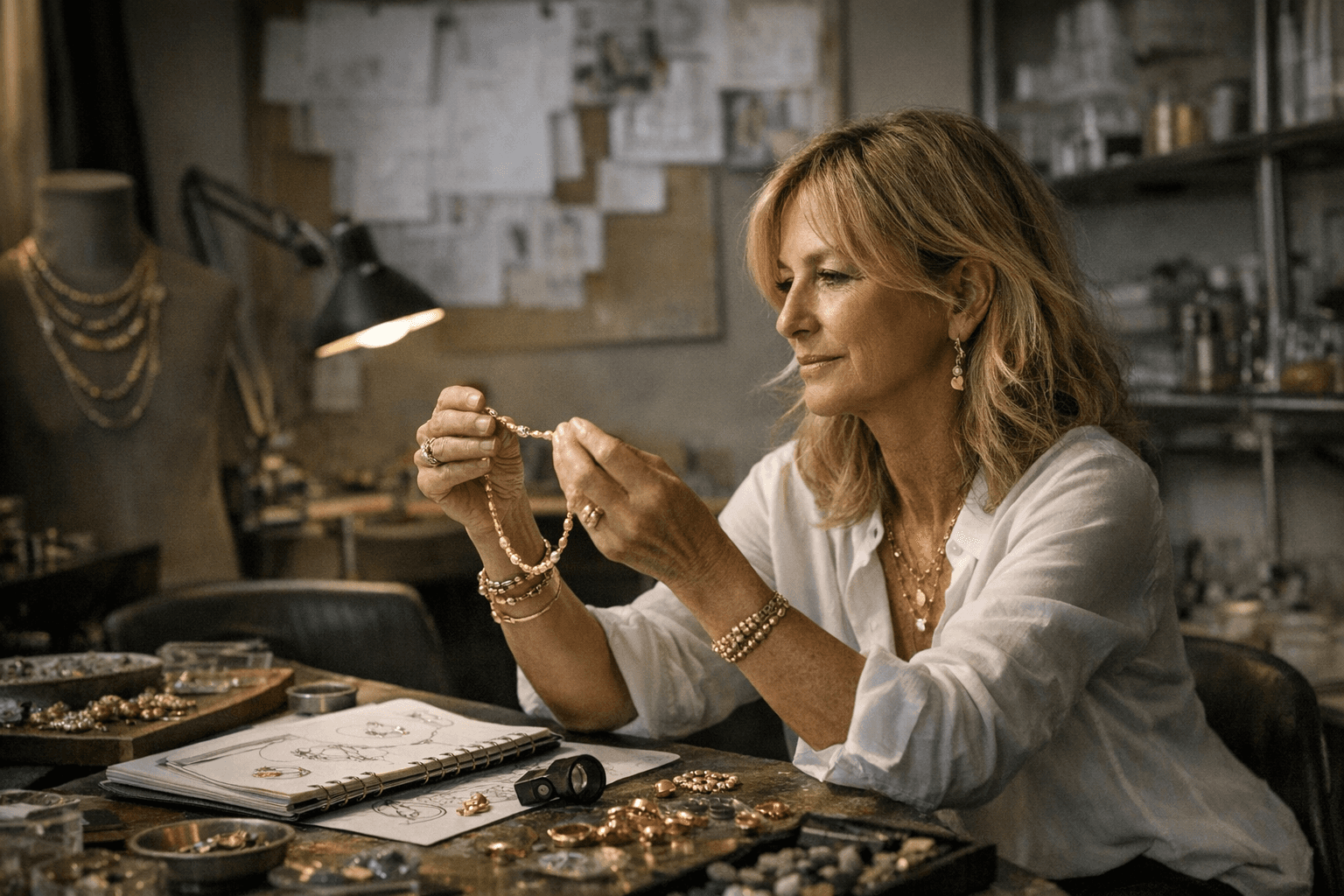
Bicego's consistent advice across interviews is the same: buy fewer pieces, but buy the ones that can speak in more than one register.
Texture as Signature
One of the quieter but most distinctive aspects of Bicego's design vocabulary is her commitment to surface. She has worked extensively with hand engraving, satin finishes, and the contrast between matte and high-polish gold. In linguistic terms, texture is tone of voice: two pieces can share the same structure but occupy entirely different registers based on surface treatment alone.
This matters practically because texture allows for specificity within a stack. A brushed-gold IVY cuff reads differently from a high-polish version of the same form. Combining a satin-finish bracelet with a bright-cut diamond pendant places a soft murmur beside a sharp note. Learning to read those differences, and deploy them deliberately, is what separates a jewelry wardrobe assembled by habit from one assembled with intention.
The Day-to-Night Swap
The mechanics of a day-to-night transition, done well, require one adjustment. Bicego's modular approach means the swap is a subtraction or an addition, not a full replacement.
- Remove the base layer, the quieter structural piece, and leave the punctuation and sentiment elements in place.
- Add a single evening hero: a statement TRASFORMISTA necklace, a colored-stone Boules piece, one thing that shifts the register.
- Keep the sentiment piece consistent across both moments. The ring that means something, the bracelet from a specific trip. These do not come off.
The underlying logic is that daily jewelry functions as a foundation, not a complete outfit. You dress it up or down by building around it.
Emotional Durability: Why Meaning Outlasts Status
The deeper argument Bicego makes in her March 2026 interview is not purely stylistic. It is about why people keep jewelry at all. The pieces with staying power, she argues, are those that form ongoing relationships with their wearers, through repeated use, through memories attached to specific moments, and through the ability to be reinterpreted as the wearer changes.
"My jewelry is more informal, and you can wear it in different ways and on different occasions according to your mood, according to how you feel," she has said. "The brand, Nanis, is not only jewelry; it's really the joy of having the piece of jewelry."
That is a fundamentally different value proposition from jewelry as status signal. A piece that signals wealth has to remain current to do its job, which means it dates, accumulates, and eventually gets replaced. A piece that reflects identity has no such expiration. A TRASFORMISTA bracelet worn and reconfigured across ten years carries a weight no newer and more expensive substitute can manufacture from scratch. That accumulated meaning is what Bicego calls emotional durability, and it is, she argues, what the modern luxury buyer actually wants: not a piece that announces a price point, but one that says something true about who they are.
The shift from status object to personal language is not merely sentimental. It is the design principle behind every lightweight hinge, every engraved surface, every modular clasp Nanis has engineered since 1990. The jewelry that becomes irreplaceable is the jewelry you actually wear.
This article was produced by Prism’s automated news system from verified source data, official records, and press releases, then run through automated quality and moderation checks before publishing. The system is built and supervised by the people who set the standards it runs under. Read our full AI policy.
Did this article answer your question?