Original Miami Beach Antique Show Offers Collectors Rare, Story-Driven Jewelry Finds
Sixty-two years in, OMBAS draws 600+ dealers from 30+ countries to Miami Beach, making it the richest marketplace in the country for provenance-driven estate and vintage jewelry.

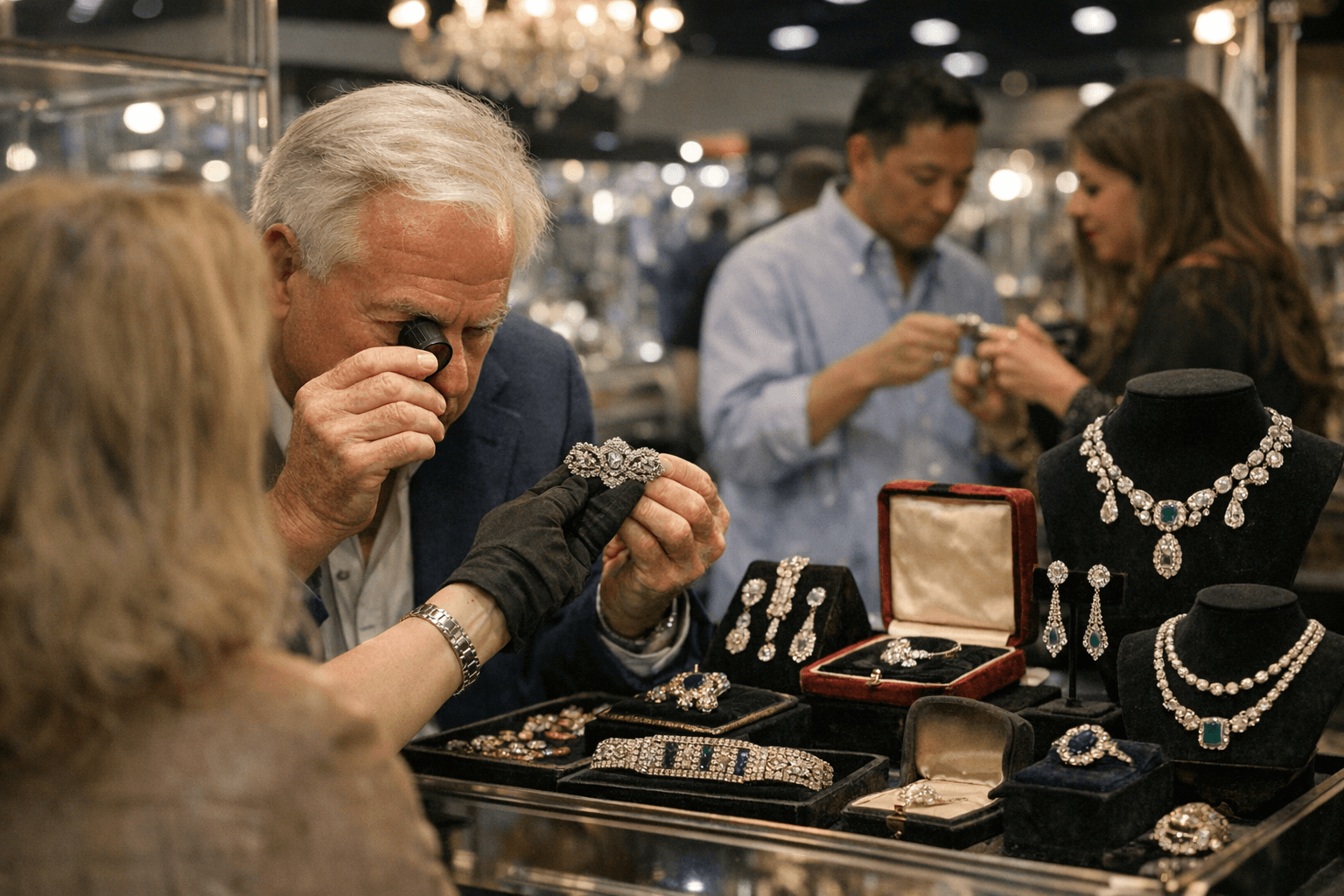
Few collecting experiences rival the density of the antique show floor, where a single afternoon can carry you from a Georgian mourning ring to a signed Art Deco diamond brooch without leaving the building. Back for its 62nd year, the Original Miami Beach Antique Show features five days of antiques, art, jewelry, timepieces, fashion and more sprawled across the Miami Beach Convention Center. What sets it apart from a standard marketplace isn't only scale. It's the show's foundational argument: that a piece's history is inseparable from its value, and that the best jewelry buying happens when you understand both.
A Marketplace Built on Provenance
More than 600 recognized dealers from over 30 countries converge on the Convention Center each year, creating an aisle-by-aisle timeline of decorative arts and jewelry that no single boutique or auction house can replicate. For over 60 years, the Original Miami Beach Antique Show has been a destination event for attendees on the hunt for unique, one-of-a-kind signed and unsigned pieces. With over 600 dealers from across the globe who are passionate and knowledgeable storytellers, OMBAS is the perfect chance to discover items that you can't find anywhere else in the world, while also learning about the history and provenance of a piece or a genre from experts in their fields.
The distinction between signed and unsigned pieces is worth understanding before you walk in. Signed work from major maisons commands its own market logic. Marquee names like Cartier, Chanel, Rolex, Hermès, Van Cleef & Arpels and Georg Jensen appear throughout the floor, alongside Patek Philippe and Rolex in the timepiece aisles. But dealers equally prize unsigned pieces: workshop jewelry that carries the full vocabulary of its period without the house name, where the strength of the setting, the quality of the stone, and the integrity of the construction make the argument on their own. These are often the pieces that reward the collector who has done their reading.
From Victorian to Art Deco: The Jewelry Timeline
From Victorian rings to Art Deco brooches to vintage bracelets, the show surfaces one-of-a-kind pieces that trace the full arc of Western jewelry history. Moving through the aisles is an exercise in reading design as cultural biography. The heavy gold and enamel work of the Victorian period gives way to the nature-inspired sinuousness of Art Nouveau, then sharpens into the platinum-and-diamond geometry of the Art Deco decade. Each transition reflects something about the society that produced it: the mourning culture of the 19th century, the Japonisme and symbolism that swept through Parisian ateliers at the century's turn, and the postwar modernity that demanded clean lines and maximum light.
Dealers present pieces from major houses such as Cartier, Rolex, Van Cleef & Arpels, and Patek Philippe, alongside unsigned or lesser-known works that often attract collectors looking for rarity rather than brand recognition. A bezel-set sapphire ring bearing no maison signature can be as historically significant as a stamped Cartier band, if the fabrication is period-correct and the provenance is traceable. OMBAS is one of the few environments in North America where both categories sit side by side, with dealers knowledgeable enough to walk you through the difference.
The Education Track
Beyond objects, the show builds an educational rhythm into each day. Talks and panels run throughout the schedule, covering topics like authentication, collecting strategy, and the evolution of design markets. This programming doesn't feel peripheral. It shapes the purchases made in the hours before and after each session.
The jewelry-specific programming this year was particularly strong. Ioannis Alexandris, author, historian, and dealer from Gemolithos, shared insight and wisdom he has garnered over decades of experience identifying authentic antique, vintage and estate jewelry, from what hallmarks to look for to understanding subtle shifts in design across eras and maisons. The session ended with audience Q&A and a signing of his book, *Antique Jewelry 1800-1939, Appreciating the Dreams*, giving attendees a working reference to carry forward.
Opening day's contribution came from Andrea Lucille Pooler, whose session "The Legacy in Your Jewelry Box" addressed a quieter but equally urgent collecting challenge. Pooler explained how to evaluate, document, and manage inherited or personal jewelry collections, with a focus on making informed decisions while preserving value and meaning. For anyone who has inherited pieces without documentation, the gap between "I think this is valuable" and "I can verify and prove what this is" is significant, and Pooler's session was designed to close it.
Saturday brought "The Art of Collecting" at 2:00 PM, where Randi Molofsky and Cameron Steiner discussed how to identify and integrate vintage pieces into modern style, a conversation aimed squarely at the growing cohort of younger collectors who approach antique jewelry not as preservation but as active wardrobing.
The watch world received its own dedicated panel, examining how social media and viral watch culture are changing the way collectors hunt and evaluate pieces, whether for a first vintage Cartier or a museum-grade Patek Philippe. Panelists included Tania Edwards of Collectability, Morgan Cardet from Matthew Bain, and vintage watch specialist Mike Nouveau, moderated by Tony Traina, founder of Unpolished Watches.
And on Sunday, March 29, "Tales from the Trade: An OMBAS Tell All" brought together Laurie Geller, Kurt Rothner, and Frank Kravitz to share candid stories from the trade, including trend forecasts, bidding wars, and unusual real-world experiences on the show floor. The kind of insider knowledge exchanged in that room is not available in any catalog or auction preview.
Appraisals with Bonhams
Curious about the value of a piece in your collection? Each valid ticket holder can receive one complimentary valuation from Bonhams expert appraisers, covering art, antiques, jewelry, watches, or accessories. The appraisal day runs Saturday, March 28, from 11 AM to 5 PM, with first-come, first-served access. For anyone holding inherited jewelry without recent documentation, this is rare: auction-house expertise delivered at no cost, in a show floor context that makes it easy to ask follow-up questions from the very dealers standing fifty feet away.
How to Navigate the Floor
OMBAS operates on a pace and logic that rewards preparation. The admission ticket is good for all five days, which matters more than it sounds. The floor is dense enough that a single visit rarely exhausts it. If a piece catches your attention but you want to survey the full aisles before deciding, vendors will hold an item on request, with a courtesy hold typically lasting one hour. Asking questions is not only acceptable but is the point. As one OMBAS insider puts it, dealers "will wax poetically about a piece" when you invite them to.
Advance tickets were available online for $30 per person; onsite entry is priced at $50. Comfortable footwear is a practical requirement: the show spans the full Miami Beach Convention Center, and covering it properly takes hours, not minutes.
Why the Antique Show Still Matters
The new jewelry market is exceptionally good at surface. It delivers trend, finish, and newness with efficiency. What it cannot replicate is accumulated time, the patina of a Georgian table-cut diamond that has been worn and reset and handed down, the silverpoint engraving on a Victorian locket that once enclosed a portrait no longer identified. OMBAS offers these objects in a context that insists on their meaning, with dealers who have spent careers learning to read them and an educational program designed to pass that literacy on.
This year's show features a packed schedule of educational sessions, Q&A panels, live podcasting and complimentary appraisals that make clear the fair's ambition extends well beyond commerce. It is positioning itself, and its collectors, as stewards of a physical record of how people made and wore beautiful things across centuries. For buyers who have grown weary of jewelry as seasonal product, that proposition is genuinely rare.
This article was produced by Prism’s automated news system from verified source data, official records, and press releases, then run through automated quality and moderation checks before publishing. The system is built and supervised by the people who set the standards it runs under. Read our full AI policy.
Did this article answer your question?