Rare Colored Gemstones Rise as Collectors Seek Scarcity, Provenance, and Value
Rare colored gemstones are outpacing diamonds at auction as market volatility and soaring gold prices push elite collectors toward stones where scarcity and provenance command record premiums.
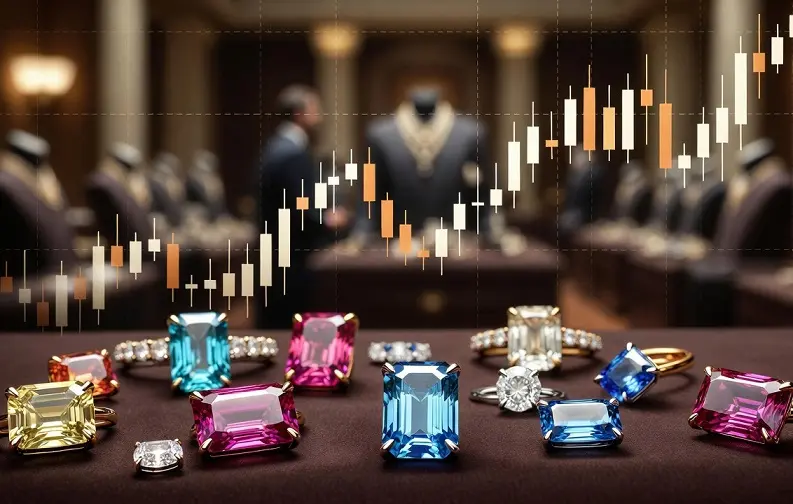
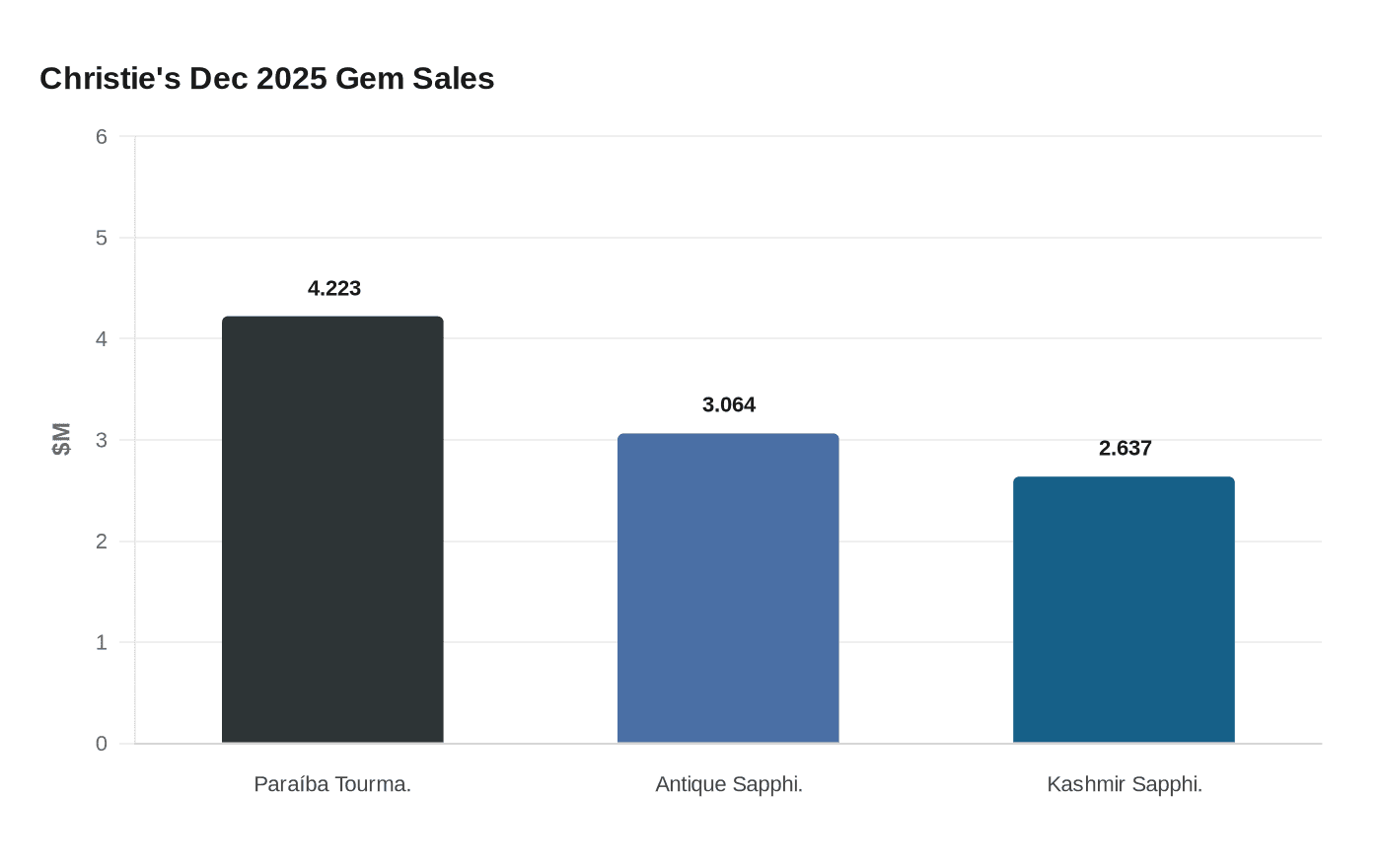
When Christie's gavel fell in December 2025 on a 13.54-carat Paraíba tourmaline and diamond necklace by Tiffany & Co., it struck at $4.223 million, setting a world record for the highest price and highest price-per-carat ever paid for a Paraíba tourmaline at auction. Tourmaline, historically overshadowed by the classic triumvirate of rubies, sapphires, and emeralds, had become the surprise star of one of the season's most closely watched Magnificent Jewels sales. The moment was not an anomaly. It was a signal.
Across the colored gemstone market in 2026, elite collectors and institutional buyers are redirecting capital toward naturally rare stones at a pace that reflects something deeper than trend. Market volatility and geopolitical uncertainty have pushed a significant cohort of wealthy buyers toward tangible, portable assets with an intrinsic quality floor. Resale markets and gold at historic highs have reinforced jewelry's reputation as a long-term store of value, and within that conversation, colored stones with verified origin and finite supply are commanding the most serious attention.
The Architecture of Rarity
The appeal of rare colored gemstones is structural, not merely aesthetic. Unlike gold or platinum, which can be refined and re-refined in perpetual supply, a Paraíba tourmaline owes its existence to a precise copper-bearing geological environment found in only a handful of locations: the original Paraíba state of Brazil, Nigeria, and Mozambique. Its signature neon blue glow, produced by copper and manganese rather than the iron compounds behind most blue stones, cannot be replicated synthetically with any credibility among serious collectors. That structural scarcity translates directly into price: high-quality Paraíba tourmalines in the five-carat-and-above category now reach $87,000 per carat at the finest end, surpassing comparable white diamonds, which top out around $68,000 per carat in the same weight range. Paraíba is one of the few colored gems with broad global buyer demand, a quality that enhances secondary market liquidity and compounds its appeal for collectors who view acquisitions as investments as much as objects of beauty.
Tanzanian spinel tells an equally instructive story about what scarcity, combined with growing recognition, can do to pricing. Mahenge spinels from Tanzania were largely unknown to mainstream buyers a decade ago; they have since seen prices surge from approximately $1,000 per carat in 2019 to as much as $20,000 to $30,000 per carat by 2023. Pink and red remain the most coveted colors, accounting for 58.3% and 7.6% respectively of all Tanzanian spinel production, figures that illuminate just how finite the supply of the most desirable material truly is. The stone's rapid rise is a case study in what happens when connoisseur-level recognition catches up with geological reality.
Provenance as the Price Multiplier
If rarity is the foundation of colored stone value, provenance is the multiplier. Origin matters enormously in this market, and no auction sale demonstrates that more clearly than Christie's New York in December 2025. At the same Magnificent Jewels event where the Paraíba tourmaline set its record, a Cartier art deco ring featuring a 17.66-carat Kashmir-origin, no-heat sugarloaf cabochon sapphire from the estate of Mr. and Mrs. John D. Rockefeller 3rd sold for $2.637 million. A separate pair of antique sapphire and diamond earrings achieved $3.064 million, more than double their $1.5 million estimate.
The word "Kashmir" carries a premium that has become almost mythological in the trade. The deposit in the Indian Himalayas that produced its finest material during a relatively brief window in the late nineteenth and early twentieth centuries is essentially exhausted, creating a fixed and diminishing supply set against rising global demand. The same logic applies to Burmese rubies from Mogok, Colombian emeralds with specific mine attributions, and Brazilian Paraíba tourmalines from the original Serra da Cangalha discovery. In each case, geography is not decorative context; it is a fundamental component of value.
The industry is formalizing that premium with increasing rigor. In December 2025, the Gemological Institute of America announced the expansion of its origin-determination services to include opal, peridot, and demantoid garnet, effective January 1, 2026. The move reflects a broader institutionalization of origin certification: as the premium attached to specific geographic sources grows, so does the market's appetite for independent verification. Sourcing credentials from Madagascar for sapphires, Colombia for emeralds, and recognized Brazilian localities for tourmaline now function as essential transaction documents, not supplementary paperwork.
The Market Forces Behind the Shift
The macro environment is playing a direct role in accelerating collector interest. Wealthy consumers are increasingly channeling capital into jewelry amid market volatility, with tangible assets drawing capital that might previously have flowed into equities or traditional commodity hedges. High gold prices have simultaneously raised the floor on fine jewelry resale values and sharpened the appeal of stones that appreciate independently of metal pricing.
The scale of the movement is captured in the projections: the global gemstone market is expected to expand from $38.4 billion in 2026 to $72.8 billion by 2036, a 6.6% compound annual growth rate. But that headline figure conceals a more significant internal divergence. Natural, certified, high-provenance stones are pulling sharply away from synthetic and mass-market alternatives, which face growing commoditization pressure. The natural gemstone segment is expected to grow at 4.8% annually through 2035, sustained by exactly the kind of scarcity and documentary verification that sophisticated collectors increasingly demand. It is not a market moving uniformly upward; it is a market concentrating value at the verifiable top.
Color as Symbolism and Investment Layer
What distinguishes the current moment from previous cycles of colored stone enthusiasm is how thoroughly the investment logic has fused with personal meaning. Colored gemstones are appearing with increasing frequency not just in collector cabinets but in engagement rings and bespoke high jewelry commissions, where buyers are choosing rubies, sapphires, and emeralds alongside Paraíba tourmalines, spinels, and alexandrites as declarations of identity, not merely fashion gestures.
This dual framing, color as personal symbolism and as investment-grade rarity, is reshaping how high jewelry houses and independent ateliers approach sourcing and storytelling. A piece built around a no-heat Burmese ruby with a documented chain of custody carries a different weight now than it did five years ago. It is simultaneously a wearable object, a statement of taste, and a transferable asset with a paper trail. The collector who commissions it understands that a GIA origin report and a clean treatment status are, for their stone, what a clear title is for real estate.
That convergence between the emotional and the transactional is perhaps the most consequential shift the colored stone market has undergone. For decades, the trade treated beauty and investment potential as parallel but separate conversations. The collector buying a Kashmir sapphire did so for one reason; the investor did so for another. In 2026, those buyers are increasingly the same person, bringing gemological literacy, provenance expectations, and long-term value thinking to what might once have been a purely sentimental purchase.
As long-established deposits continue to deplete and institutional appetite for hard assets holds firm, the colored gemstones with the strongest provenance narratives will continue to attract premiums that reward both their current owners and the collectors who acquire them next. The Christie's record was a data point. The forces behind it are structural.
This article was produced by Prism’s automated news system from verified source data, official records, and press releases, then run through automated quality and moderation checks before publishing. The system is built and supervised by the people who set the standards it runs under. Read our full AI policy.
Did this article answer your question?