TJS Scholarship Recipients on Their Goals as Jewelry Professionals
Six TJS scholarship recipients, including a Skidmore student who turns thrift-store spoons into rings, reveal how they plan to build careers in fine jewelry craft.
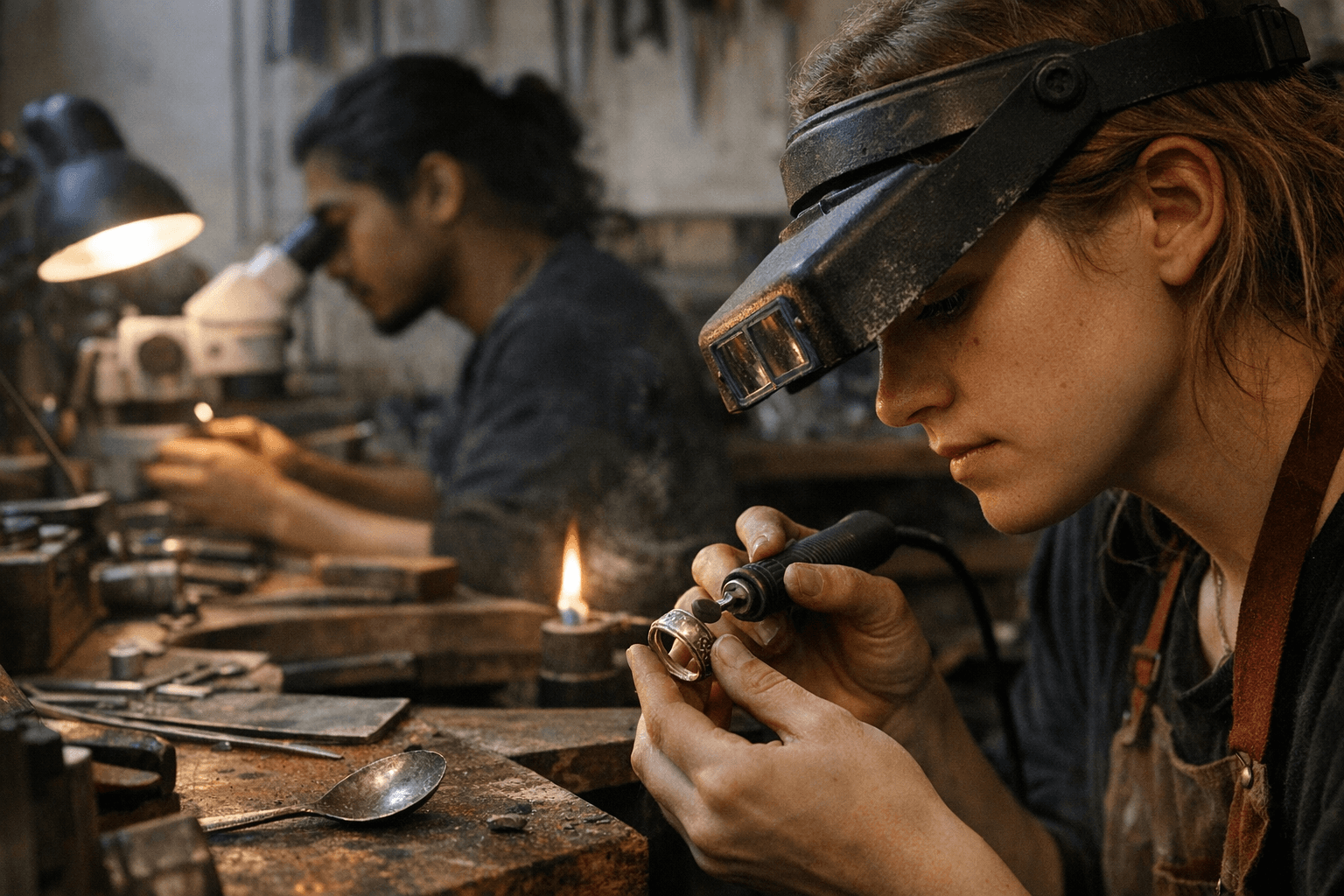
When William Lew first started cutting antique spoons into rings sourced from thrift stores and antique shops, he wasn't thinking about a career. He was thinking about process. "What started as making rings out of old spoons turned into something I want to build my life around," says Lew, a student in the jewelry and metals program at Skidmore College in Saratoga Springs, N.Y. That instinct earned him a place among the six recipients of The Jewelry Symposium's 2026 scholarship class, a cohort that spans bench students, an apprentice, and a newly promoted shop lead, each arriving at the craft from a distinctly different direction.
The 2026 class includes four students, one apprentice, and one emerging jeweler. Four sponsors, GIA, Mano Acero Jewelry, Techform Casting, and the Dougherty Charitable Fund, back the awards in full: each recipient receives symposium registration, three nights at the Detroit Marriott Troy during the May 16–19 event, catered meals, a book, a thumb drive of all presentations, and a certificate of attendance.
Alongside Lew, who works under the brand name ThingsWillFinds, is Amelia Zavagnin, studying at GIA in Alberta, Canada. A first-generation jeweler, Zavagnin draws directly on her landscape. "How can one not be inspired by the mountains and prairies of Alberta?" she said. "For me, fine jewelry is the perfect medium." Her stated goal is a recognizable line of designs rooted in that enduring, centuries-shaped natural beauty.
Two of the six recipients, Kylie Weinzierl and Ron White, are students at North Bennet Street School in Boston. Weinzierl's aesthetic is already defined: chunky statement rings and wedding bands in yellow gold. Her ambitions extend well beyond the bench. "My goal in the jewelry industry is to ultimately own my own studio, specifically one that is a beacon of the community, and offer bespoke handmade jewelry, lessons, events, and more," she said.
Camille Richard is apprenticed to master jeweler Ronda Coryell and approaches TJS as an opportunity to widen her technical range. "The variety of topics scheduled will help expand my horizons and expose me to new facets of the industry," she said. Her presence in the cohort reflects TJS's deliberate effort to reach jewelers before they complete formal training, not after.
Aaron Taylor, shop lead and jeweler at Skeie's Jewelers in Eugene, Ore., is the class's most seasoned figure. Recently promoted from an apprenticeship, Taylor frames the symposium primarily as a peer exchange. "It will be a truly invaluable experience to spend time with such pioneers in the industry and learn from fellow jewelers and goldsmiths that have the same passion for pushing the limits of the craft," he said.
Lew's goal, stated plainly, is to "become a highly skilled bench jeweler working at the highest level of craftsmanship" and to surround himself with people better than he is. That phrase captures something essential about what TJS is trying to do with this scholarship program: not just fund attendance, but sustain the conditions under which craft ambition compounds. The 2026 class doesn't represent a single vision for jewelry's future. It represents six of them, all grounded in the belief that mastery at the bench is still worth building a life around.
This article was produced by Prism’s automated news system from verified source data, official records, and press releases, then run through automated quality and moderation checks before publishing. The system is built and supervised by the people who set the standards it runs under. Read our full AI policy.
Did this article answer your question?