Van Cleef's Alhambra Dominates China, But Can the Clover Expand Its Legacy
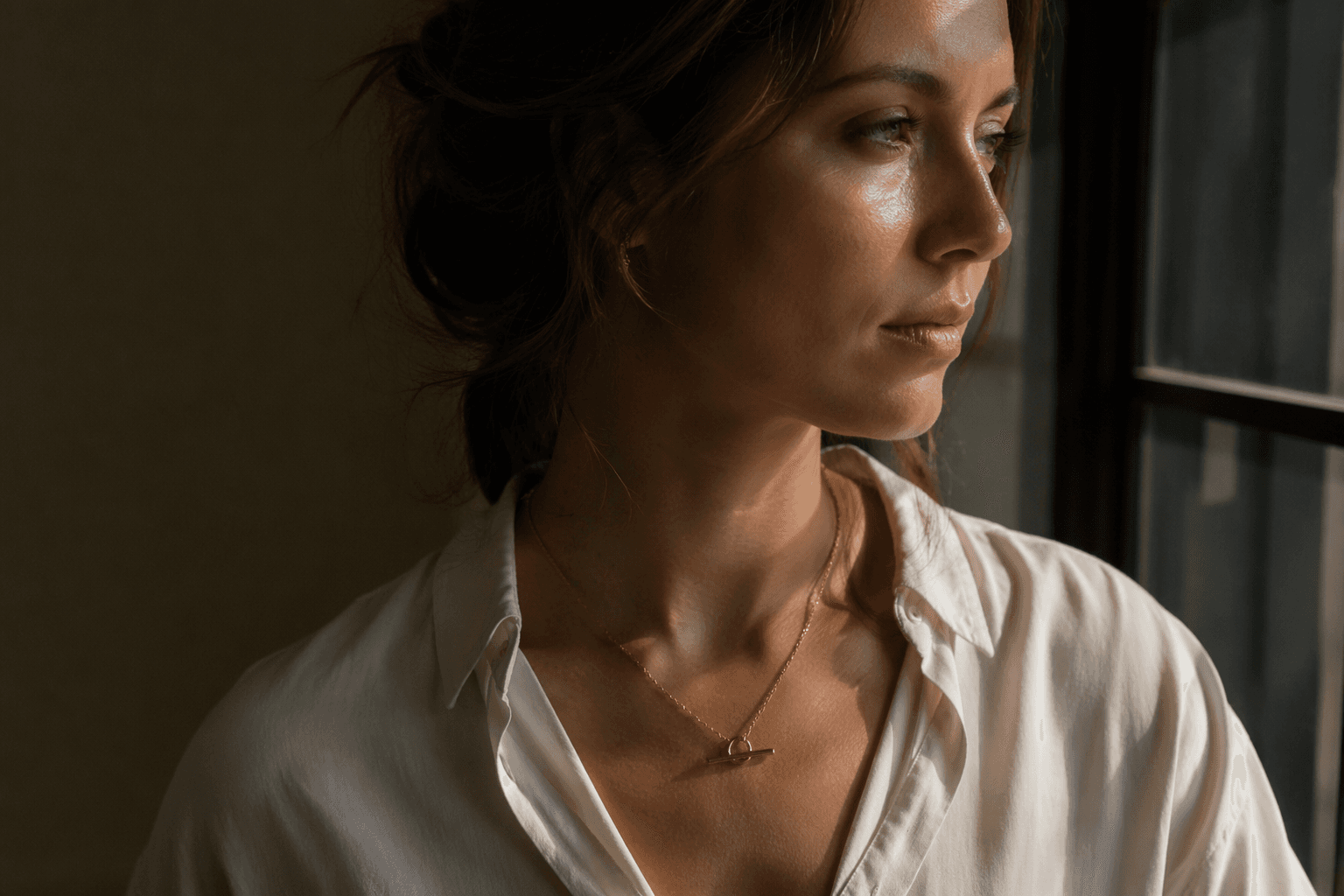
The Alhambra clover is China's most potent jewelry status symbol, but Van Cleef & Arpels now faces the rare luxury problem of a motif so recognized it risks becoming its own ceiling.
The four-leaf clover has always carried a promise: luck, by virtue of its rarity. Four-leaf clover motifs first appeared in Van Cleef & Arpels' archives as early as 1906, and Jacques Arpels, the nephew of the founding couple and an avid collector, would often pick them in his backyard to give to employees as good luck charms. When he created the Alhambra in 1968, Jacques married the four-leaf clover motif with the Moorish quatrefoil of the Alhambra Palace in Granada, Spain, building a piece rooted in both cultural symbolism and the belief that "to be lucky, you must believe in luck." What no one at Place Vendôme could have predicted is how completely that philosophy would resonate in China five decades later, to the point where the motif has become something far larger than a jewelry collection: a social contract.
A Jing Daily feature from March 11, 2026, examined why Van Cleef & Arpels' Alhambra has become a "near-ubiquitous symbolic purchase in China." The answer, as analysts including Jack Porteous of TONG Global and Lisa (Chenyan) Z. have articulated, runs deeper than aspirational taste. The Alhambra is now "social shorthand for luck, status and taste" among middle-class luxury consumers in China — a phrase that captures exactly what makes this piece so difficult to replicate and so difficult to transcend.
The Clover as a Second Logo
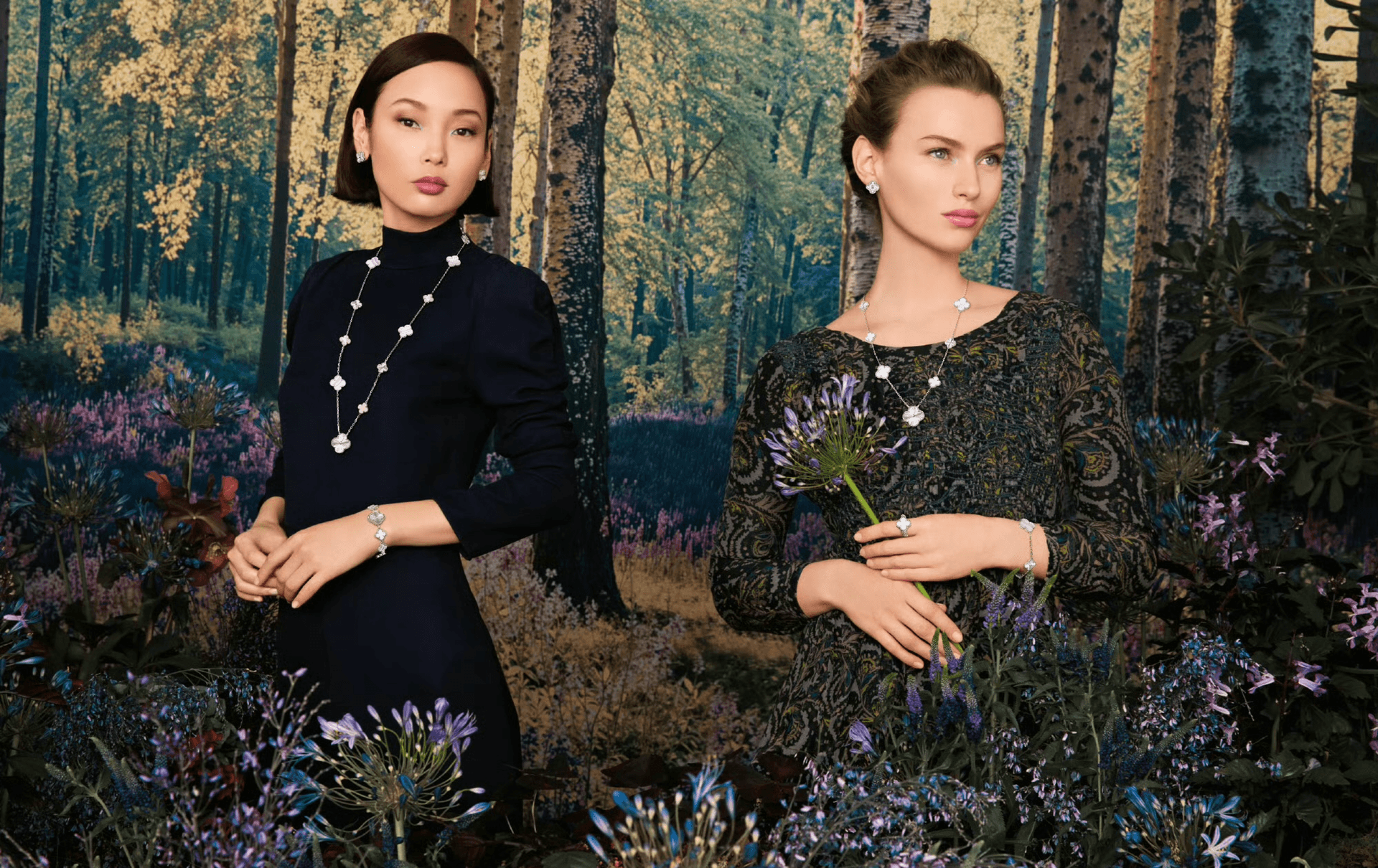
The Alhambra collection draws inspiration from the four-leaf clover, a universal symbol of luck, and the Moorish quatrefoil, rooted in architectural tradition; its name pays homage to the Alhambra Palace in Granada, Spain, known for its sweeping archways and intricate geometric designs. Despite its seemingly clean sinuous form, no fewer than fifteen successive steps of selection, production, and verification are required to create an Alhambra jewel that will withstand the test of time. That craft complexity, however, is invisible to the eye. What registers immediately is the shape: the rounded, beaded quatrefoil, repeated across necklaces, bracelets, earrings, and rings in materials ranging from malachite and mother-of-pearl to onyx, carnelian, and pavé diamonds.
In China, that instant readability has become the collection's greatest commercial asset. The four-leaf clover motif functions as a "second logo" for Van Cleef, one that operates independently of the brand's name, reinforced by a dense ecosystem of Xiaohongshu narratives linking different stones to specific meanings: luck, wealth, and protection. Malachite, with its deep veined green, has developed its own coded language in Chinese consumer culture. So has mother-of-pearl. On Xiaohongshu, posts don't simply show Alhambra pieces worn; they assign them meaning, building a layered symbolic architecture that Van Cleef & Arpels itself never scripted but has clearly benefited from.
For Van Cleef & Arpels, despite a tough local market reality, shoppers are instilling new meaning in the brand's Alhambra collection as "good feng shui items," which in turn support sales and drive brand awareness. The Jing Daily feature documented viral social posts that have amplified this phenomenon, each one reinforcing the clover's status as both talisman and trophy.
The Price Dynamic Driving Demand
Understanding the Alhambra's grip on Chinese consumers requires understanding what happens when desire meets pricing pressure. "Duty-free price gaps and recurring price hikes have intensified demand, turning Alhambra into both an aspirational jewelry icon and a travel-shopping strategy." The observation is precise: the Alhambra is not just worn, it is strategically acquired.
Van Cleef & Arpels raised Alhambra prices in April 2025 by an average of 4.8 percent in the United States and 5.1 percent in Europe, with malachite pieces seeing the steepest increases, in some cases close to 14 percent in a single adjustment. This followed similar increases in 2024 and 2023; over the past three years, some Alhambra pieces have risen in retail price by 20 percent or more. Each hike, counterintuitively, has reinforced desirability. The price increases implemented in 2025 aim to strengthen the brand's perceived value and stimulate the appeal of vintage pieces, while the investment dimension is becoming increasingly important — Alhambra jewelry is now considered a true safe haven, capable of preserving and even increasing its value over the long term.
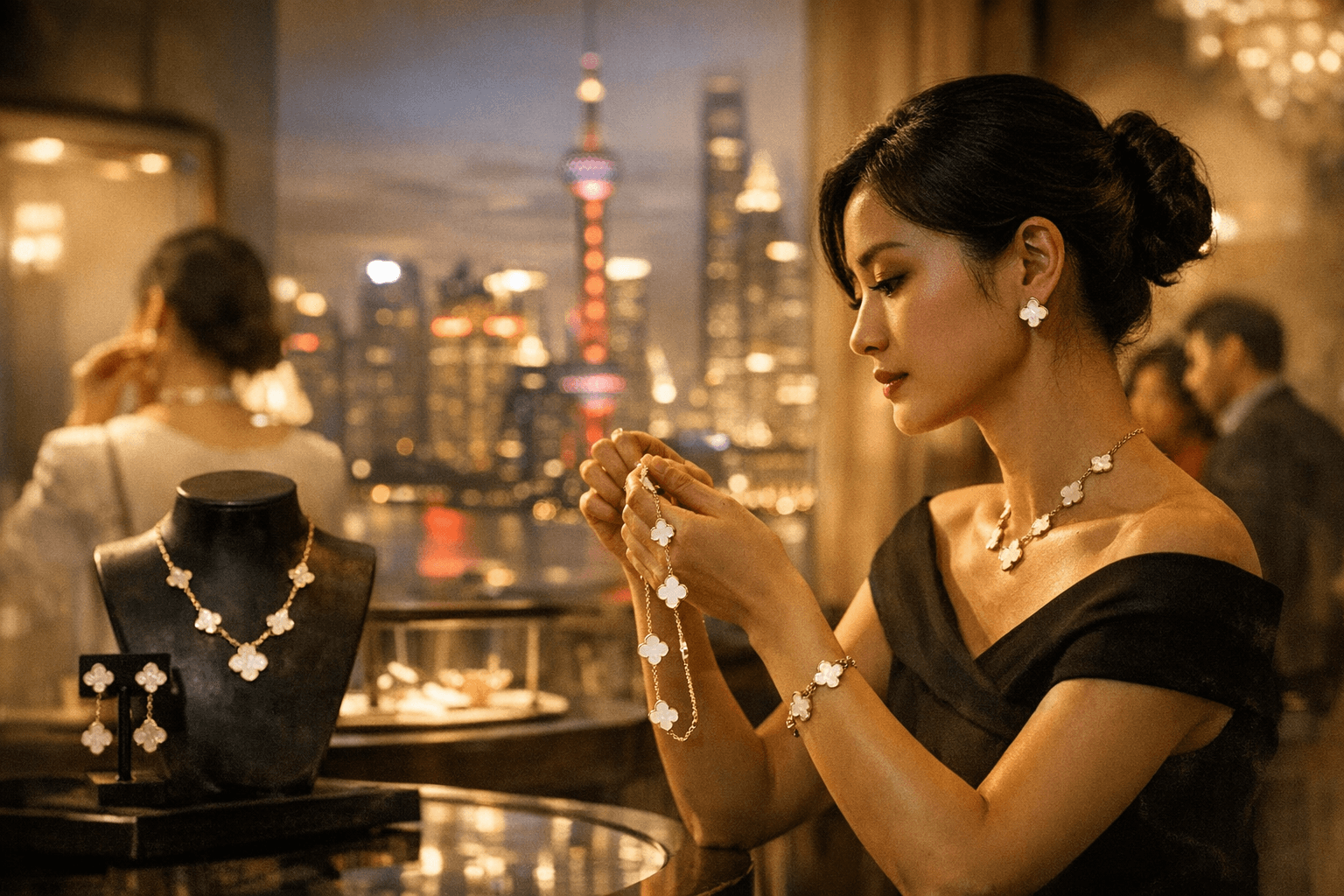
The most expensive place to buy Van Cleef & Arpels is in China, which makes Hainan's duty-free channel enormously attractive. The Jing Daily feature explicitly cited a Hainan duty-free stock shortage as evidence of just how intense that channel pressure has become. Van Cleef & Arpels counts 29 stores, excluding two duty-free shops in Hainan, in mainland China. Those two duty-free doors carry outsized weight: for price-conscious middle-class luxury consumers, they represent the most financially rational entry point into the collection. When stock runs out, the shortage itself becomes content, another signal that the Alhambra is in demand.
Hainan saw duty-free sales soar 47 percent in the first month after starting island-wide independent customs operations under the Hainan Free Trade Port, with offshore duty-free shopping topping CNY 4.9 billion from December 18 to January 17. Electronics, gold jewelry, and cosmetics are the three best-selling categories, with many products having additional discounts on top of their duty-free prices. In this environment, an Alhambra bracelet priced at a meaningful discount to the mainland boutique price is not just a purchase; it is a financially literate decision.
The Structural Challenge of Moving Beyond the Clover
Here is where Van Cleef & Arpels' China success story becomes more complicated. "Efforts to elevate other collections such as Perlée face structural challenges, as Chinese consumers often favor instantly recognizable designs over craftsmanship-driven subtlety." The brand has invested seriously in Perlée's China presence. For the first time in China, Van Cleef & Arpels installed a pop-up event outside the luxury shopping mall, taking over a candy-colored home objects boutique on Yuyuan Road; the pop-up spotlighted the Perlée collection, a jewelry line that highlights gold beads, based on a graphic installation designed by French artist Arthur Hoffner. On Weibo, the topic "Van Cleef & Arpels Perlée collection" has amassed 23.21 million views. By any measure, that is meaningful engagement. Yet awareness has not translated into the same cultural embeddedness that the Alhambra commands.
The Perlée collection's generous, smooth, regular gold beads imbue pieces with a harmonious sense of volume, and when set with precious stones, the pieces reveal meticulous craftsmanship that optimizes the flow of light and enhances brilliance. The problem is not the jewelry; the problem is the semiotics. Perlée lacks the clover's luck-symbol anchoring. It does not carry the same encoded meaning on Xiaohongshu. It asks consumers to appreciate craft and proportion rather than recognize a culturally loaded icon. For a market cohort that has built purchasing rituals around symbolic weight, that is a significant ask.
Balancing Ubiquity with Exclusivity
"As Alhambra's ubiquity grows, Van Cleef must balance visibility and exclusivity, while exploring new narratives like Lucky Spring to diversify beyond the clover." This tension is the brand's defining strategic question in China. The same visibility that has made the Alhambra a near-universal status signal among middle-class consumers could, over time, dilute the exclusivity that justifies its price. When a piece can be spotted on every third wrist in a Shanghai shopping mall, the aspirational distance between the buyer and the piece begins to shrink.
Securing a 5-Motif Alhambra at a U.S. boutique currently requires a client history or a 3-month waitlist, a form of artificial scarcity that sustains desire in Western markets. In China, the dynamic works differently: demand is intensified precisely because the piece is visible everywhere, each sighting functioning as a social endorsement. But that model has a ceiling. A motif can only be aspirational for so long before it becomes familiar in the wrong direction.
Lucky Spring represents one answer: a new narrative layered over the existing Alhambra iconography, one that re-contextualizes the clover within a seasonal, culturally resonant frame. Whether it can carry the same symbolic weight as the original motif — or whether it functions as a seasonal refresh that temporarily renews desire without altering the underlying dynamic — remains to be seen. The deeper question is whether any new collection can build the kind of organic, platform-native symbolic ecosystem that Xiaohongshu has constructed around the Alhambra over years of consumer-generated storytelling.
Van Cleef & Arpels has said it will continue to open new boutiques and increase investments in China, one of its three largest markets globally, fueled by confidence in sales growth potential. That confidence is well-founded. In the words of Laura Lai, managing director of Van Cleef & Arpels China: "In an economic downturn, what matters more for a brand is the market share. When the cake shrinks, we want to get a bigger piece of the pie."
The Alhambra has given Van Cleef & Arpels an extraordinary position in China's luxury jewelry market — one built not on advertising spend alone but on the rarer alchemy of a motif that became genuinely meaningful to its buyers. The challenge now is that a piece powerful enough to function as social shorthand is also powerful enough to define the brand so completely that everything else struggles to breathe beside it. The clover that brought luck may now require some of its own.
This article was produced by Prism’s automated news system from verified source data, official records, and press releases, then run through automated quality and moderation checks before publishing. The system is built and supervised by the people who set the standards it runs under. Read our full AI policy.
Did this article answer your question?