Gucci high jewelry leans on floral and nautical motifs, vivid stones
Gucci's new high jewelry turns to floral, nautical, and Horsebit motifs, and Horsebit looks like the most wearable bridge to moissanite's vivid, high-contrast styling.
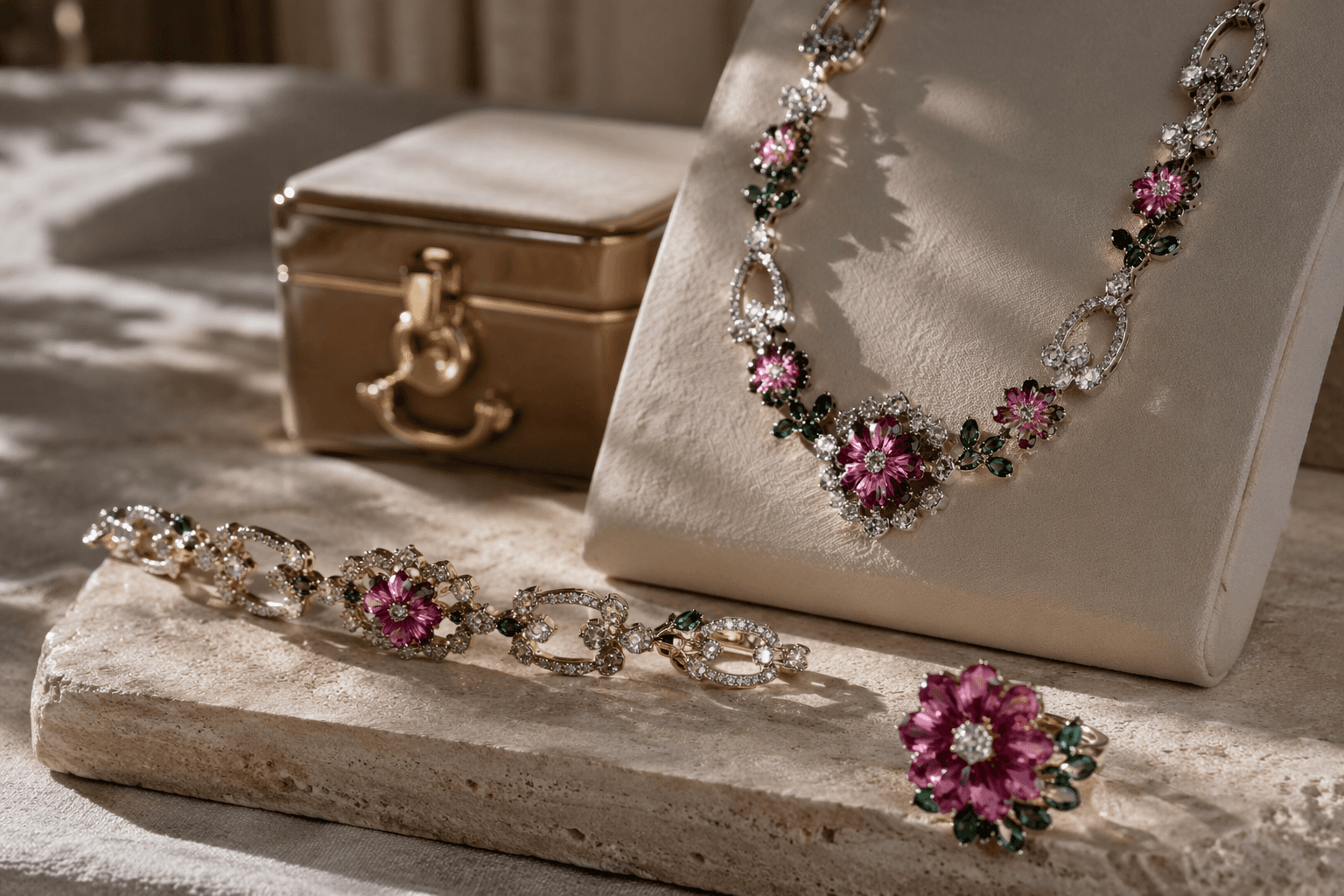
Gucci's latest high jewelry collection swaps quiet refinement for graphic recognition: floral scrolls, nautical links, and the Horsebit motif all arrive in saturated stones, from tsavorite and emerald to aquamarine, sapphire, paraiba tourmaline, and diamonds. The effect is less about blending in and more about being read from a distance, which is exactly why the look translates so well to moissanite, where scale, color, and contrast can do the visual work without diamond-level pricing.
Four families, one louder language
The collection is organized into four families, Gucci Flora, Gucci Nodo, Everlasting G, and Iconic Signatures. That structure matters because it lets the house move from archive reference to logo-like hardware without losing a common thread: each group uses a recognizable shape as the anchor, then pushes it into jewel-box drama.
Prices for all jewels are on request, which keeps the collection firmly in aspiration territory. It also leaves the focus on design rather than sticker shock, a useful reminder that the strongest high jewelry today often sells its image first and its materials second.
Flora begins with Grace Kelly
Gucci Flora still carries one of the cleanest origin stories in luxury jewelry language. In 1966, the house commissioned illustrator Vittorio Accornero to create the Flora silk scarf as a gift for Grace Kelly, then Princess of Monaco, and that archive reference continues to inform the collection now.
That lineage gives the floral pieces a different weight from generic blossom jewelry. They are not just petals and leaves for decoration; they are part of Gucci's visual memory, a coded reference that reads instantly to anyone who knows the house and still feels approachable to anyone who simply sees the color.
Horsebit and Marina Chain bring the clearest shift
Iconic Signatures includes two of Gucci's best-known motifs, Horsebit and the Marina chain, and these are the pieces that make the trend shift most obvious. The Horsebit returns in parures, including one set in white gold, tsavorite, and diamond, while the Marina Chain motif is inspired by the nautical world and reinterpreted with diamonds and vibrant green tsavorites.
The Marina Chain can read as the most dramatic of the two, with its link language stretching jewelry into more sculptural territory. Horsebit feels more wearable now because it is compact, instantly recognizable, and easier to place on a ring, necklace, or bracelet without overwhelming the hand or neckline. It delivers branding without the full costume effect, which is why it is the motif most likely to move from editorial pages into everyday styling.
Why the color story matters
The standout detail is not only the motifs, but the way Gucci uses color to sharpen them. Tsavorite's green, paired with diamonds, gives the collection a crisp contrast, while sapphire, aquamarine, emerald, and paraiba tourmaline push the pieces away from minimalism and toward statement dressing.
That matters in moissanite too. Buyers drawn to moissanite often want the same mix of brightness, presence, and value, and a strong color choice can make a piece feel more editorial than its price point suggests. A colorless or near-colorless moissanite center with green accents, blue side stones, or a vivid halo can borrow Gucci's formula without copying a single motif.
How moissanite wears the same idea
Moissanite's appeal keeps widening because it sits at the intersection of affordable luxury, ethical sourcing, and conflict-free positioning. Market research keeps returning to those same drivers, and the projections show how broad that appetite has become: one estimate puts the global moissanite jewelry market at $3.2 billion in 2025, another projects $3.95 billion by 2033, a separate forecast reaches $10.5 billion by 2035, and a U.S. estimate places the market at $2,452.71 million in 2025.
The numbers vary because the scopes vary, but the direction is consistent. Consumers are rewarding jewelry that looks intentional, photographs well, and feels easier to justify, whether that means a larger stone, a bolder silhouette, or a color accent that gives the piece personality. In that context, Gucci's shift is not just a runway note about a heritage house; it is a useful template for how statement jewelry is changing at the bench, in the showroom, and on the wrist.
This article was produced by Prism’s automated news system from verified source data, official records, and press releases, then run through automated quality and moderation checks before publishing. The system is built and supervised by the people who set the standards it runs under. Read our full AI policy.
Did this article answer your question?