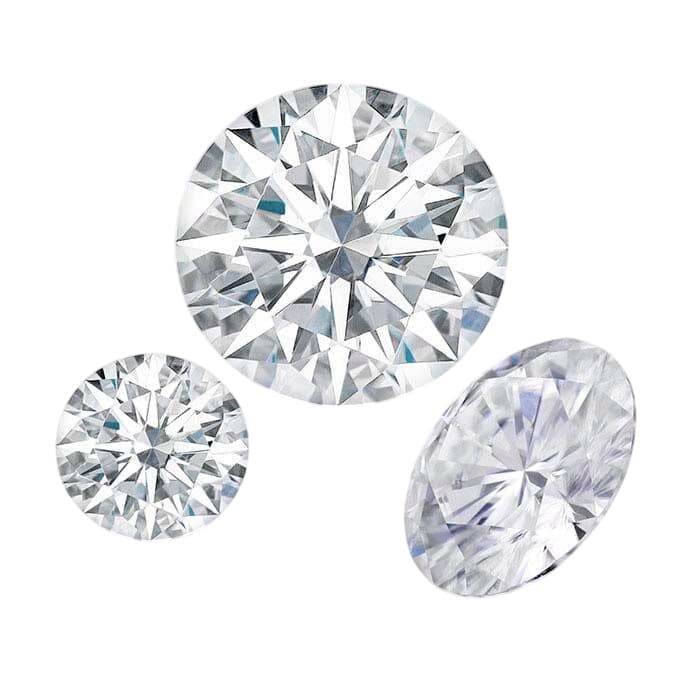
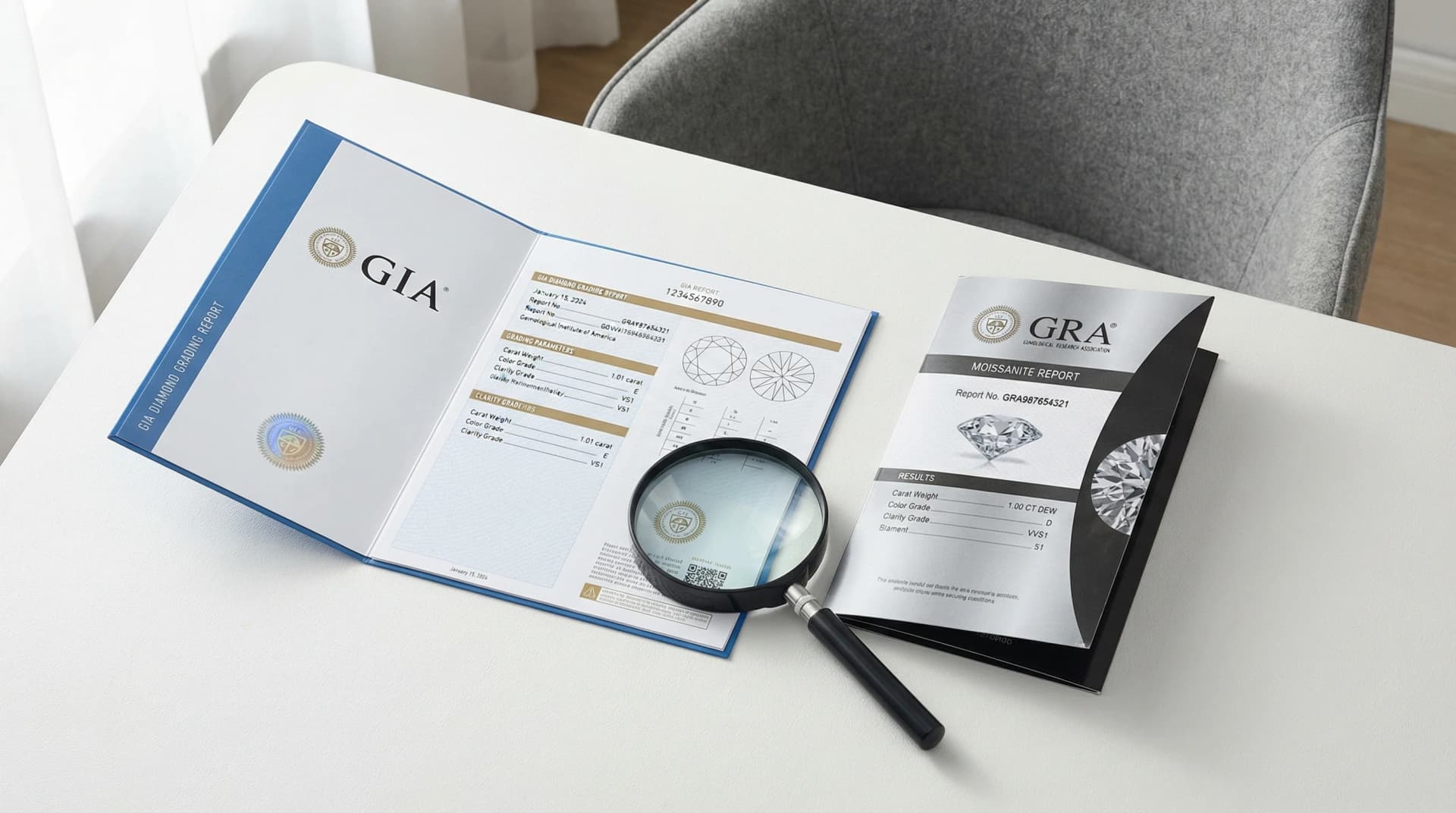
How jewelers identify moissanite with loupe tests and thermal probes
A loupe can reveal moissanite’s doubled facet junctions, but a thermal pen can still call it diamond. The safest check is screen, inspect, then confirm.
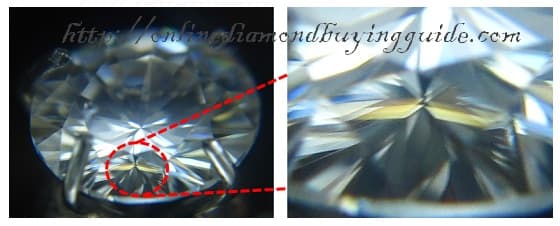
Moissanite can sit close enough to diamond that a quick handheld tester gives false comfort. Under a jeweler’s loupe, though, the stone tells a different story: its doubly refractive structure can split facet junctions into a doubled outline, and the interior can look slightly blurred instead of crisp. For anyone buying a ring or checking one already in the jewelry box, the safest approach is not to trust a single result, but to move from light behavior to magnification and then to confirmation.
What makes moissanite such a convincing stand-in
Natural moissanite entered the record in 1893, when Henri Moissan found it in rock samples from Meteor Crater near Canyon Diablo, Arizona, and the modern jewelry story followed much later, after synthetic moissanite emerged as a serious diamond substitute. That synthetic material is much closer to diamond in appearance and heft than earlier imitations, which is exactly why it became a practical test case for jewelers.
The stone’s physical numbers explain the look. Moissanite has a refractive index of 2.65 to 2.69, a dispersion value of 0.104, and a Mohs hardness of 9.25. In plain buying terms, that means strong brilliance, lively fire, and durability that makes it appropriate for daily wear, especially in rings that have to survive knocks, cleaners, and the friction of real life. It can also show slightly yellow or gray tones at certain angles, which becomes useful when a seller wants to describe the stone as perfectly diamond-like and nothing else.
What the loupe reveals first
The fastest visual tell is double refraction. Moissanite is doubly refractive, so when you look through magnification you can see a double image of the back facets, and the stone’s interior may appear soft or blurry. Under a loupe, the facet junctions can appear doubled because of the stone’s anisotropic optical character.
A practical loupe check usually comes down to a few visible signs:
- doubled facet junctions
- a doubled or slightly split image of back facets
- a soft, blurry interior rather than a sharp one
- slight yellow or gray undertones at certain angles
None of those alone should be treated as a final verdict, but together they create a reliable visual pattern. If the stone is clean, well cut, and large enough to inspect, the loupe can be more revealing than a one-button tester.
Why thermal probes can create false confidence
Handheld gemstone testers are useful, but they are not oracle devices. These tools commonly rely on thermal and sometimes electrical conductivity, which means they can narrow the field quickly without settling every identity question. In a GIA case study, a synthetic moissanite coated with diamond film produced a thermal conductivity reading that indicated diamond, while the electrical conductivity result was not convincing.
A thermal pen can tell you that a stone behaves like something diamond-like under heat transfer, but it cannot always tell you whether you are holding a natural diamond, a lab-grown diamond, a simulant, or a moissanite treated in a way that confuses the test. The result may feel definitive; it is not.
When the stone is valuable, altered, or being sold with a premium claim, confirmation needs a stronger chain. In GIA’s fraud case involving synthetic moissanite with a fraudulent inscription, there were no useful distinguishing inclusions, but the microscope showed obvious double refraction, and the final identification required infrared absorption and Raman spectra. That is the real hierarchy of verification: quick screening first, deeper instruments second.
GIA’s iD100 screening device uses advanced spectroscopic technology to distinguish natural diamonds from lab-grown diamonds and simulants in under two seconds.
Where brand markings help
Brand-specific engraving can be a valuable cross-check when the stone comes from a named maker. Charles & Colvard ties its moissanite standard to 1995, and its Signature engraving appears on the girdle of all stones 4 mm and larger. The company also laser engraves moissanite gemstones with information intended to help with authenticity confirmation.
That kind of marking gives you something concrete to compare against the seller’s documentation and the setting itself. If the stone is branded, the engraving can support the visual ID. If the engraving is absent, that does not automatically rule out moissanite, because unmarked stones exist and smaller stones may not carry the same inscription standard.
The most useful buyer habit is to match the physical stone to the paperwork rather than treating either one as enough on its own. A visual ID from a jeweler is strongest when it is backed by magnified evidence, and a brand engraving is strongest when it matches the seller’s stated origin and product line.
How to protect yourself before and after the sale
A smart purchase starts with the simplest question: what exactly is the stone, and how was it identified? If a jeweler can show doubled facets under the loupe, explain the stone’s refractive behavior, and point to a matching brand inscription on a 4 mm or larger Charles & Colvard stone, that is a solid identification path. If the answer depends only on a thermal probe, you have not finished the conversation.
The same rule applies after purchase. Keep any paperwork that ties the stone to the setting, especially if you bought a branded moissanite or a piece sold with a specific identity claim. For high-value stones, treated stones, or purchases where the difference between moissanite and diamond changes the price dramatically, ask for laboratory confirmation rather than relying on one quick test.
This article was produced by Prism’s automated news system from verified source data, official records, and press releases, then run through automated quality and moderation checks before publishing. The system is built and supervised by the people who set the standards it runs under. Read our full AI policy.
Did this article answer your question?