How moissanite gets blue and pink through surface coatings
Blue and pink moissanite often gets its color from an ultrathin surface film, not the crystal itself. That distinction changes how you judge value, durability, and disclosure.
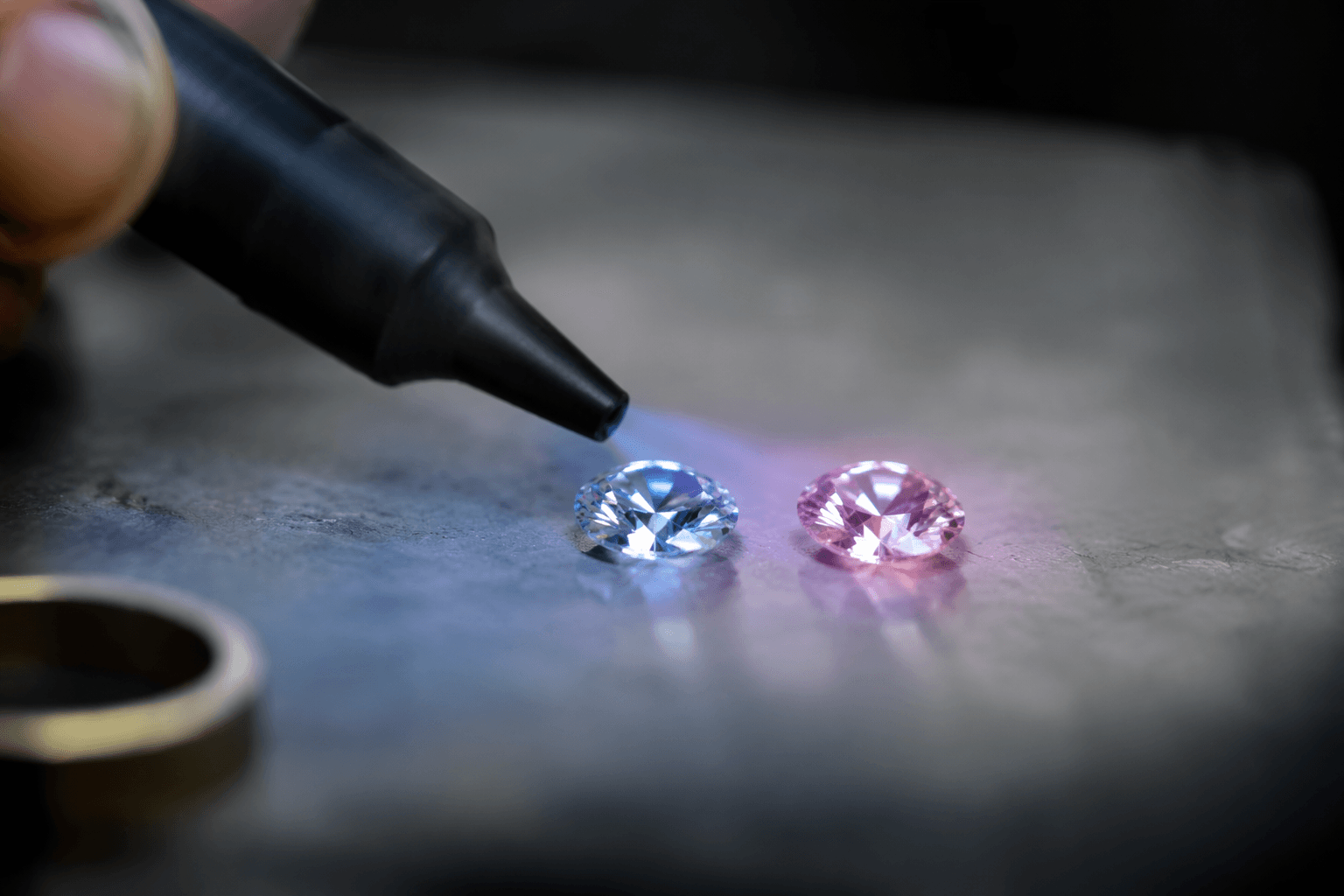
A blue or pink moissanite can look vivid at first glance, but the color may live only on the surface.
Color at the skin of the stone
By GIA’s measure, synthetic moissanite throws slightly more brilliance than diamond and more than twice the fire, which is part of why it became a popular diamond imitation in the late 1990s and remains a familiar engagement-ring stone. It also has a Mohs hardness of 9.25, so it is a tough everyday gem. What changes the story in blue and pink pieces is not the moissanite crystal itself, but a thin surface film applied to create a color effect.
That distinction is easy to miss when the stone sits in a bezel or flashes under store lighting. A buyer may see a rare-looking hue and assume the color is inherent, when in fact the visual effect can come from a nanoscale coating built to mimic rare blue and pink diamonds. In jewelry terms, that is a different proposition altogether: one is a body-color material, the other is a treated surface.
How gemologists catch the coating
GIA’s Spring 2024 study examined commercial synthetic moissanite coated to simulate rare blue and pink diamonds using Auger electron spectroscopy with argon ion beam sputtering, spherical aberration-corrected transmission electron microscopy with electron energy loss spectroscopy, and electron probe microanalysis.
The result was clear: the coatings produced distinct blue and pink hues and showed thin-film properties at the nanoscale. The color was not just a casual tint or an accident of crystal growth. It was engineered at the surface, where composition and thickness can change the visual result from one sample to the next.
Colored moissanite can be described in ways that blur the line between inherent material color and surface treatment. A seller who understands the difference should be able to tell you whether the hue comes from the stone itself or from a coating, and that answer should shape how you evaluate the piece.
Why the coating changes wear and care
A coated stone can still be beautiful, but the care instructions should be more cautious than for uncoated moissanite. The reason is simple: the color sits at the outermost layer, where abrasives, harsh chemicals, prolonged wear, or repeated cleaning can affect appearance over time. A coating may be durable enough for jewelry use, but it is not the same thing as color built through the body of the gem.
That is why settings matter. A high-set ring with open galleries exposes more of the stone’s surface to contact, while a bezel can shield the edges and protect the finish from some everyday knocks. Earrings and pendants often live an easier life than rings, which means a coated blue or pink moissanite may hold up better in those categories than in a ring worn hard every day. Even so, the right question is not whether the stone is “strong enough,” but how the coating behaves when it is rubbed, cleaned, or worn against other surfaces.
Treat a coated moissanite as a treated gem. Gentle cleaning, soft brushes, and caution with ultrasonic or abrasive methods are the safer path when a color effect depends on a film rather than the crystal itself.
The market moved quickly
The French Gemmological Laboratory saw a 0.41 ct pink coated synthetic moissanite in 2018 and identified it as the first such example it had encountered. Its testing, which included infrared, UV-visible, Raman, and EDXRF methods, showed iron and titanium were responsible for the color of the calcium-rich film.
An Australian Gemmological Association trade update counted surface-coated synthetic moissanite in more than twenty colors, including iridescent mystic effects. Brighter blue, yellow, pink, and red versions appeared more recently through surface coatings, while earlier colored moissanite was mostly limited to brown, green, light blue, teal, and black. All patent rights for synthetic moissanite production expired in 2018, coinciding with a sharp rise in production, availability, and lower prices.
Once a stone is sold online or across a counter as “blue moissanite” or “pink moissanite,” the buyer should know whether that color is built into the material or applied afterward. The difference affects value, maintenance, and how faithfully the stone has been represented.
What to ask before paying a premium
The safest buying habit is to ask direct, specific questions before you fall in love with the color.
- Is the color inherent, or is it created by a surface coating?
- Has the stone been tested or disclosed as coated synthetic moissanite?
- Will the color be stable under normal wear and routine cleaning?
- Is the piece intended for daily ring wear, or is it better suited to earrings or a pendant?
- What paperwork comes with the stone, and does it identify the material clearly?
Moissanite has also appeared in misleading contexts. GIA and the American Gem Society have warned about counterfeit jewelry packages and fake reports circulating with moissanite described as diamond. The American Gem Society said GIA received more than 50 calls about counterfeit diamond grading reports, and some of those reports said the jewelry contained moissanite.
This article was produced by Prism’s automated news system from verified source data, official records, and press releases, then run through automated quality and moderation checks before publishing. The system is built and supervised by the people who set the standards it runs under. Read our full AI policy.
Did this article answer your question?