How to clean moissanite, remove oil film and restore sparkle
The oil-slick film is the thief of moissanite’s fire, but it is usually only residue. With the right soap, cloth, and timing, most stones come back to life.
An oil-slick film can make a moissanite ring look tired long before the stone itself has lost a trace of brilliance. The good news is that this dullness is usually a surface problem, not a permanent one: lotions, skin oils, and everyday grime cling to the stone and mute the optical performance that makes moissanite so striking in the first place.
Why the sparkle disappears
Moissanite earns its appeal from two traits that are easy to forget until they vanish under residue: a high refractive index and strong dispersion. That is what creates the lively flash and rainbow return collectors expect, and it is why even a thin film can make the stone look flat or hazy. At 9.25 on the Mohs scale, moissanite is hard enough for daily wear, so the problem is rarely fragility. It is contamination.
The telltale sign is not a scratch or a chip. It is a watery, rainbow-like sheen sitting on top of the stone, often most visible under direct light. This is an organic film build-up, the kind that can gather on pieces worn often and can resemble an oil slick. For regularly worn rings, earrings, and pendants, a monthly cleaning routine is a sensible baseline, with more frequent attention if the piece lives in lotion, sunscreen, or hand sanitizer.
What actually works at home
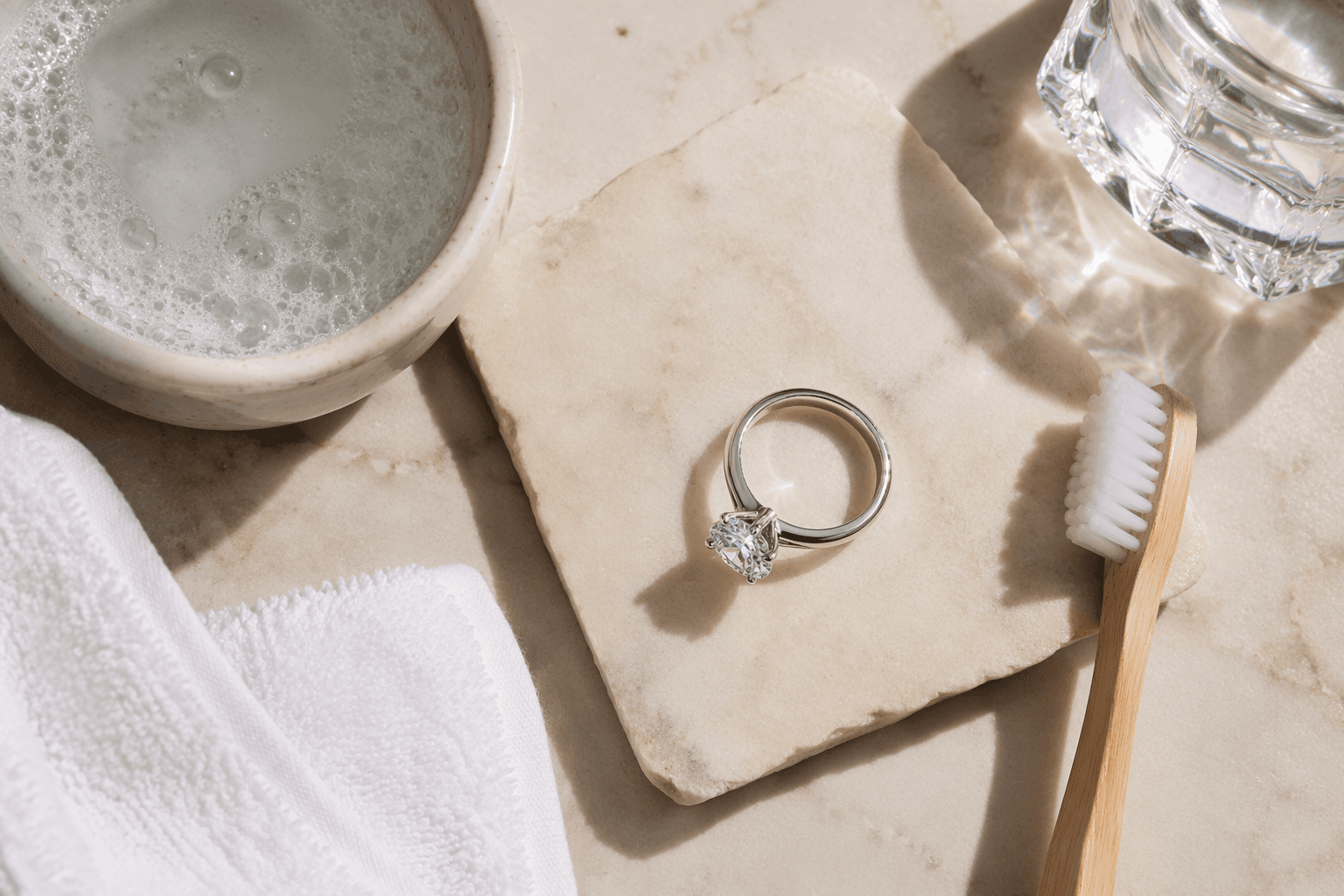
The safest starting point is also the simplest: warm water, mild dish soap, and a soft toothbrush. Warm water, mild dish soap, and a soft toothbrush are the easiest way to clean moissanite jewelry, and mild dish soap, baking soda, and vinegar can help lift away residue without abrasion. The aim is to break the film’s grip, not to scour it off.
A practical routine looks like this:
1. Fill a small bowl with warm water and a few drops of mild dish soap.
2. Let the piece soak briefly so oils loosen.
3. Use a soft toothbrush to reach under the stone and around the setting.
4. Rinse carefully in clean water.
5. Dry with a soft, lint-free cloth.
That last step matters. Use a soft, lint-free cloth, and avoid rinsing directly over a sink, which can put loose stones at risk. A strainer plug or a bowl rinse is far safer when you are cleaning rings with prongs, pavé shoulders, or any setting that has seen years of wear.
When a cloth is enough, and when it is not
If the film is light, a special cleaning cloth can remove it. That can be enough for a pendant or a pair of earrings that only need a quick polish after a day out. But if the stone still reads gray, blue-toned, or brown-toned after a careful wash, the residue has likely moved beyond ordinary surface grime.
This is where many owners make the mistake of scrubbing harder. Aggressive abrasion will not restore the fire any faster, and it can scratch surrounding metals, especially softer gold finishes or finely detailed galleries. It is better to repeat a gentle cleaning than to attack the piece with a brush, paste, or abrasive pad.
When to leave it with a jeweler
A professional cleaning is the right move when the setting matters as much as the stone. Monthly cleaning is a good baseline for regularly worn moissanite, but a jeweler should also inspect and clean the piece at least once a year, especially for engagement rings that are exposed to daily knocks and torque. That annual check is when a setter can catch a loose prong, worn basket, or slight shift that home cleaning cannot fix.
Ultrasonic cleaning is safe for moissanite under normal conditions, and jewelers often use ultrasonic machines and steamers to remove routine dirt and oils. That is useful for colorless and near-colorless stones, where heat is not a concern and the goal is simply to strip away buildup. When the film is stubborn enough to survive those methods, Charles & Colvard recommends a heated beaker solution held around 190 to 200 degrees for 45 minutes to an hour before rinsing and steaming.
Why color-treated stones need special caution
Color-treated moissanite is a different case. High heat can remove the color treatment, which changes the rules for repair and cleaning. Some repairs can be done with the stone left in place, but torch heat is risky for green, yellow, or other treated stones, and in certain cases the jeweler will need a laser welder instead.
The safest decision is straightforward: if the stone is color-treated, heavily fouled, or part of a setting that needs soldering, let a professional handle it. Colorless moissanite is far more forgiving under routine cleaning and standard jewelry work; treated moissanite is not.
Why moissanite behaves this way
Moissanite is not fragile, but it is optically dramatic, which makes residue easier to notice. In GIA’s 1997 description of synthetic moissanite, the stone was presented as a new diamond imitation with a Mohs hardness of 9.25 and a dispersion of 0.104. That combination helps explain why moissanite can look so alive under clean conditions and so muted under film.
Charles & Colvard introduced moissanite to the world nearly 30 years ago.
The deeper origin of the stone
Moissanite is the mineral name for natural silicon carbide, and natural occurrences were found in the Canyon Diablo meteorite. Gem-quality natural moissanite is extremely rare and has never been found in usable sizes for jewelry. That rarity is why nearly all consumer moissanite is lab-created.
Henri Moissan’s association with the mineral connects the gem to a scientific origin story, while the synthetic material made moissanite accessible at jewelry scale.
This article was produced by Prism’s automated news system from verified source data, official records, and press releases, then run through automated quality and moderation checks before publishing. The system is built and supervised by the people who set the standards it runs under. Read our full AI policy.
Did this article answer your question?