Moissanite shines as a durable, affordable diamond alternative
Moissanite’s meteorite backstory is real, but today’s jewelry stones are mostly lab-made. The payoff is big fire, strong wear and a lower price than diamond.
Natural silicon carbide found in Arizona’s Canyon Diablo meteorite bears the mineralogical name moissanite. Nearly all moissanite sold for jewelry is lab-created, and that is exactly why it has become a serious alternative for shoppers who want brightness, durability and a friendlier price tag without crossing into diamond territory.
From meteorite myth to jewelry case
The stone is named for Henri Moissan, the French chemist who won the 1906 Nobel Prize in Chemistry after isolating fluorine and developing the Moissan electric furnace. That mineralogical name gives the stone a genuine celestial origin story even though the gems set in rings today are not pulled from meteor fragments.
Jewelry-grade moissanite is manufactured, not mined, so the consumer is buying a lab-created gemstone with a meteorite-linked name rather than a naturally occurring crystal recovered from space rock.
Why moissanite sparkles so intensely
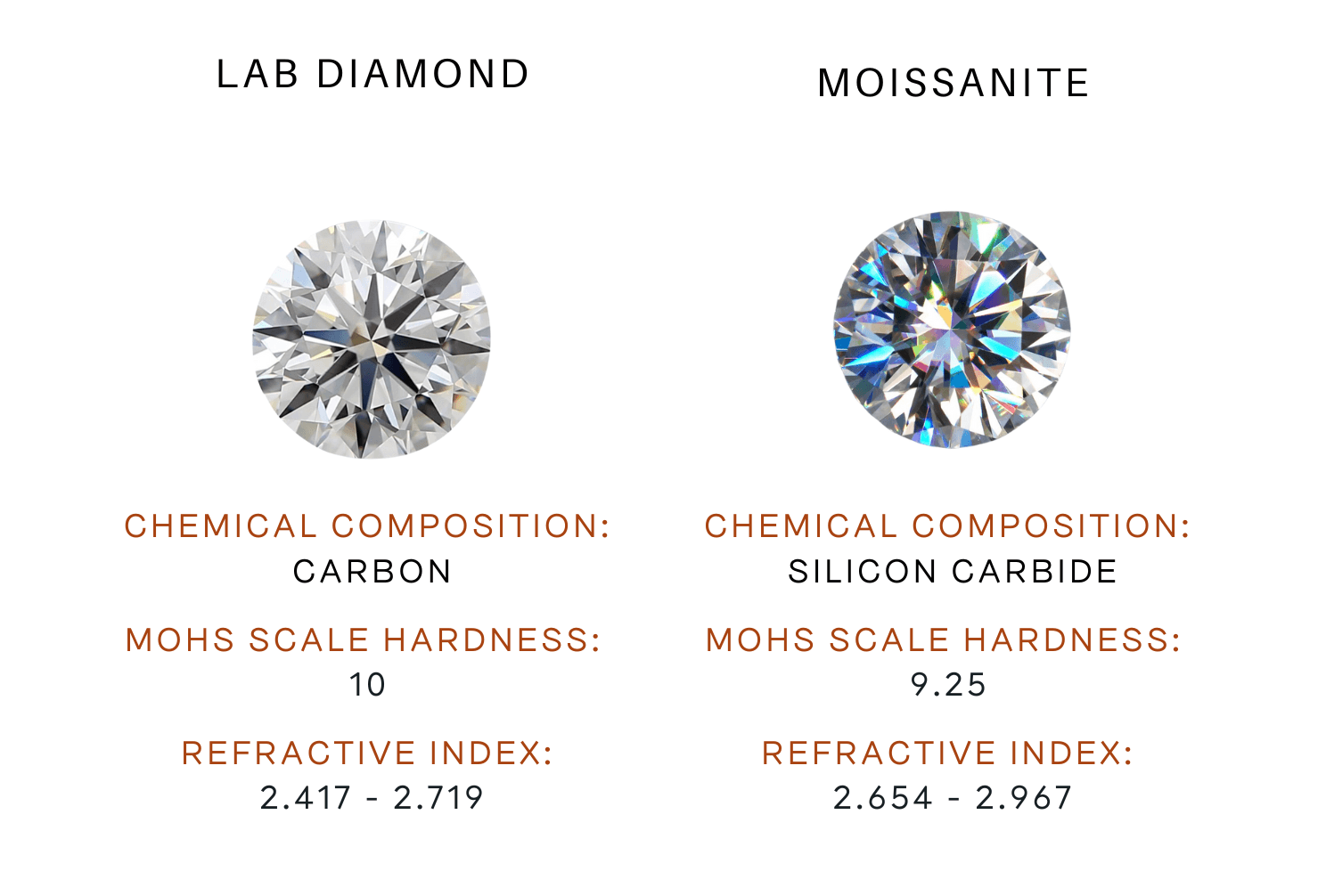
Moissanite’s visual punch comes from its optical properties. A 1997 Gemological Institute of America article described near-colorless synthetic moissanite produced by C3 Inc. with refractive indices of 2.648 and 2.691, dispersion of 0.104 and a specific gravity of 3.22. Those numbers explain why the stone throws so much light back and splits it into sharp flashes of color, the quality shoppers often describe as “fire.”
Synthetic moissanite became popular in the late 1990s as a diamond imitation and has since become a very popular engagement ring stone because of its brilliance, intense fire and durability. It is a simulant rather than a diamond because its chemical composition, crystal structure and optical properties are different.
For anyone comparing it with cubic zirconia, this is where moissanite sits in a different lane. Cubic zirconia is the familiar budget lookalike; moissanite is the stone people choose when they want more of the diamond-like visual drama without taking on diamond pricing.
What durability means in real wear
Hardness is where moissanite stops feeling like a fashion substitute and starts behaving like a daily-wear stone. GIA places it at 9.25 on the Mohs scale, which makes it one of the hardest gemstones available, second only to diamond among common gemstones. That hardness is the reason moissanite can handle the kind of wear that defeats softer simulants.
Simulated stones can develop scratches and visible abrasions, especially along facet junctions, which is the sort of wear that quickly changes a stone’s look. Moissanite’s hardness does not make it indestructible, but it does make it a practical choice for rings and other pieces that are meant to be worn often rather than saved for special occasions.
Price, ethics and the provenance question
GIA identifies affordability as a major reason people choose moissanite, especially when they want a budget-friendly alternative to diamond. Because nearly all jewelry moissanite is lab-created, the buyer is also getting a clearer provenance story than many mined stones can offer.
The market also includes moissanite that has been coated to imitate rare fancy-colored diamonds, including blue and pink stones. Some of those colored coatings are permanent while others can fade or chip, so color claims deserve the same skepticism you would give any treatment that changes appearance more than chemistry.
For shoppers who care about ethics, the cleanest approach is to ask exactly what the stone is and whether any coating or enhancement has been used. A plain near-colorless moissanite with no surface treatment is straightforward: a manufactured gemstone with a known composition and strong wear properties. A coated stone is a different conversation, because the color may be part of the finish rather than the material itself.
How to read the stone before you buy
The most useful moissanite questions are the unglamorous ones. Is it near-colorless or treated for color? Is it being sold as a diamond, or clearly disclosed as a simulant? Does the price reflect the fact that it is a lab-created gemstone with high brilliance but not diamond’s chemistry?
This article was produced by Prism’s automated news system from verified source data, official records, and press releases, then run through automated quality and moderation checks before publishing. The system is built and supervised by the people who set the standards it runs under. Read our full AI policy.
Did this article answer your question?