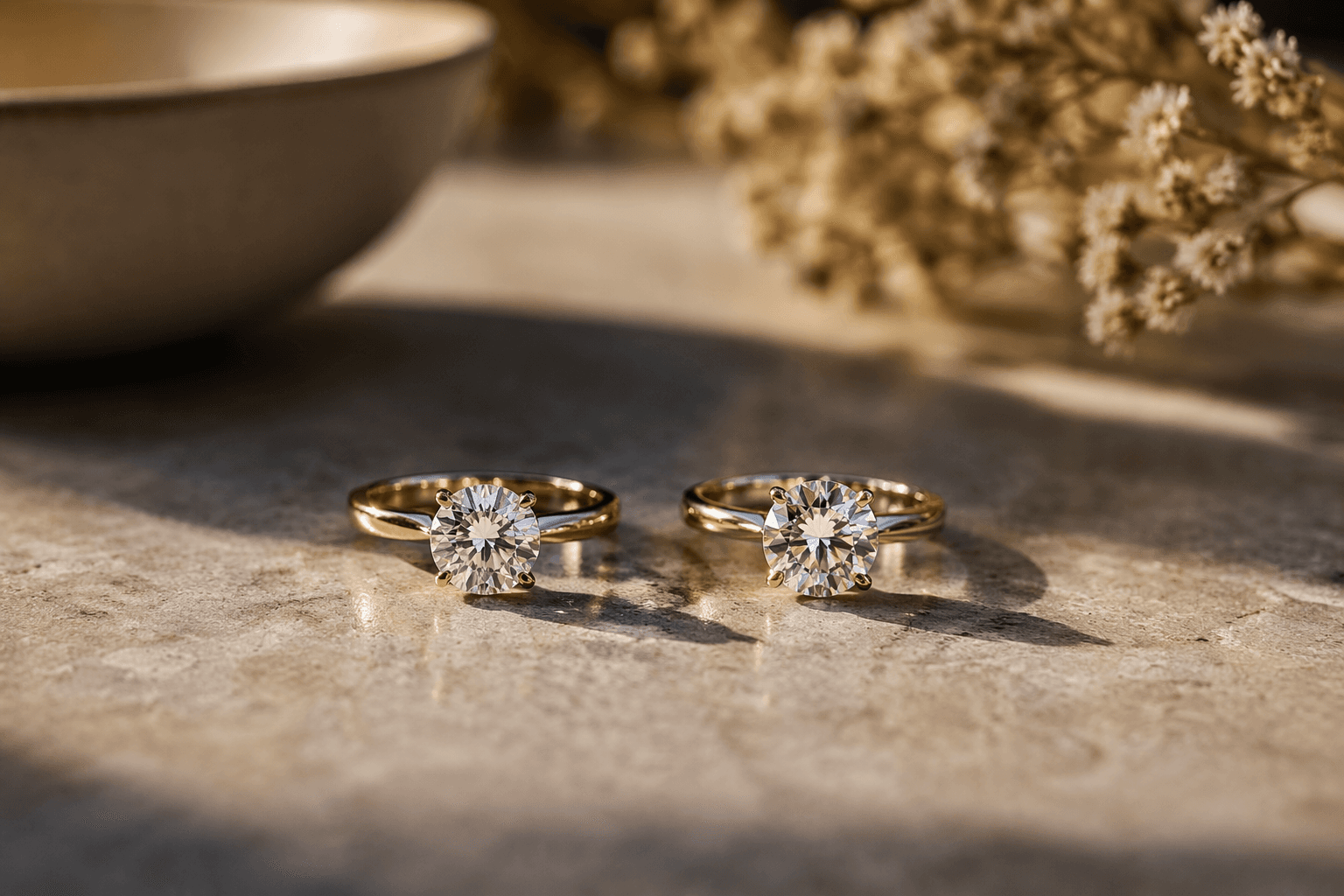
Moissanite vs diamond: which engagement ring stone is right?
Moissanite can slash the cost of an engagement ring while delivering more fire than diamond, but buyers who want a classic look or prestige may still land on diamond.
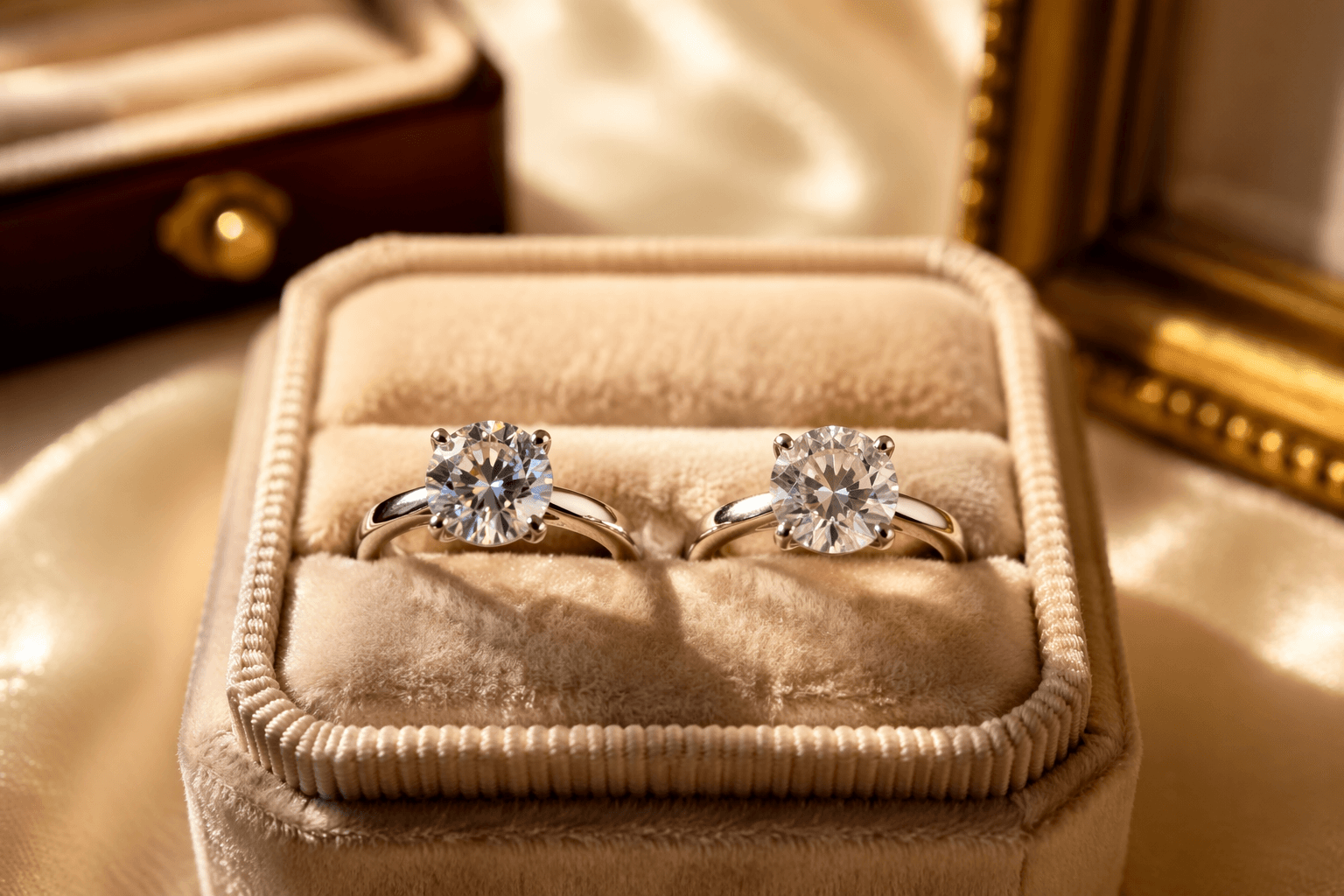
Commercial synthetic moissanite entered the gemstone market around 1997 as a diamond imitation before becoming a category of its own. Diamond and moissanite can both anchor a beautiful setting, but they behave differently in light, carry different price tags, and send different signals about tradition and long-term expectations.
What moissanite actually is
Moissanite is a lab-created gemstone made of silicon carbide. GIA gives synthetic moissanite a refractive index of 2.648 to 2.691, dispersion of 0.104, hardness of 9.25 on the Mohs scale, and specific gravity of about 3.22 to 3.23.
The stone has a long backstory before it became a budget-friendly engagement option. Natural moissanite was first identified in a crater in Arizona, then later identified by French chemist Henri Moissan and named in his honor.
Charles & Colvard grows raw silicon carbide crystal into a boule before cutting and polishing it into the final gem. Moissanite is not mined in the way diamond is, and its value proposition rests on engineered consistency rather than geological rarity.
Price is where the comparison turns sharply
For many couples, the first question is simple: what does the stone cost, and what else could that money buy? The Knot puts a one-carat natural diamond at about $2,000 to $16,000 depending on the 4 Cs, while lab-grown diamonds can cost 50% to 70% less than natural diamonds. Moissanite can be even less expensive than lab-grown diamonds, which is why it keeps showing up in serious shopping conversations.
That price difference lands in a market where the average engagement ring cost nationwide was $5,200 in The Knot’s 2024 Jewelry & Engagement Study. Against that backdrop, moissanite can free up money for a better setting, a more intricate band, or simply a ring that stays comfortably below the emotional ceiling many buyers set for themselves.
Couples are no longer limited to diamonds or a single idea of tradition; they are comparing moissanite, lab-grown diamonds, and colored gemstones at the same time.
Sparkle is where moissanite wins some buyers and loses others
Moissanite’s visual signature is more dramatic than diamond’s. GIA puts it at more than twice the fire of diamond and slightly more brilliance, which means the stone sends off stronger rainbow flashes as it moves. For buyers who want a ring that catches the eye in daylight, under restaurant lighting, and in every quick glance at a hand on a steering wheel, that effect can feel luxurious.
In larger sizes, especially one carat or above, moissanite’s intense fire may make it easier to identify as a non-diamond gem. That is not a flaw for everyone, but it is a real aesthetic choice: moissanite reads as brighter and more fiery, while diamond usually reads as steadier and more restrained.
That difference is often the deciding line for sparkle-first shoppers. If you want the biggest optical show for the money, moissanite has a strong case. If you want the more familiar diamond look, especially one that does not call attention to its own rainbow flashes, diamond is the clearer fit.
Durability matters, but so does daily expectation
Moissanite is hard enough for everyday wear, with a Mohs hardness of 9.25, placing it close to diamond on the scale of wear resistance. In practical terms, that makes it suitable for engagement rings, not just occasional jewelry. It will stand up well in classic prong settings, halo rings, and solitaire designs, especially when the stone is protected by a well-made mounting.
How you want the ring to age in your life, visually and symbolically, also matters. A diamond carries the expectation of being the default engagement stone, while moissanite offers a strong, durable alternative that looks different enough for some wearers to love and others to reject immediately.
Diamond still carries the prestige, familiarity, and resale assumptions that many people attach to engagement jewelry. Moissanite offers less of that inherited status, even when its performance on the hand is excellent.
Who should choose moissanite
Moissanite makes the most sense for budget-driven shoppers who want a larger-looking center stone without entering diamond pricing territory. It also fits buyers who care most about sparkle, because its fire is more intense than diamond’s and its brilliance remains strong in everyday light. If the goal is a striking ring that feels expressive rather than conventional, moissanite is often the smarter spend.
It is also the cleaner fit for people who see the ring as a design object first. A well-cut moissanite in a crisp solitaire, a three-stone setting, or a vintage-inspired halo can look luxurious without requiring the financial stretch of a natural diamond. The lower price can make room for stronger craftsmanship in the setting itself.
Who should choose diamond
Diamond is still the better fit for tradition-minded buyers who want the stone most people expect to see in an engagement ring. It is also the more natural choice if diamond prestige matters to you, whether for personal symbolism, family expectation, or the long-term assumptions people bring to the category. Even with the rise of lab-grown diamonds and moissanite, diamond remains the reference point against which all other center stones are measured.
For some couples, that reference point is the whole point. A natural diamond does not just offer sparkle; it carries a market history, a conventional hierarchy, and a widely understood meaning that moissanite cannot replicate. If that recognition matters more than maximizing size or minimizing cost, diamond is still the clearer answer.
This article was produced by Prism’s automated news system from verified source data, official records, and press releases, then run through automated quality and moderation checks before publishing. The system is built and supervised by the people who set the standards it runs under. Read our full AI policy.
Did this article answer your question?