Conch Pearls: Rare Ocean Gems With a Rich and Fascinating History
A 45-carat pearl the size of a small walnut, produced by a Caribbean snail revered by the Incas as a mouthpiece of the gods, is rarer than almost any diamond.
Hold a queen conch shell to your ear and you hear the sea. Hold a conch pearl in your hand and you hold something the ocean almost never gives up: a gem with no nacre, no iridescence, and no cultured equivalent, formed in total secrecy inside a living Caribbean mollusk. These are not pearls in the conventional sense, and that distinction matters enormously to anyone thinking about buying, collecting, or simply understanding them.
What a Conch Pearl Actually Is
Conch pearls are calcareous concretions, not nacreous pearls. Where a traditional pearl builds its luminous surface from layer upon layer of aragonite platelets secreted by a mollusk's mantle, a conch pearl forms inside the queen conch, *Strombus gigas*, through an entirely different biological process. The result is non-nacreous: there is no orient, no soft iridescence, no layered sheen. Instead, gemologists Emmanuel Fritsch and Elise B. Misiorowski, writing in *Gems & Gemology* in Winter 1987, described conch pearls as sometimes exhibiting "a porcelain-like luster" that is at once matte and luminous, oddly compelling precisely because it differs so completely from what most people expect a pearl to look like.
The queen conch itself is found across various areas of the Caribbean, from the Bahamas to Venezuela, and has been harvested for millennia, primarily for food. The pearl is an accidental byproduct, discovered by fishermen opening shells in search of meat. By 1987, Fritsch and Misiorowski noted that demand for buying in the Dominican Republic had sharply increased, an early signal of the commercial interest that would follow.
The Flame Structure: A Gem's Signature
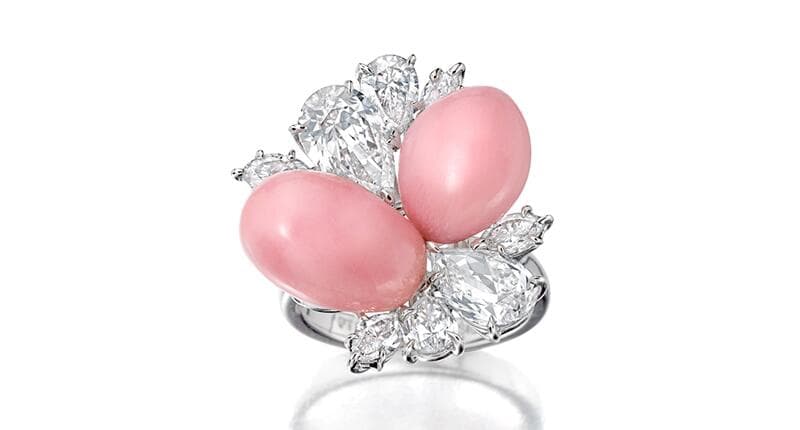
The single most distinctive feature of a fine conch pearl is the flame structure, an optical phenomenon that produces undulating, chatoyant-like ripples across the surface of the stone, resembling the flickering pattern of a candle flame viewed through silk. Fritsch and Misiorowski wrote that "in conjunction with the pink color, the mysterious allure of the flame structure in conch 'pearls' has traditionally added to its desirability." This is not hyperbole. A conch pearl without a visible flame structure is still a conch pearl, but a specimen with strong, clearly defined flames commands a premium that reflects genuine rarity within an already rare category.
The Harry Winston suite described in the *Gems & Gemology* article illustrates this perfectly. Harry Winston, Inc. created a necklace and earrings incorporating six pink conch pearls, with the necklace featuring a deep reddish pink button-shaped stone and the pendant holding a pear-shaped pearl weighing 45 carats, or 180 grains, described as "probably one of the world's largest." The article notes that "strong flame structure is readily apparent in many of the 'pearls' in the suite," and the piece was made for the firm's most exclusive clientele. That 45-carat specimen remains a benchmark: Fritsch and Misiorowski documented that conch pearls over 10 carats are rare, making anything approaching that weight genuinely extraordinary.
Color and Desirability
Conch pearls occur in a range of colors, including white, cream, yellow, brown, and orange. Pink is the most coveted, from pale blush to deep reddish pink, and the combination of a saturated pink body color with strong flame structure represents the pinnacle of what this gem can offer. The porcelain-like surface amplifies the color rather than diffusing it, which is why a fine pink conch pearl photographs beautifully and wears with unusual presence in jewelry. Fritsch and Misiorowski noted that this combination made pink conch pearls "quite popular in jewelry at the turn of the last century," a period when Edwardian jewelers incorporated them into brooches, pendants, and rings alongside diamonds and enamel.
A History Older Than Modern Gemology
The conch shell's significance predates any gem catalog. In antiquity, the Incas and many early cultures regarded it as a symbolic mouthpiece of the gods, and as the historian Dickinson wrote in 1968, "Perhaps it was because, when held to the ear, the voice of the sea god murmured through it." This mythic resonance surrounded the shell long before anyone catalogued its pearls systematically.
The earliest documented reference to pearls specifically from *Strombus gigas* appears in the 1839 Catalogue of the Collection of Pearls and Precious Stones formed by Henry Philip Hope, the same collector whose name is attached to the Hope Diamond. That a Victorian connoisseur of Hope's stature was collecting conch pearls nearly two centuries ago speaks to how long these stones have fascinated serious collectors, even as they remain largely unknown to the broader public.
What They Cost and What They Look Like in Contemporary Jewelry
The market for conch pearls is narrow and specialist. Because there is no culturing process, every conch pearl is entirely natural, and the global supply depends entirely on the wild queen conch population, which is subject to conservation restrictions across much of its Caribbean range. That supply constraint, combined with the difficulty of finding gem-quality specimens with desirable color and strong flame structure, keeps prices high and inventory limited.
Assael, one of the few American houses with a consistent presence in the conch pearl market, has supplied specimens that have appeared in trade publications as reference examples of what a quality loose stone looks like. For a sense of retail scale at the assembled-jewelry level, a bracelet from Tara Pearls featuring 20 natural conch pearls totaling 23.60 carats, combined with 1.27 carats of rubies, 0.42 carats of fancy diamonds, and 2.62 carats of white diamonds, all set in 18-karat white gold, was listed at $79,485. That price reflects both the material rarity and the labor intensity of sourcing matched conch pearls in sufficient quantity for a multi-stone piece.
Why Conch Pearls Deserve More Attention
For anyone interested in the intersection of natural history and fine jewelry, conch pearls occupy a genuinely singular position. They cannot be farmed. They cannot be replicated convincingly. They come from a single species, in a defined and ecologically sensitive region, in colors and with optical effects that no other gem material produces in quite the same way. The flame structure is not an enhancement or a treatment; it is either there or it is not, written into the stone at formation.
The gemological literature on them remains relatively sparse. Fritsch and Misiorowski's 1987 *Gems & Gemology* paper stands as a foundational reference, and the National Jeweler's 2018 feature by Senior Editor Brecken Branstrator brought the material to a broader trade audience. But compared to the volumes written about diamonds, sapphires, or even freshwater pearls, conch pearls remain a specialist's territory. For a collector willing to do the research, that obscurity is precisely the point.
This article was produced by Prism’s automated news system from verified source data, official records, and press releases, then run through automated quality and moderation checks before publishing. The system is built and supervised by the people who set the standards it runs under. Read our full AI policy.
Did this article answer your question?