Pearls move from jewelry boxes to couture and red carpet looks
Pearls are spilling beyond necklaces into couture and red-carpet dressing, testing whether the category is expanding or merely being styled to death.

Pearls leave the jewelry box
Pearls are no longer behaving like a single-category gem. They are turning up on dresses, blouses, sarees and accessories, and that spillover is doing more than filling a styling mood board: it is testing whether pearls can widen their commercial reach without losing the quiet prestige that made them desirable in the first place.
The strongest argument for their current power is not that pearls look pretty on fabric, but that they now move fluently between high jewelry, couture embellishment and red-carpet spectacle. A pearl can still anchor a strand at the collarbone, yet the same material now reads just as convincingly when it is stitched into a gown, scattered across a blouse or worked into a saree with enough volume to make the whole garment feel like a jewel.
From adornment to wardrobe architecture
Indian fashion has been especially visible in this shift. Ananya Panday appeared in Abu Jani Sandeep Khosla’s Pearl collection, while Tara Sutaria wore a Tarun Tahiliani pearl saree, both looks proving that pearls are being used less as finishing accents and more as the structural idea around which the outfit is built. The effect is maximalist rather than delicate: pearls are not merely decorating the garment, they are defining its identity.
That same logic appeared on larger stages long before the current wave of pearl-heavy dressing felt inevitable. Alia Bhatt’s 2023 Met Gala appearance in a Prabal Gurung gown reportedly crafted with 100,000 pearls was a reminder that pearl work can function at an extreme scale, where labor, surface density and shimmer become part of the message. Once a gem can command that kind of textile presence, it stops being confined to the jewelry box and starts behaving like a fashion system of its own.
Why the market should care
This matters commercially because pearl-adjacent fashion can expand demand in two different ways. In the best case, it creates aspiration around the gem itself, encouraging buyers to want pearl necklaces, earrings, hair ornaments and brooches that echo the clothing they see on runways and red carpets. In the weaker version, pearls become a decorative code that lives entirely in fashion, while the jewelry category absorbs the symbolism but not the sales.
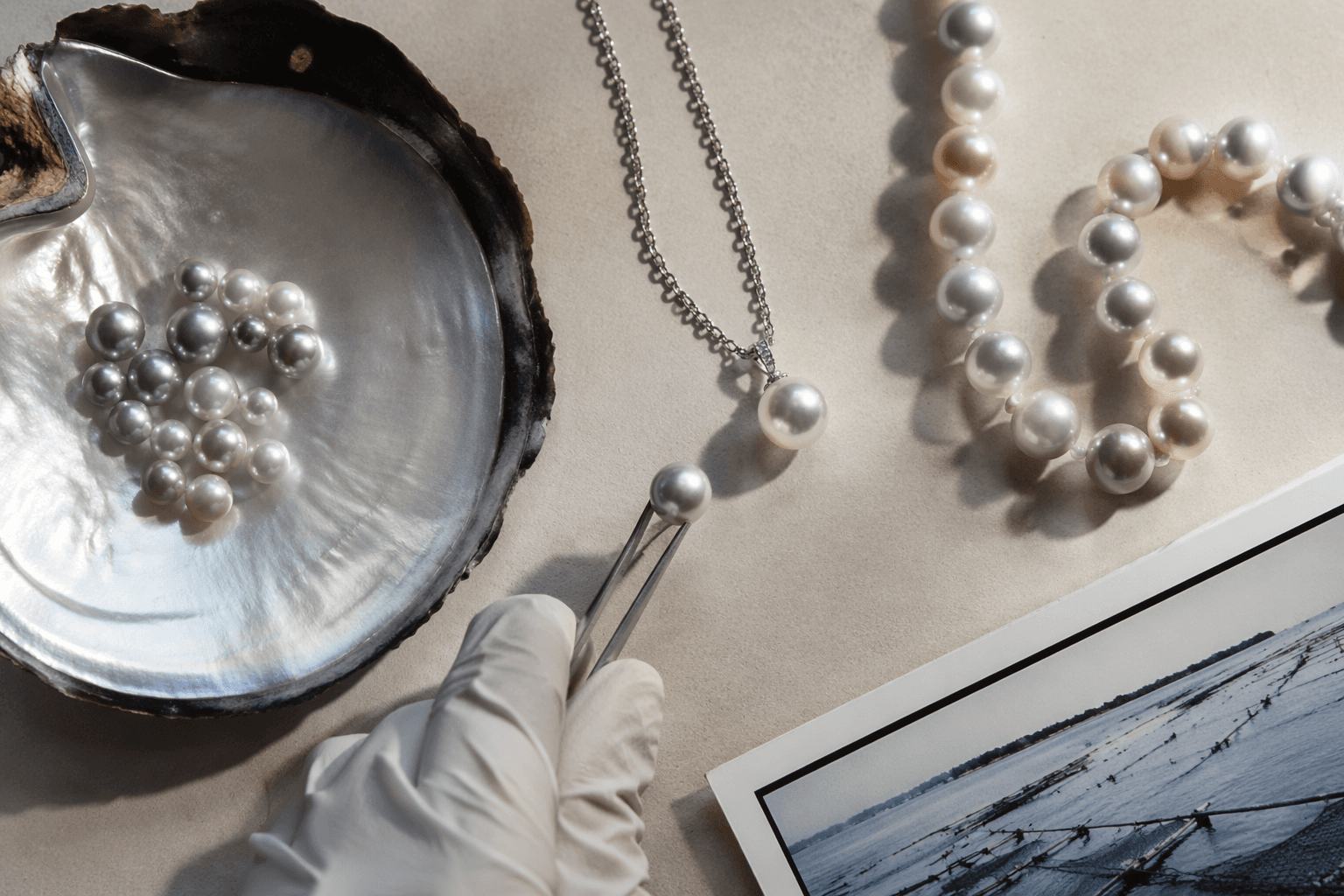
That tension sits at the heart of the current pearl moment. A pearl on a hemline may trigger desire, but it can also dilute the sense of rarity that supports premium positioning. If pearls become shorthand for surface embellishment alone, the gem risks being reduced to a motif. If the fashion spotlight leads viewers back to the qualities that make pearls valuable, luster, size, shape, nacre and the subtle differences between cultured varieties, then the runway translation becomes a real market expansion rather than a passing styling flourish.
A long history of status and reinvention
Pearls have always carried more than ornament. The Metropolitan Museum of Art notes that seed pearl necklaces were especially popular in the early to mid-19th century and were considered de rigueur in the ballroom by the middle of that century. The museum also records that Mary Todd Lincoln received a seed pearl parure from Tiffany & Company for Lincoln’s inauguration, proof that pearls have long been recruited to signal public dignity as much as private taste.
Their prestige stretches much farther back. In ancient Rome, the Metropolitan Museum says, pearls were among the most sought-after luxury materials, with the finest imported from the Persian Gulf. Roman society understood what luxury houses still understand now: pearls communicate rarity through provenance, not just sparkle.
Coco Chanel later changed the pearl’s social meaning again. Tatler Asia describes how Gabrielle Chanel transformed faux pearls from costume jewelry into symbols of sophistication, helping democratize luxury without stripping pearls of their polish. Her famous insistence on “ropes and ropes of pearls” still echoes through fashion because it framed pearls as styling language, not just precious object, and that idea has proved remarkably durable.

Why couture keeps returning to pearls
Fashion week coverage suggests the interest is not anecdotal. WWD described spring 2026 jewelry presentations in Paris as full of “not-your-grandma’s pearls,” a phrase that captures the category’s current split personality: still classic, but no longer obedient to classic form. Charlotte Chesnais introduced a fine jewelry line with pearls, and Aurélie Bidermann used freshwater pearls in spring 2026 pieces that leaned contemporary, asymmetrical and sculptural rather than demure.
Giambattista Valli’s spring 2026 collection, titled with a reference to “Girl with a Pearl Earring,” shows how deeply the gem remains embedded in fashion’s visual memory. That reference works because pearls still carry an almost instant cultural charge, whether they appear in a painting, a necklace or a fully beaded gown. When designers keep returning to them, it is usually because pearls can do something few materials can: they suggest inheritance and experimentation at the same time.
What to watch next
The current pearl story is less about a single trend than about a marketplace test. Couture and red-carpet exposure can raise the category’s prestige, but the real question is whether that visibility translates into stronger demand for well-made pearl jewelry, or whether it merely feeds an endless cycle of editorial styling.
The answer will depend on craftsmanship as much as imagination. The pearl pieces that matter most will be the ones that preserve the gem’s natural authority, whether they sit in a restrained bezel setting, a classic prong arrangement or a more modern, design-forward construction. Pearls can absolutely move onto clothing and accessories, but their long-term value still rests on the same thing that made them luxurious in Rome, in the 19th-century ballroom and in Chanel’s salon: the unmistakable sense that a pearl is never just decoration, but a small, luminous declaration of taste.
This article was produced by Prism’s automated news system from verified source data, official records, and press releases, then run through automated quality and moderation checks before publishing. The system is built and supervised by the people who set the standards it runs under. Read our full AI policy.
Did this article answer your question?