Everything New Pearl Buyers Need to Know Before Shopping
Not all pearls are equal: nacre thickness, luster, and origin separate a $100 strand from a $10,000 one. Here's how to read the difference before you buy.
The four pearl types and what separates them
Before evaluating quality, understand what you're actually looking at. The four cultured pearl types sold in mainstream jewelry differ in origin, host organism, nacre depth, and price, and knowing those differences protects you from paying South Sea prices for Akoya quality, or missing an exceptional freshwater piece because you assumed it was entry-level.
Freshwater pearls are farmed in lakes and ponds, almost entirely in China, inside the Hyriopsis cumingii mussel. Because each mussel can produce multiple pearls simultaneously, freshwater harvests dwarf saltwater production by volume, which keeps prices accessible: a strand can start around $100. Sizes typically run 5mm to 16mm, and, critically, freshwater pearls are solid nacre all the way through, with no bead nucleus inside. That structural difference makes them surprisingly durable despite their modest price point.
Akoya pearls are the classic saltwater cultured pearl, grown primarily off the coasts of Japan in regions including Ise Shima, Ehime, and Nagasaki. The host oyster is smaller and more delicate than its South Sea counterpart, which means Akoya pearls rarely exceed 9.5mm (a 10mm Akoya is genuinely rare). Their nacre layer is relatively thin, measuring roughly 0.3mm to 0.6mm around a large shell-bead nucleus, but the crystalline structure of that nacre produces the most mirror-sharp luster of any pearl type. Top-grade Hanadama Akoya strands can reach $10,000 to $11,000.
Tahitian pearls come from the black-lipped oyster in French Polynesia and carry the pearl world's most dramatic color palette: peacock green, eggplant purple, deep blue, pistachio, cherry, and steel gray, none of it treated. The colors are entirely natural, which is a meaningful distinction when you start comparing treatments (more on that below). Tahitians range from 8mm to 14mm, with rare specimens reaching 18mm. Strand prices run from $500 to well over $100,000 depending on size, luster, and the rarity of the color combination.
South Sea pearls are the largest cultured pearls produced commercially, averaging around 13mm and occasionally reaching 20mm. They are farmed in the warm waters of Australia, Indonesia, the Philippines, Myanmar, and Thailand, with approximately 60 percent of production coming from Australia. The silver-lipped and gold-lipped oysters that produce them grow slowly and deposit nacre at a rate that results in layers measuring 2mm to 6mm, far thicker than an Akoya pearl. That depth of nacre creates a satiny, luminous glow rather than a mirror-like reflection. South Sea strands start around $2,500 and climb steeply with size and quality.
The seven quality factors, explained
The GIA evaluates pearls across six core value factors: size, nacre quality, surface quality, luster, shape, and color. Matching is an additional factor applied to strands, earring pairs, and multi-pearl pieces. Understanding each one shifts you from passive shopper to informed buyer.
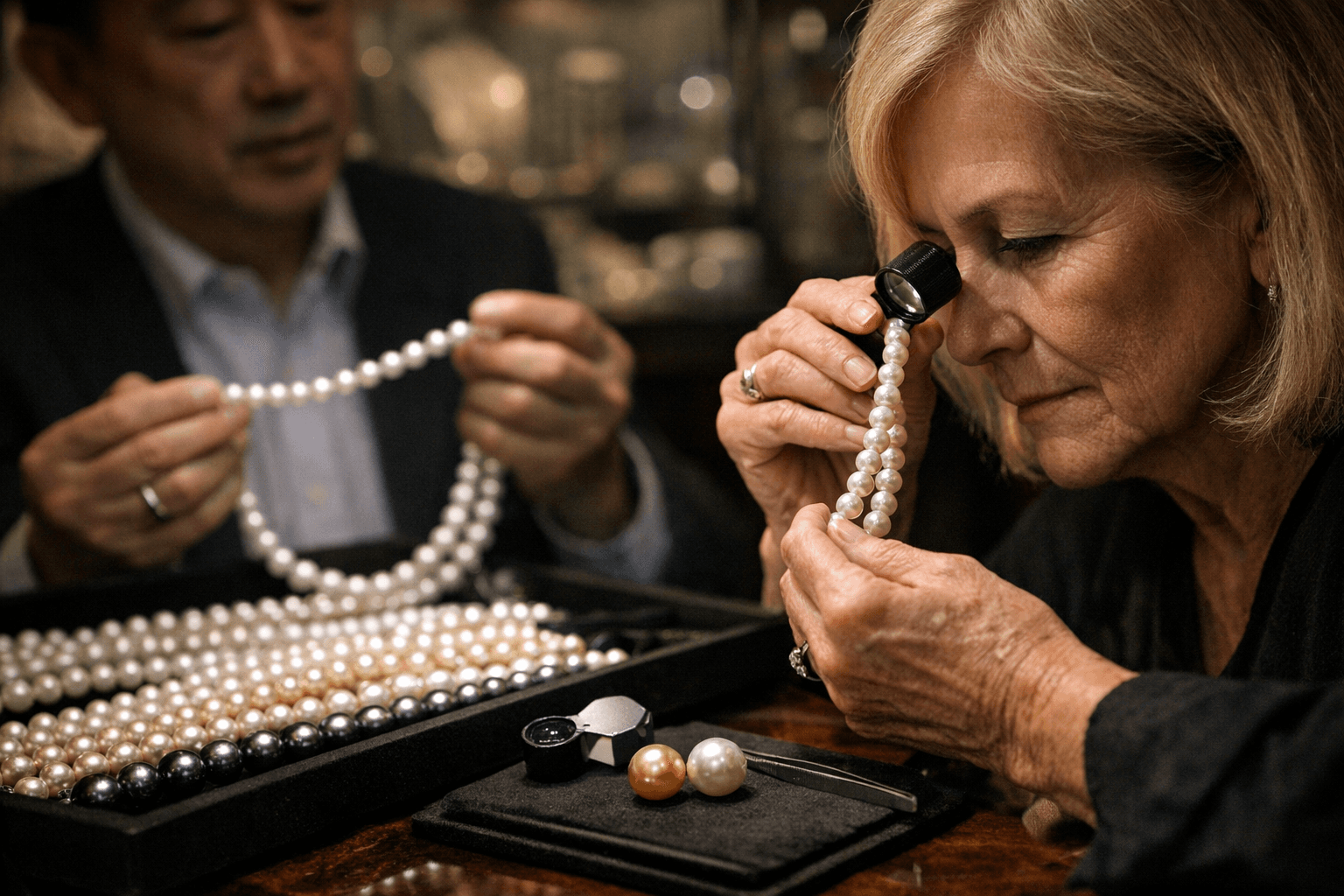
*Luster* is the most immediately visible quality indicator. Hold a pearl under a light and look for the sharpness of the reflection. In a top-grade Akoya, you should be able to see your own facial features reflected back. A South Sea pearl at peak quality glows from within; the luster is softer but deeply luminous. Chalky or dull surfaces indicate thin or poorly formed nacre regardless of type.
*Nacre thickness* matters most in Akoya pearls, since thin nacre is their primary structural vulnerability. Look for a minimum of 0.4mm per side at AA+ grade or above. Freshwater pearls, being solid nacre, don't carry this risk. South Sea pearls rarely have nacre concerns given their extended growth period. If a seller can't confirm nacre depth on Akoya pearls, that's a gap worth noting.
*Orient* is a secondary optical effect, a rainbow iridescence that plays across the surface and is distinct from basic luster. It appears most visibly in freshwater and South Sea pearls with thick nacre, and is widely considered a mark of exceptional quality.
*Surface quality* is graded by the size, number, and type of blemishes present. All natural pearls have surface characteristics, since they are organic objects formed by living animals. Tiny wrinkles, pinprick holes, and light spots under the nacre surface are common in Akoya pearls. Grade scales typically describe surfaces as "95% clean" or better for higher grades.
*Shape* runs from perfectly round (the rarest and most prized) through near-round, oval, button, drop, and baroque. Round pearls command a premium because they require more favorable conditions to form symmetrically. Baroque shapes, where the pearl is freeform and asymmetrical, are experiencing renewed interest for their sculptural character in contemporary jewelry design.
*Matching*, for strands, earrings, and bracelets, refers to how consistently the pearls align in color, luster, shape, size, and overtone. A graduated strand, where pearls taper from a larger center stone to smaller ends, requires careful selection across the full length.
Grading systems and what to ask for
Two grading scales are widely used. Akoya pearls follow an A to AAA system, with AAA representing exceptional roundness, high luster, and clean surfaces. Freshwater, Tahitian, and South Sea pearls are typically graded on an A to AAAA scale. Tahitian farmers also use an A-D system (where A is highest), which maps onto the wider scale used by retailers.
When buying online, ask whether the seller can provide a lab report from a recognized gemological laboratory. For higher-value purchases, a GIA report or equivalent documentation confirming pearl type, treatment status, and nacre thickness is a reasonable request, not an unusual one. Be cautious of listings with heavily edited photographs, vague return policies, or sellers who cannot describe whether a pearl has been treated.
Treatments: what's standard and what to watch for
Most cultured pearls receive some post-harvest treatment. Bleaching is standard practice for freshwater and Akoya pearls to even out color before sale; this is considered routine in the trade. Dyeing is used to create non-natural colors in freshwater pearls and should always be disclosed. Irradiation is sometimes used to darken colors, particularly in freshwater pearls. Coating, which involves applying a surface layer to simulate luster, is a red flag in fine jewelry and should be explicitly ruled out.
Tahitian and South Sea pearls are typically sold without color treatment, and this is part of what justifies their price. If a seller cannot confirm treatment status on these types, treat that ambiguity as a reason to ask harder questions.
Buying strategy by use and budget
For everyday earrings or a first strand, freshwater or Akoya pearls in the 7mm to 8mm range at AA or AA+ grade offer excellent luster and durability at manageable prices. Prioritize nacre thickness and luster over size at this tier.
For a strand intended as a longer-term piece, consider where you are placing your budget: in Akoya pearls, size beyond 8mm comes at a steep premium. In freshwater pearls, investing in better surface quality and luster rather than maximum size tends to yield a more beautiful result per dollar. If you're drawn to Tahitian or South Sea pearls, a single pendant or pair of earrings often gives you better quality at a given budget than a full strand.
Modern styling has also made single-type strands less obligatory. Mixing pearls with yellow gold or oxidized silver settings, or pairing a baroque freshwater pendant with a chain, achieves the organic quality of pearls while fitting contemporary jewelry aesthetics.
Care and maintenance
Pearls sit at 2.5 on the Mohs hardness scale, making them significantly softer than most other gemstones. The nacre that gives them their beauty is the same material that makes them vulnerable.
The routine is simple: wipe each pearl with a soft, dry cloth after wearing, before storing. This removes perspiration, perfume residue, and cosmetic trace. Never apply perfume, hairspray, or lotion while wearing pearls; always put pearls on last. Keep them away from ammonia, bleach, vinegar, and hydrogen peroxide entirely.
Storage matters. Do not keep pearls in airtight plastic bags or in a bank safe deposit box. Pearls are porous and require ambient humidity to stay supple; sealed environments cause them to dry out, leading to micro-fractures and eventual brittleness. A soft cloth pouch or lined jewelry box compartment is ideal.
For strands, restringing is essential maintenance. Silk thread, which is the standard for pearl necklaces and bracelets, stretches, frays, and accumulates grime between knots over time. If you wear a strand regularly, plan to have it restrung annually. For occasional wear, every two to three years is appropriate. Do not wait for a visible break; replacing a strand in progress is far less costly than searching for a lost pearl.
With consistent care and correct storage, a well-made pearl piece will outlast most of the other jewelry in your collection.
This article was produced by Prism’s automated news system from verified source data, official records, and press releases, then run through automated quality and moderation checks before publishing. The system is built and supervised by the people who set the standards it runs under. Read our full AI policy.
Did this article answer your question?