GIA Adds RFID Traceability Numbers to Cultured Pearl Classification Reports
GIA now embeds a unique RFID number in pearl reports, letting a single South Sea gem carry its full origin story from oyster farm to jeweler's bench.
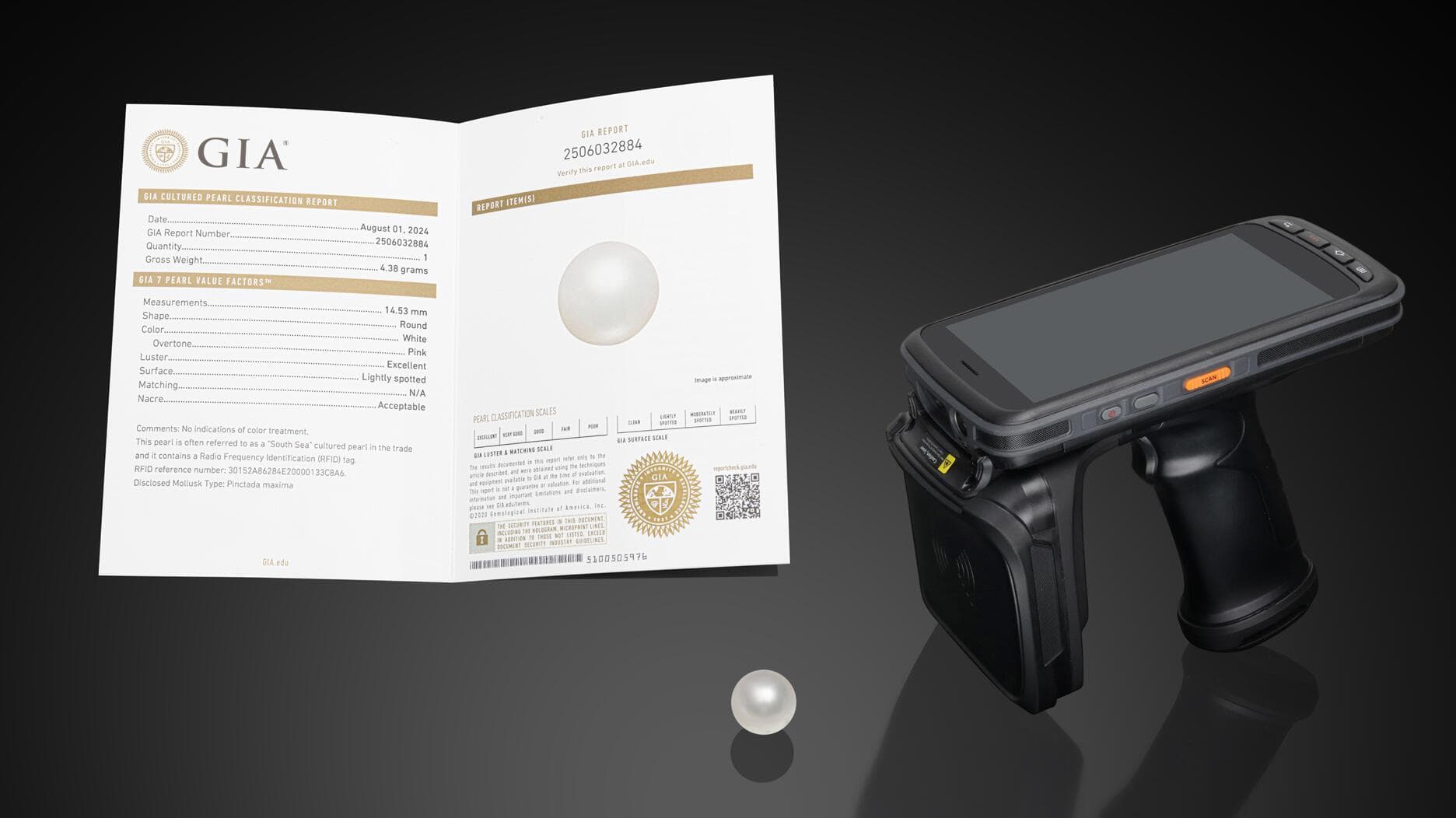
Every cultured pearl begins as an act of biological patience: a technician implants a bead nucleus into a living mollusk, then waits years for nacre to accumulate. What happens between that moment and the finished strand in a jeweler's case has long been opaque. The Gemological Institute of America moved to change that when it began including unique RFID traceability reference numbers in its Cultured Pearl Classification Reports for pearls whose bead nuclei contain embedded wireless tags.
The technology making this possible is Metakaku®, a patented system developed by Hong Kong-based Fukui Shell Nucleus Factory over roughly a decade of research. Rather than attaching a tracking device externally, Metakaku® embeds a wireless Radio Frequency Identification tag directly inside the bead nucleus, the small sphere implanted at the heart of every bead-nucleated cultured pearl. During GIA's standard examination, an RFID reader detects the tag and extracts its unique reference number. That number is then recorded in the Comments Section of the Cultured Pearl Classification Report, where it is matched to the pearl's quality attributes as assessed under GIA's seven Pearl Value Factors: Size, Shape, Color, Nacre, Luster, Surface, and Matching.
To demonstrate the system, Fukui submitted a batch of Akoya, South Sea, and Tahitian pearls to GIA, each cultured with an RFID-enabled nucleus. The three species, Pinctada fucata, Pinctada maxima, and Pinctada margaritifera, represent the core of the prestige saltwater pearl market, and their inclusion signals that the technology was stress-tested against the full range of bead-nucleated pearl production.
"The integration of RFID details with GIA Cultured Pearl Reports represents a significant step forward in efforts to enhance traceability and transparency in the pearl industry," said Tom Moses, GIA's executive vice president and chief laboratory and research officer.

Fukui has expanded Metakaku® beyond that initial submission, rolling the technology out to pearl producers in French Polynesia, Myanmar, Indonesia, Japan, and China. David Wong, project director of Fukui Shell Nucleus and the innovator behind Metakaku®, described the ambition plainly: "Through Metakaku®, we hope to provide value and inspire greater opportunities for every single pearl that is harvested."
GIA has graded pearls since 1949, and its seven Pearl Value Factors remain the closest thing the industry has to a universal quality language. Adding an RFID reference number to that framework does not change how a pearl is graded, but it does change how that grade can be trusted. A Cultured Pearl Classification Report has always told a buyer what a pearl is; the RFID number begins to tell them where it has been.
What the system does not yet resolve, at least based on current reporting, is whether the unique reference number will be linked to a publicly searchable traceability database accessible to retailers and end buyers, or whether it functions primarily as a producer- and laboratory-side verification tool. That distinction will determine how meaningfully the technology serves the growing consumer demand for provenance transparency, particularly for pearls positioned as sustainably farmed.
This article was produced by Prism’s automated news system from verified source data, official records, and press releases, then run through automated quality and moderation checks before publishing. The system is built and supervised by the people who set the standards it runs under. Read our full AI policy.
Did this article answer your question?