GIA's 7 Pearl Value Factors Remain the Gold Standard for Buyer Education
Most pearl buyers still don't know what nacre thickness means — GIA's 7 Pearl Value Factors close that gap with a framework jewelers and gemologists trust worldwide.

Walk into almost any jewelry counter that sells pearls and you'll hear the same vague sales language: "lustrous," "high quality," "AAA grade." That last phrase, in particular, is essentially meaningless. Unlike the AAA designation used for diamonds, pearl grading has no universal industry-wide standard behind it — no regulatory body enforces what "AAA" actually means from one retailer to the next. The Gemological Institute of America recognized this problem decades ago, and the solution it built over a 70-year research program is the framework serious buyers, gemologists, and trade professionals now reach for: the GIA 7 Pearl Value Factors.
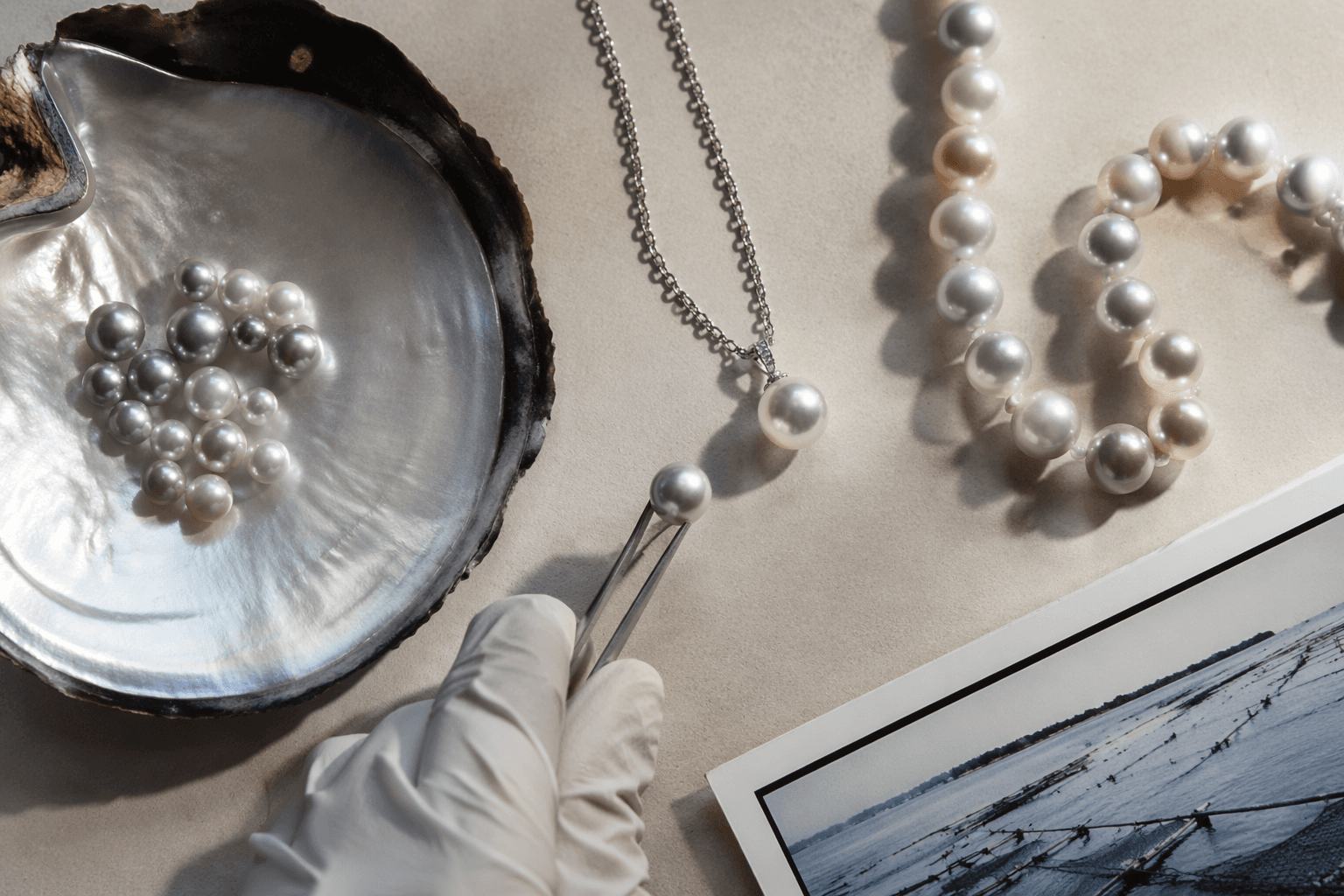
The GIA 7 Pearl Value Factors system classifies pearls according to size, shape, color, luster, surface, nacre, and matching. Each factor addresses a distinct physical characteristic, and together they form a complete picture of a pearl's quality that, crucially, applies across all pearl types — the system provides a systematic way to evaluate pearls of all types, and to describe their appearance and quality in a way everyone can understand. For anyone spending serious money on a strand, a pair of drops, or a single statement pendant, understanding these seven benchmarks is the most practical education available.
Size
Pearl measurements are stated in millimeters, rounded to the nearest 0.5 mm. Trade members measure the diameter of drilled individual spherical pearls perpendicular to the drill hole and state that measurement as its size. For non-spherical shapes, measurements reflect both length and width. Size matters because, all other factors being equal, a larger pearl is rarer: a mollusk takes significantly longer to deposit nacre around a larger nucleus. South Sea pearls range 8–20mm and above, with larger sizes commanding premium prices, while akoya pearls typically fall in the 5–11mm range. A single millimeter of additional diameter on a South Sea pearl can represent a meaningful jump in price at auction.
Shape
The three main categories of shape are spherical, symmetrical, and asymmetrical (semi-baroque and baroque). Within those broad categories, GIA uses seven descriptors: round, near-round, oval, drop, button, baroque, and circled. A perfectly round pearl is the rarest naturally occurring shape, and it commands a corresponding premium. That said, baroque and semi-baroque pearls have cultivated a dedicated following among designers precisely because their organic asymmetry is unrepeatable. Shape alone doesn't determine value — a spectacularly lustrous baroque Tahitian pearl will outperform a dull, near-round akoya every time — but it is the first factor that catches the eye and sets buyer expectations.
Color
Color in pearls is more layered than a single hue. The body color of the pearl is determined by hue, tone, and saturation. Orient is the combination of colors glistening just below the surface of the pearl. Overtone is a layer of translucent color that appears over the pearl's body color. A classic akoya strand might have a white body color with a rose overtone — it's this overtone that gives premium Japanese akoyas their characteristic warmth. For Tahitian pearls, the prized body colors run from peacock green to deep aubergine, and what's valuable in one pearl type might be common in another: white is prized in South Sea and Akoya pearls, while dark colors are valued in Tahitian pearls. Color preferences also shift regionally, which means a buyer purchasing for resale needs to understand not just the GIA descriptors but the market they're selling into.
Luster
Luster is arguably the single most important of the seven factors — the quality that separates a pearl that looks alive from one that looks chalky and inert. Luster is the intensity and sharpness of the light reflected from a pearl's surface. Nacreous pearls display varying degrees of luster, while non-nacreous pearls have a softer shine. Pearls with excellent luster have sharp, bright reflections on the surface. Different pearl varieties have different standards for luster. The GIA Luster Scale ranges from Excellent to Poor. The five grades are Excellent, Very Good, Good, Fair, and Poor. At the Excellent end, you can see your own reflection in the surface of the pearl with near-mirror clarity. At the Poor end, the surface appears flat, with no perceptible depth. Luster is largely a function of nacre quality — thicker, more regularly deposited nacre layers produce stronger, sharper reflections.
Surface Quality
No pearl is flawless. Surface characteristics, also called blemishes, are a natural byproduct of the organic growth process. Surface characteristics are judged by size, number, location, visibility, and the types of blemish. If surface characteristics are numerous or severe, they can affect the durability of a pearl and severely lower its value. They have less effect on the pearl's beauty and value if they are few in number, or if they are minor enough to be hidden by a drill-hole or mounting. The GIA Surface Scale classifies pearls as Clean, Lightly Spotted, Moderately Spotted, or Heavily Spotted. Location matters as much as number: a single visible pit on a pearl's face reduces value more than several small spots hidden near the drill hole. Jewelers routinely orient pearls during stringing to minimize the visual impact of surface blemishes, a detail worth asking about before purchase.
Nacre Quality
Nacre is not simply a coating — it is the pearl itself, built up in concentric layers of aragonite crystals. Nacre quality is determined by its thickness and the regularity of its layers. GIA classifies three categories of nacre quality: Acceptable, Nucleus Visible, and Chalky Appearance. The majority of pearls in the jewelry trade fall into the Acceptable category. Nucleus Visible means the bead nucleus shows through the nacre, a sign of thin deposition that also compromises durability. Chalky Appearance is the most severe finding. Nacre thickness varies considerably by pearl type: South Sea pearls carry nacre of approximately 2–3mm, Tahitian pearls approximately 0.8–2mm, and akoya pearls approximately 0.3–0.6mm. Freshwater pearls that are non-nucleated are composed entirely of nacre, which is why they can be so robust despite lower price points. A GIA pearl report will flag thin or damaged nacre directly, giving buyers a documented baseline for durability assessment.
Matching
The seventh factor applies only when multiple pearls are intended to look alike — a strand, a pair of earrings, a multi-pearl bracelet. Matching relates to the uniformity of pearls in strands, earrings, or other multiple-pearl jewelry items, and is highly dependent upon a skilled grader to determine matching across the other six value factors. The GIA Matching Scale ranges from Excellent to Poor, or is listed as Not Applicable for single pearls and certain intentionally mismatched jewelry items. Assembling a perfectly matched strand of South Sea pearls — where every pearl must align across size, shape, color, luster, and surface — can take years of harvest accumulation. It is the most labor-intensive aspect of high-end pearl jewelry and the one most invisible to buyers who don't know to ask about it. A strand graded Excellent for matching reflects not just superior individual pearls but a jeweler's sustained commitment to curation.
Why the Framework Holds
The first serious attempt to systematize pearl grading appeared in GIA's own Gems & Gemology journal in 1942, proposed by an author who suggested pearls could be grouped into categories such as gem quality, extra-fine quality, and fine quality, based on factors including shape, luster, surface blemishes, color distribution, and iridescence. This approach was further improved by GIA's Richard T. Liddicoat Jr., who in 1967 proposed a refined system that laid the groundwork for the modern seven-factor standard. The framework has since been incorporated into GIA's Graduate Pearls program, its eLearning curriculum, and its pearl laboratory reports — making it the most consistently cited reference in trade education globally.
For a buyer navigating a market crowded with proprietary grading labels and opaque retail descriptors, the seven factors are a reliable filter. Ask for a GIA pearl report or, at minimum, ask your jeweler to describe each factor explicitly. A seller who can answer those questions with precision is demonstrating the same standard of care that went into sourcing the pearls in the first place.
This article was produced by Prism’s automated news system from verified source data, official records, and press releases, then run through automated quality and moderation checks before publishing. The system is built and supervised by the people who set the standards it runs under. Read our full AI policy.
Did this article answer your question?