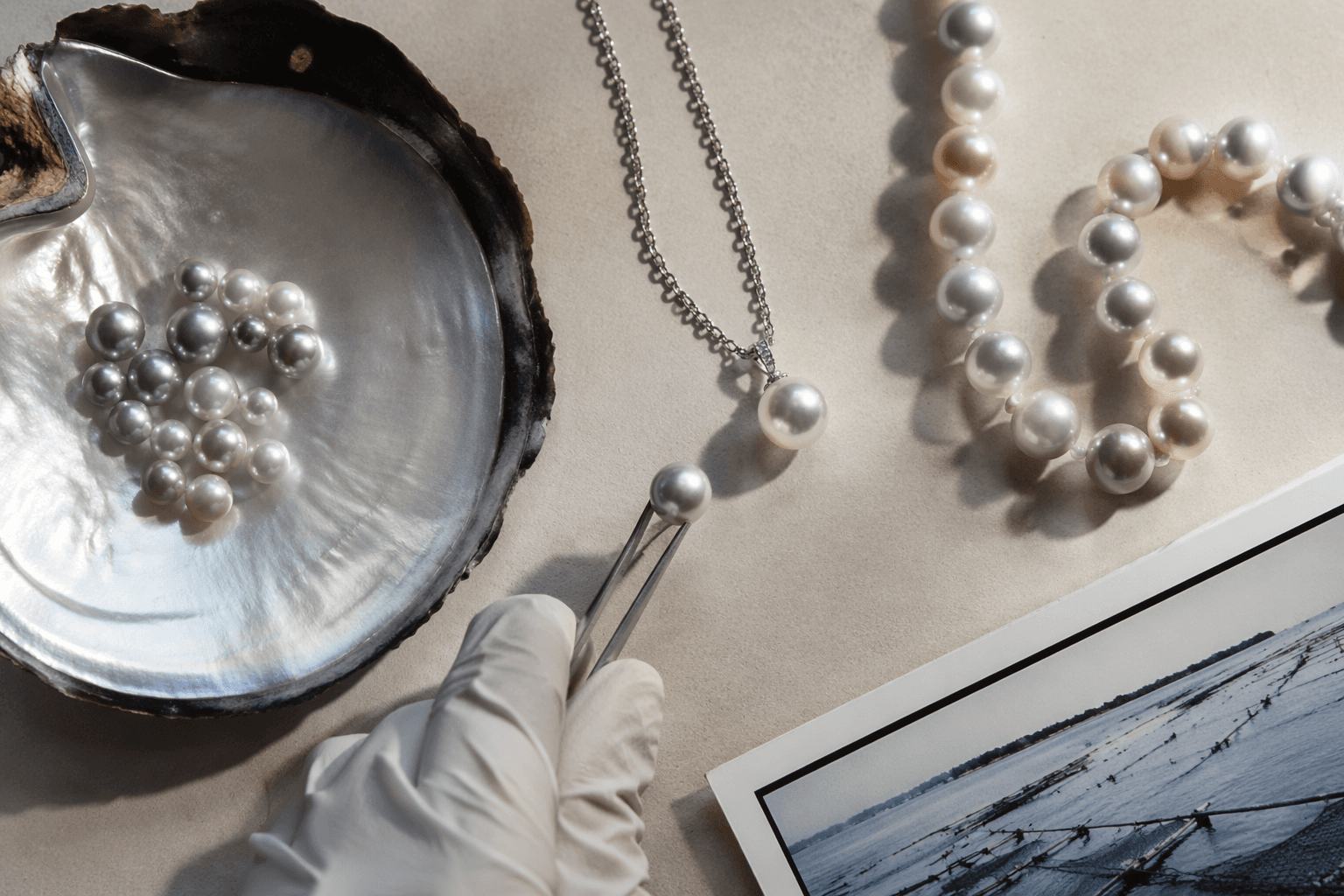
How Akoya, South Sea and Tahitian Pearls Form, Are Valued and Bought
Learn how Akoya, South Sea and Tahitian pearls are born, what determines their value, and the practical choices that make a purchase lasting and beautiful.
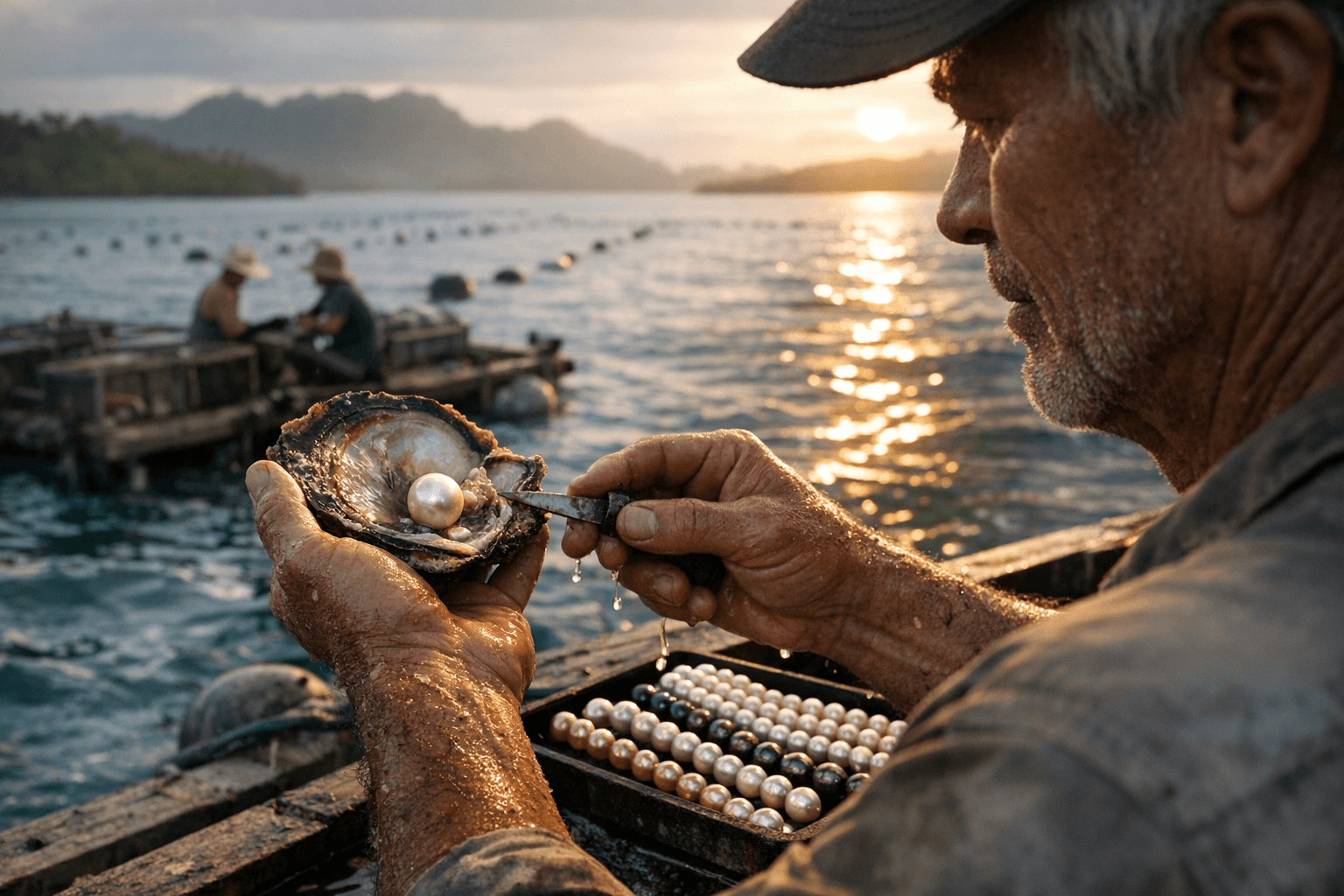
Pearls are records of a mollusk’s response to a single irritant; their value is written in layers of nacre, surface calm, and the light they return. Below I examine how Akoya, South Sea and Tahitian pearls form, how experts grade them, and what to look for when you buy.
1. Akoya pearls, formation, characteristics and valuation
Akoya pearls are classic round white or near-white saltwater pearls prized for their mirrorlike luster. They are produced by the small saltwater oyster cultivated primarily off Japan and China; a bead nucleus is implanted and the oyster secretes alternating aragonite and conchiolin layers that form nacre. Typical sizes fall between about 6 mm and 9 mm for the most desirable strands; Akoya necklaces in the 7–8 mm range command the strongest prices because they balance rarity with the high, reflective luster collectors want.
Valuation for Akoya hinges on luster and matching above nearly all else. Because the nacre layers on Akoya pearls are generally thinner than on South Sea varieties, surface perfection and a high degree of mirrorlike reflection are critical: a blemish or dull area will reduce value dramatically. Matching is also an exacting craft, an even color, luster and size across a strand distinguishes a museum-quality choker from a ready-to-wear piece. Expect treated white Akoya pearls to be bleached for color consistency; disclosure matters.
- Inspect luster up close: hold the pearl to the light and look for crisp reflections rather than a soft sheen.
- For necklaces, prefer hand-knotted strands with small, secure clasps; the knotting protects each pearl and keeps the strand wearable for decades.
- If you favor classic round strands, accept that perfectly round Akoyas in larger sizes are rare and priced accordingly.
Buying tips for Akoya:
2. South Sea pearls, formation, characteristics and valuation
South Sea pearls are the giants of the cultured pearl world, formed inside the Pinctada maxima oyster that inhabits warm waters around Australia, Indonesia and the Philippines. Their appeal is physical and tactile: sizes commonly range from about 9 mm to 16 mm and beyond, and their thicker nacre gives a richly satiny luster rather than a hard mirror. South Sea pearls appear in warm white and creamy to deep golden tones; the golden South Sea from the Philippines or the white from Australian farms each have pedigrees collectors value.
Nacre thickness is the defining metric for South Sea pearls, and it dictates longevity. Thick, even nacre yields pearls that age gracefully, resisting surface degradation and maintaining depth of color and light transmission. Surface quality and shape matter too, while slightly off-round South Sea baroque pearls can be spectacular in sculptural jewelry, round South Sea pearls remain the rarest and most valuable. Size multiplies value: a perfectly round 13–15 mm white pearl with clean surface and strong satiny luster will sit at the top of any valuation ladder.
- Prioritize nacre thickness and surface cleanliness over absolute perfection of roundness if you appreciate larger, dramatic pearls.
- Ask about origin and farm practices; the largest South Sea pearls typically come from Pinctada maxima farms in Indonesia and the Philippines, while Australian pieces carry strong provenance for collectors.
- Consider single-pearl pendants or matched pairs if a full large-strand exceeds your budget, the visual impact of a single 12–14 mm South Sea pearl can outshine many smaller multi-pearl strands.
Buying tips for South Sea:
3. Tahitian pearls, formation, characteristics and valuation
Tahitian pearls are not technically “black” pearls but are celebrated for their natural dark bodycolors and complex overtones, peacock green, aubergine, slate, and silver. Cultured in the black-lipped Pinctada margaritifera of French Polynesia and surrounding waters, they typically range from about 8 mm to 14 mm. The coloration is genetic and environmental: the oyster’s mantle tissue and water conditions influence the pearl’s bodycolor and overtones, making each gem nearly a fingerprint.
For Tahitians, coloration and luster combine to determine value. A deep, even bodycolor with vivid overtones (for example, a peacock overtone that shifts from green to aubergine as the pearl turns) is prized; equally important is surface cleanliness and nacre thickness, since thicker nacre deepens and stabilizes those overtones. Roundness and matching carry premium value as with other types, but many collectors prize striking baroque or drop-shaped Tahitians for their unique color play.
- Examine overtones in natural light and at different angles; the most valuable Tahitians change color subtly as they move.
- Be alert to treatments: some darker pearls are dyed or enhanced, so request disclosure and certification when color uniformity seems unnaturally perfect.
- Consider the balance between bodycolor and surface: a richly colored pearl with modest surface marks can sometimes be more desirable than a spotless but flat-toned specimen.
Buying tips for Tahitian:
4. How pearls are universally valued, the five key factors
All saltwater pearls are judged by the same essential criteria: size, luster, surface quality, nacre thickness, and shape/matching. Size is measured in millimeters and is straightforward: larger usually equals rarer and more expensive. Luster refers to how crisply a pearl reflects light; it's the single attribute that most immediately communicates quality. Surface quality evaluates blemishes and texture; fewer spots and smoothness increase value. Nacre thickness influences both durability and depth of light; for cultured pearls, thicker nacre is superior. Finally, shape and matching, roundness and uniformity across a strand, determine what a necklace or pair will ultimately be worth.
5. Practical buying checklist and care
1. Request certification and provenance: whether Akoya, South Sea, or Tahitian, prefer pearls that come with lab documentation describing species, treatments, and origin.
2. Inspect luster and surface in daylight: luster should be crisp; surface should show minimal blemishes for classic strands.
3. Consider the design outcome: choose perfectly matched round pearls for traditional strands, and opt for baroque or drop forms for more modern, sculptural settings.
4. Check construction: hand-knotted silk, reinforced clasps, and secure settings preserve value; bezel or prong choices alter how a pearl sits and how it wears, pearls benefit from settings that cradle not compress.
5. Plan for long-term care: store pearls flat, away from chemicals and leather; their nacre responds to acids and dryness, so periodic professional cleaning and re-knotting extend life.
Conclusion Pearls are both biological artifacts and wearable narratives: Akoya for mirrorlike refinement, South Sea for generous scale and satiny depth, Tahitian for dramatic color. Know the five valuation pillars, size, luster, surface, nacre and shape/matching, and match them to how you plan to wear the piece. With that knowledge, a pearl purchase becomes an investment in craft, provenance and light, one that can grace a wrist, ear or neck for generations.
This article was produced by Prism’s automated news system from verified source data, official records, and press releases, then run through automated quality and moderation checks before publishing. The system is built and supervised by the people who set the standards it runs under. Read our full AI policy.
Did this article answer your question?