How Tidal Flows and Wind Shape Pearl Quality in French Polynesia
In Ahe Atoll's 138 km² lagoon, tidal currents and trade winds control the nutrient flows that determine whether a black pearl's nacre is brilliant or dull.
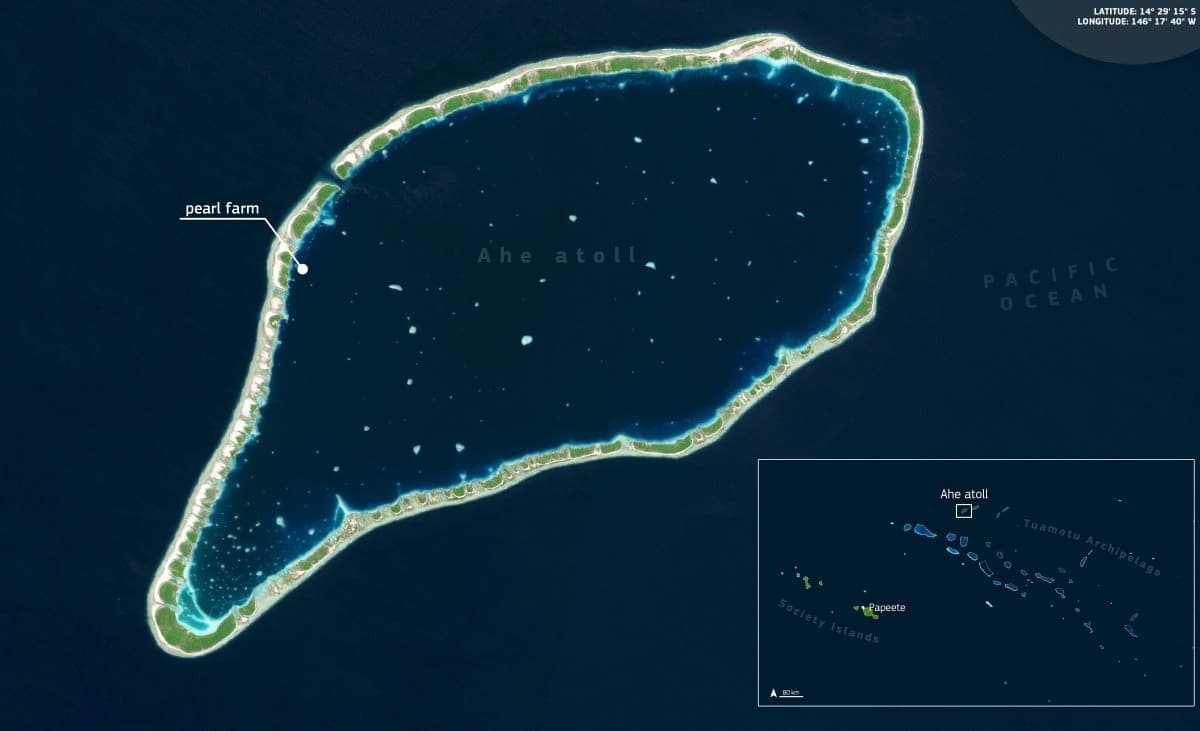
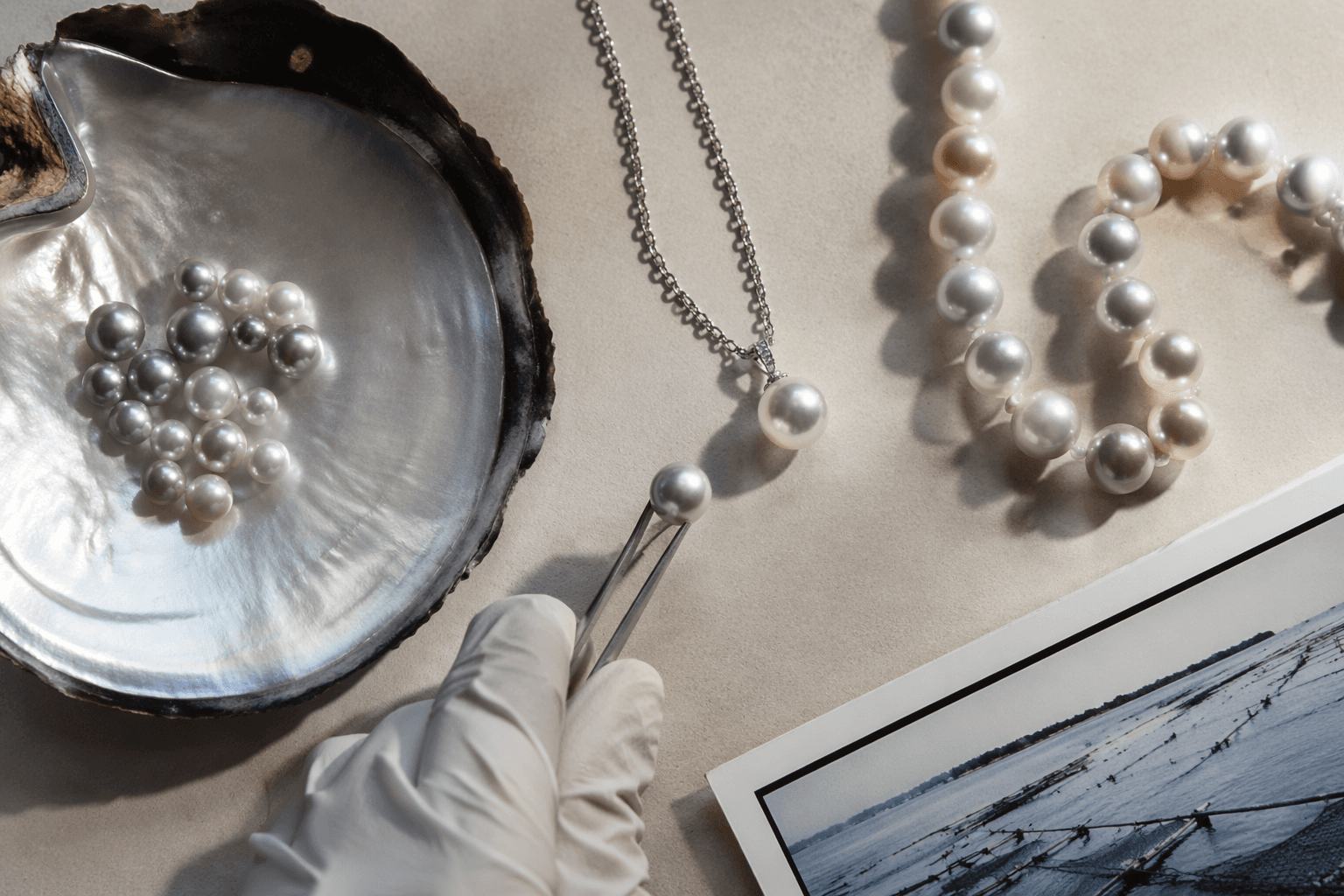
The difference between a Tahitian black pearl worth several hundred dollars and one worth a fraction of that often comes down to nacre. Nacre thickness, nacre luster, the depth of color that emerges from thousands of ultrathin crystalline aragonite layers laid down by a living oyster over sixteen months or more. What most buyers do not know is how much that outcome depends on geography you can barely see on a map. At Ahe Atoll, 484 kilometers from Tahiti in the Tuamotu Archipelago of French Polynesia, the physical forces shaping pearl quality are not in the grafting room or the harvest vessel. They are in the water itself, governed by tide and trade winds.
A Lagoon Built on a Single Opening
Ahe is an elongated ring of narrow coral islets enclosing a deep blue lagoon. Its landmass covers just 12 km², but the lagoon it surrounds spans 138 km², connected to the open Pacific through one passage: the Tiareroa pass. That ratio of water to land is everything. The atoll's 490 residents, most of them concentrated in the village of Tenukupara, live almost entirely in relation to what that lagoon produces. An associated commune of Manihi, Ahe sits within a chain of coral atolls whose economies, from spat collection to pearl harvest, are organized around the behavior of semi-enclosed tropical water bodies.
The single-pass design is not incidental to pearl farming. It determines the entire logic of water circulation inside the lagoon, including how nutrients arrive, how long they linger, and how unevenly they distribute themselves across 138 km² of productive water.
Two Forces, One Lagoon
Research using a year of in situ field data and a three-dimensional hydrodynamic model has characterized how Ahe's water moves, and the findings are counterintuitive. The tidal amplitude at Ahe averages less than 30 centimeters, modest by most standards. But that small tidal signal, once funneled through the narrow Tiareroa pass, generates currents reaching 2 meters per second. The pass acts like a nozzle, creating a jet-like circulation that partitions the lagoon interior into three distinct residual circulation cells.
The jet is not the dominant force over the lagoon as a whole, however. That role belongs to wind. Ahe is characterized scientifically as a wind-driven, tidally and weakly wave-flushed deep lagoon. Trade winds drive the overturning circulation that controls how water moves across the full 138 km² of lagoon surface. Together, tidal exchange through the pass and wind-driven surface circulation control water renewal rates and the distribution of nutrients that oysters depend on for growth.
The numbers on renewal time are striking. The lagoon's full renewal time sits at approximately 250 days, meaning the same water can circulate within the atoll for the better part of a year. The effective flushing time, a measure of how quickly water is exchanged under normal forcing conditions, averages 80 days across the lagoon as a whole. But that average conceals dramatic spatial variation. Some zones receive far more frequent exchanges than others; pockets of the lagoon, particularly in the southwest, carry higher concentrations of regenerated nutrients because of how intensively they have been farmed. Spatial heterogeneity in primary productivity is directly traceable to local hydrodynamics, and that heterogeneity has real consequences for what grows inside an oyster hung on a longline ten meters below the surface.
Where Water Meets Nacre
*Pinctada margaritifera*, the black-lipped pearl oyster, is a filter feeder. Its nacre deposition rate, and therefore the pearl's eventual thickness, luster, and color, depends fundamentally on how much it can eat. Food availability in the lagoon is determined by phytoplankton concentration, which is itself governed by nutrient levels, which are controlled by water circulation. The chain connecting a trade wind shift to the surface of a finished pearl is direct, if rarely described in those terms.
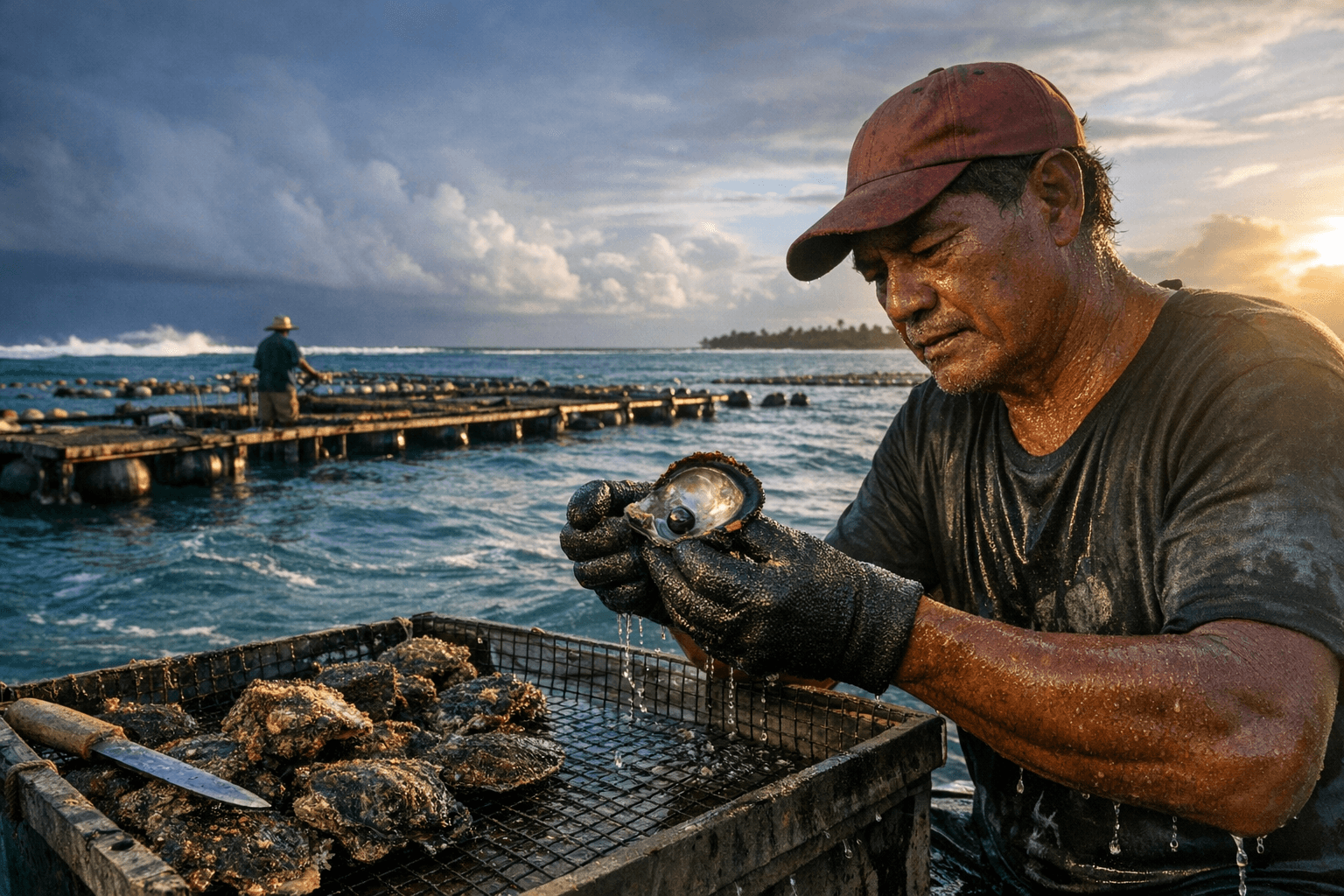
Studies of nitrogen dynamics in the Ahe lagoon found that phytoplankton production is sustained overwhelmingly by recycled nitrogen: roughly 68 percent of the pelagic nitrogen demand is met through remineralization rather than new oceanic input. That means the local cycling of nutrients, shaped by how the wind stirs the water column and how the tidal jet distributes water through the pass, is the dominant engine of oyster food supply.
Pearl color and grade are also affected by culture site conditions, not just the genetics of the donor oyster. Where within the lagoon a grafted oyster spends its sixteen months to two years of growth matters for the final pearl, partly because food availability differs by zone and partly because temperature gradients affect the rate of aragonite crystal formation. French Polynesian export law sets a minimum nacre thickness of 0.8 millimeters, a standard that an oyster under-nourished in a poorly circulated pocket of the lagoon may struggle to meet.
The Farm in Numbers
By 2010, Ahe supported 57 cultured pearl farmers operating across 1,055 hectares of marine concessions, roughly 8 percent of the total lagoon area. Farms are positioned along the inner rim of the atoll, where calm, sheltered conditions favor cultivation and longline infrastructure can be maintained year-round. Production is organized through government-regulated concessions, with farm placement decisions that, in principle, reflect the spatial logic of the lagoon's circulation patterns.
The broader Tuamotu industry those farms feed into carries significant economic weight. In 2022, exports of pearl products from French Polynesia reached 6.2 billion F.CFP, with raw cultured pearls accounting for most of that value. Black cultured pearls from the Tuamotu and Gambier island groups represent roughly two-thirds of the territory's total export earnings, making pearl aquaculture the second-largest industry after tourism.
Climate Pressure and the Cost of Abandonment
That economic significance makes the physical vulnerability of lagoon-based farming difficult to dismiss. Wind regimes in the south-central Pacific are shifting under climate change, and because overturning circulation in Ahe's lagoon is wind-driven, changes in trade wind strength or direction translate directly into changes in nutrient distribution and water renewal rates. A lagoon that took generations of pearl farmers to read and map cannot be easily recalibrated when the forcing conditions change.
The industry has already been through one cycle of contraction. The economic decline that characterized Tuamotu pearl farming over the past decade left a visible mark on Ahe's lagoon floor. A 2013 survey of 47 sites in the lagoon identified 20 distinct types of derelict gear from abandoned farms, including discarded installations that had drifted beyond concession boundaries. Forty-five percent of surveyed sites showed measurable impact. Derelict gear in a semi-enclosed lagoon with an 80-day average flushing time does not disappear quickly.
The physics of Ahe are not poetic. Two meters per second through a coral pass, 250 days to renew a lagoon, 68 percent of a pearl oyster's food supply derived from water the lagoon has already cycled once. But those numbers are what stand between a buyer in Tokyo or Paris and the pearl they are examining under a jeweler's loupe. The quality they see in the nacre is, in the most literal sense, a record of the wind that blew across that lagoon while the oyster was growing.
This article was produced by Prism’s automated news system from verified source data, official records, and press releases, then run through automated quality and moderation checks before publishing. The system is built and supervised by the people who set the standards it runs under. Read our full AI policy.
Did this article answer your question?