How to Buy Pearls: Types, Value Factors, and Inspection Tips
The GIA's 7 Pearl Value Factors can mean a tenfold price difference between two strands that look nearly identical. Here's how to read them before you buy.
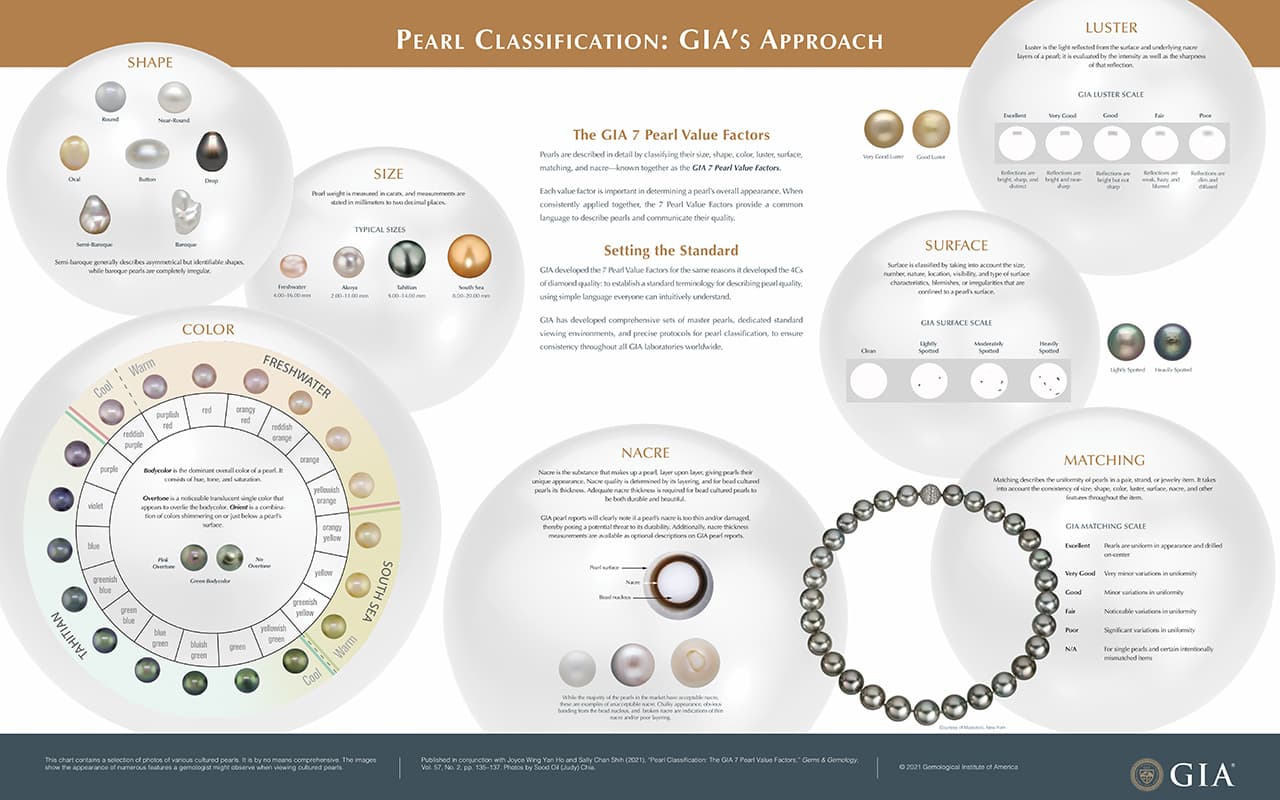
Two pearl strands can sit side by side in a jeweler's case, look nearly identical at a glance, and carry price tags that are ten times apart. The difference almost always comes down to the GIA 7 Pearl Value Factors: Size, Shape, Color, Luster, Surface, Nacre, and Matching. The Gemological Institute of America developed this classification system over 70 years of research, for exactly the same reason it created the 4Cs of diamond quality: to give buyers and sellers a shared, precise language. Before choosing a single strand, learning what those seven factors actually measure is the most valuable thing you can do.
The Four Pearl Families
Not all pearls begin in the same water, the same creature, or the same hemisphere. The four major cultured pearl types differ fundamentally in origin, size, color range, and price, and those differences are real, not marketing.
Freshwater pearls are grown in mussels in the natural and man-made lakes and ponds of China. A single freshwater mussel can yield up to 50 pearls in one growth cycle, which is why freshwater pearls are the most abundant and accessible type on the market. They run roughly 3 to 10 mm, though larger specimens exist, and they come in white, cream, pink, and lavender, as well as dyed colors. Critically, freshwater pearls are solid nacre throughout, not a nacre coating over a bead nucleus, which is a structural advantage worth understanding.
Akoya pearls are what most people picture when they think of a classic pearl: round, white to cream, with a rose or silver overtone and a sharp, mirror-bright luster. Grown primarily in Japan and China in the Akoya oyster, they typically range from 2 to 9.5 mm. They were the first pearls ever farmed commercially, and they remain the benchmark for matched white strands used in bridal and formal jewelry.
Tahitian pearls come from the black-lipped oyster (Pinctada margaritifera) farmed in the tropical atolls and saltwater lagoons of French Polynesia. The oyster can grow to nearly a foot in diameter, which allows for pearls ranging from 8 to 15 mm. Their body colors run from pale dove grey to very dark charcoal, and the finest specimens shimmer with iridescent overtones: peacock green, blue-green, cherry, and silver. A Tahitian pearl typically takes 18 to 24 months to reach 10 mm. Harvests are inspected and certified at random by the Perliculture Department of French Polynesia's Pearl Ministry, which requires an average nacre thickness of at least 1.0 mm.
South Sea pearls are the largest cultured pearls commercially available, ranging from 8 to 18 mm, and they grow in the silver-lipped or gold-lipped oyster across the coastal waters of Australia, Indonesia, and the Philippines. Their colors are white to silver or deep golden, depending on the oyster variety. Long cultivation periods produce thick nacre: South Sea pearls are generally required to meet a minimum nacre depth of 2 mm, which contributes directly to their luminous, satiny glow and to their position at the top of the pearl price hierarchy.
The GIA 7 Pearl Value Factors, Explained
*Luster*
Luster is the single most important value factor. It is not surface shine; it is the depth of glow produced when light enters the pearl and reflects back through the layered nacre. A high-luster pearl shows sharp, detailed reflections of objects on its surface. A low-luster pearl looks chalky, opaque, or flat, almost like paint. When the nacre layers are dense, even, and tightly stacked, luster deepens. When they are thin or irregular, luster disappears. No amount of good color or round shape compensates for poor luster.
*Nacre*
Nacre is the crystalline aragonite secreted in overlapping layers by the mollusk. Thickness and regularity both matter. Thin nacre, common in pearls that were harvested too early, can reveal the nucleus beneath as a slightly greenish tinge or a banded, dull surface. Thick nacre means durability: the pearl resists chipping and retains its luster for decades rather than years. For South Sea pearls, 2 mm is considered the minimum for durability. Freshwater pearls, being solid nacre, sidestep this concern entirely.
*Surface Quality*
GIA grades pearl surfaces across four categories: flawless or clean, lightly spotted, moderately spotted, and heavily spotted. Virtually no pearl is blemish-free: small pits, bumps, and scratches are part of a living creature's growth record. What matters is the concentration and visibility of those marks. Isolated, minor blemishes that appear only under close inspection at 6 to 12 inches rarely affect wearability. Heavy spotting that covers a large surface area, or blemishes positioned where they catch the eye, will reduce both aesthetics and value.
*Size*
Size is measured in millimeters and is the most immediately legible value driver. For Akoya pearls, each 0.5 mm increase above 7.5 mm can raise a strand's price by 20 to 30 percent; a 9 mm Akoya strand costs nearly double a comparable 7 mm strand. South Sea pearls command exponential premiums past 14 mm: a 16 mm white South Sea pearl may cost three times more than a 12 mm equivalent of similar quality. Size only adds value when luster, surface, and nacre are also strong.
*Shape, Color, and Matching*
Round pearls command the highest prices because they are the hardest to produce consistently. Near-round, button, drop, and baroque shapes each carry different premiums, and baroque South Sea or Tahitian pearls can offer exceptional luster and presence at a meaningfully lower cost than matched round strands. Color is evaluated in two parts: body color (the dominant base tone) and overtone (the secondary, translucent color visible over the surface). For Tahitian and golden South Sea pearls, deeper, more saturated overtones are more valuable. Matching, the final factor, applies to strands and sets: pearls should be consistent in size, shape, luster, and color from one end of the strand to the other, with a gradual, intentional graduation if the design calls for it.
Price Ranges: What to Expect
Freshwater strands begin around $100 for smaller, less round specimens, while gem-quality freshwater pieces in larger, rounder forms run $500 to $2,500 and beyond. Akoya strands range from roughly $300 to over $10,000, with the highest-grade Hanadama Akoya strands in the largest sizes topping out around $10,000 to $11,000. Tahitian strand prices start around $500 and climb past $25,000 for fine, large, well-matched pieces. South Sea strands generally start at $2,500 and can reach $100,000 or more for the largest, highest-quality rounds. At every level, the span within each category is wide: two Akoya strands at $800 and $4,000 can differ primarily in luster and nacre thickness, not visual drama.
Inspecting Pearls In-Store
A few simple tests reveal a great deal before you commit to a purchase.
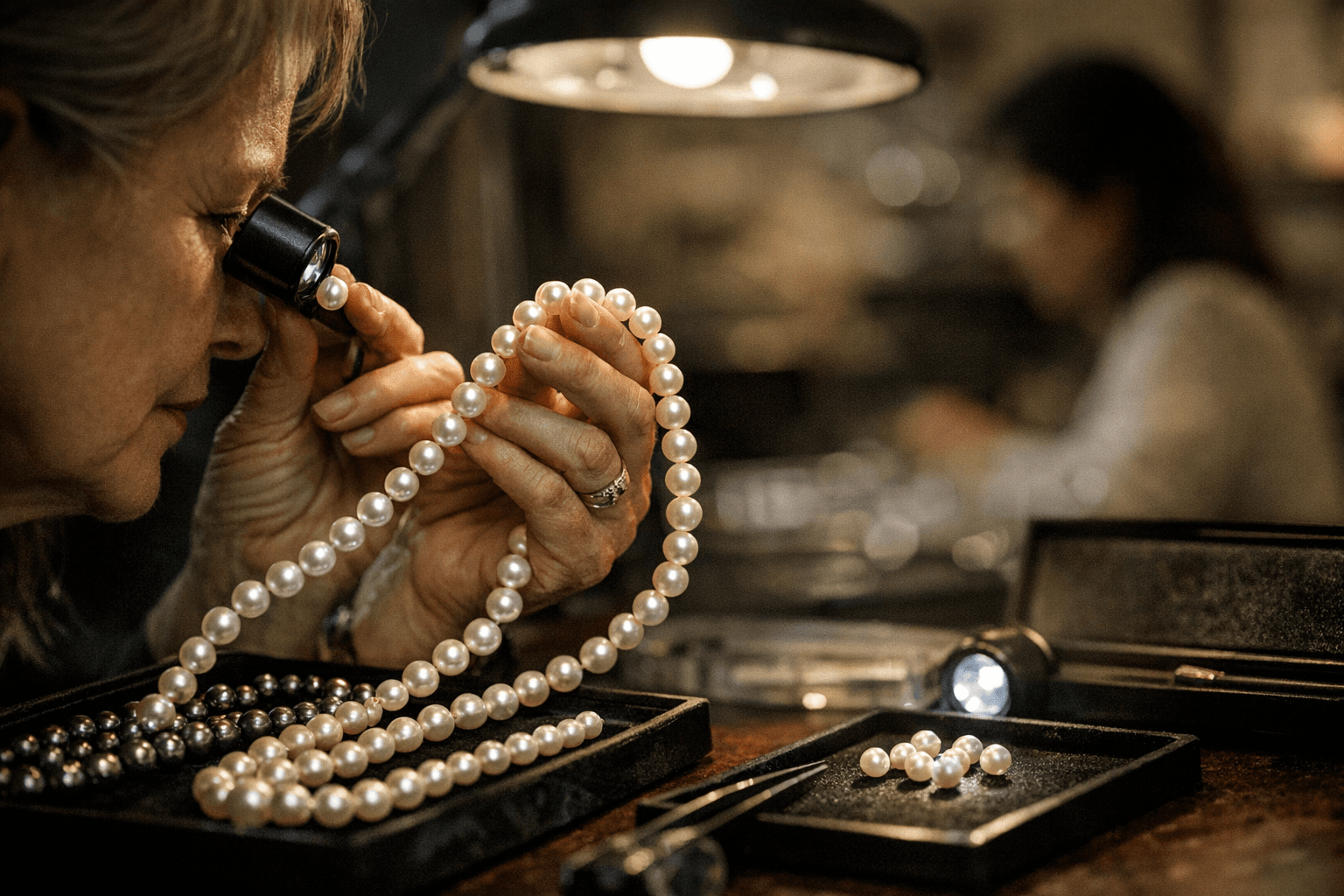
- Hold the strand under a strong light and study the reflections. High-luster pearls show clear, sharp mirror images of objects around them. Dull pearls show only a blurred glow.
- Gently rub a pearl against the edge of your tooth. Genuine pearls with normal nacre feel slightly gritty due to the crystalline surface structure. Glass or plastic imitations feel smooth. Note that very fine nacre on high-grade pearls can reduce this effect.
- Examine the drill holes closely. Thin or flaking nacre is most visible at the drill point, where it may appear as a dark line or show the bead nucleus beneath.
- Hold a strand at arm's length and check for uniformity in size, color, and luster from bead to bead. Strong matching is labor-intensive and a hallmark of quality.
Protecting Yourself as a Buyer
The pearl industry has no single universal grading standard. One seller's "AAA" may describe what another calls "AA," because the A-to-AAA scale is proprietary and applied differently by each retailer. Before purchasing, ask the seller to explain specifically what their grade means: what percentage of surface blemishes is acceptable, what luster threshold qualifies, and how nacre thickness is assessed. A seller who can answer those questions clearly is one worth trusting.
For any strand priced above a few thousand dollars, request an independent laboratory report. GIA offers pearl classification services and uses the same calibrated master sets across all its laboratory locations, producing results that are consistent and repeatable. That kind of third-party documentation confirms origin type, nacre characteristics, and whether any treatments such as dyeing or bleaching have been applied.
Always ask about the return policy before purchasing. Pearl quality is best evaluated in natural daylight, not under the warm spotlighting of a jewelry case, and a reputable seller will give you the opportunity to inspect your purchase in real-world conditions.
The pearl market rewards educated buyers. A strand with exceptional luster and 2 mm nacre at a modest size will outlast and outshine a larger but thin-nacre piece by decades. Once you know what you're looking at, the numbers on the price tag begin to tell a coherent story.
This article was produced by Prism’s automated news system from verified source data, official records, and press releases, then run through automated quality and moderation checks before publishing. The system is built and supervised by the people who set the standards it runs under. Read our full AI policy.
Did this article answer your question?