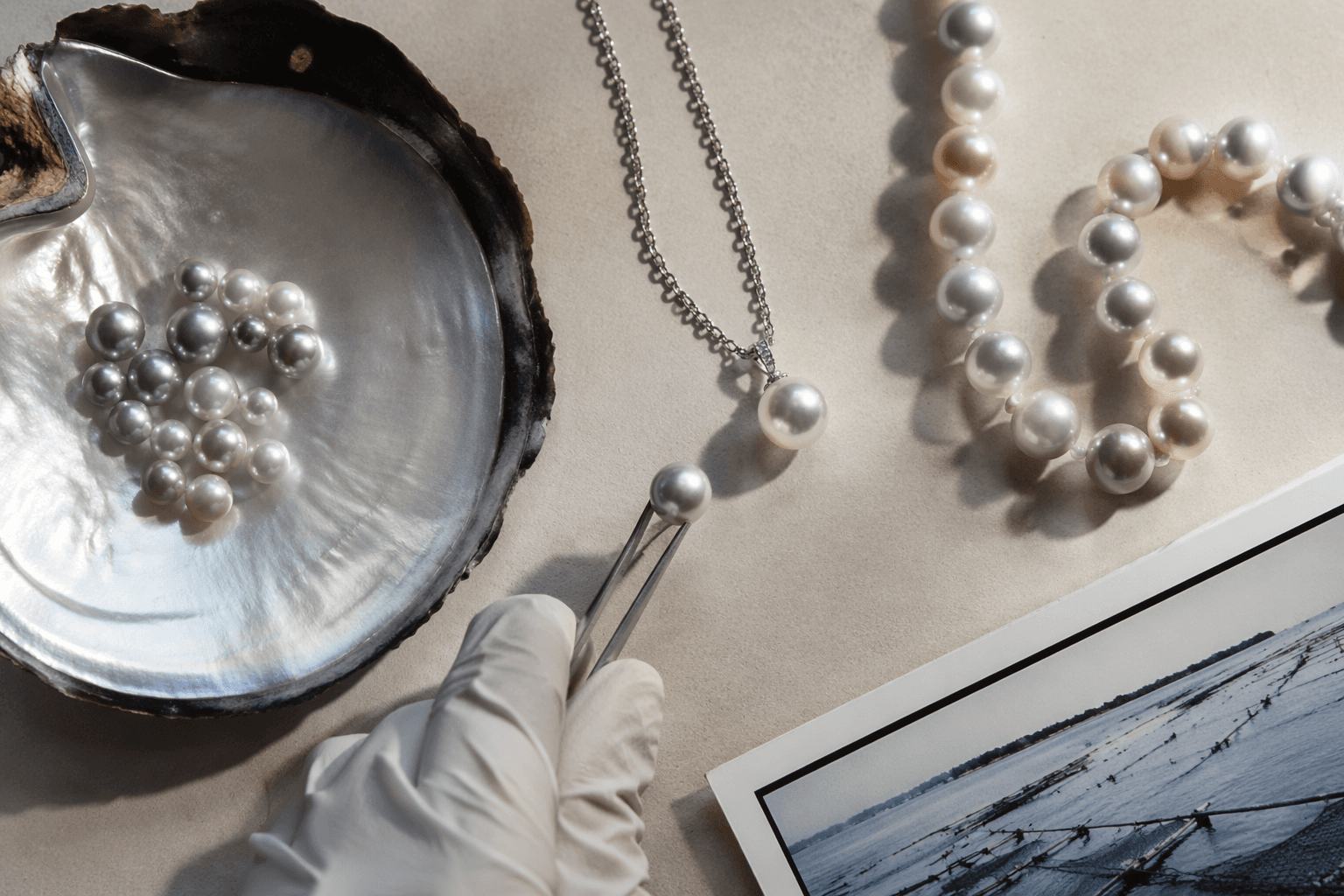
Upbeat prospects for pearls
Michael Sze of the Hong Kong Pearl Association maps 2026's sharpest demand shifts: Tahitian supply is tightening, freshwater is closing the quality gap, and buyers need a new checklist.
The GIA's 7 Pearl Value Factors, the industry's most authoritative grading framework, tell you exactly what separates a $250 freshwater strand from a $20,000 South Sea one: size, shape, color, luster, surface quality, nacre quality, and matching. Yet for most buyers standing before a jeweler's case, those criteria remain abstract. In 2026, they are anything but. Supply pressures, automation-driven shifts in quality control, and a generational change in who wears pearls, and why, have made this the most consequential pearl market in years to navigate before you spend.
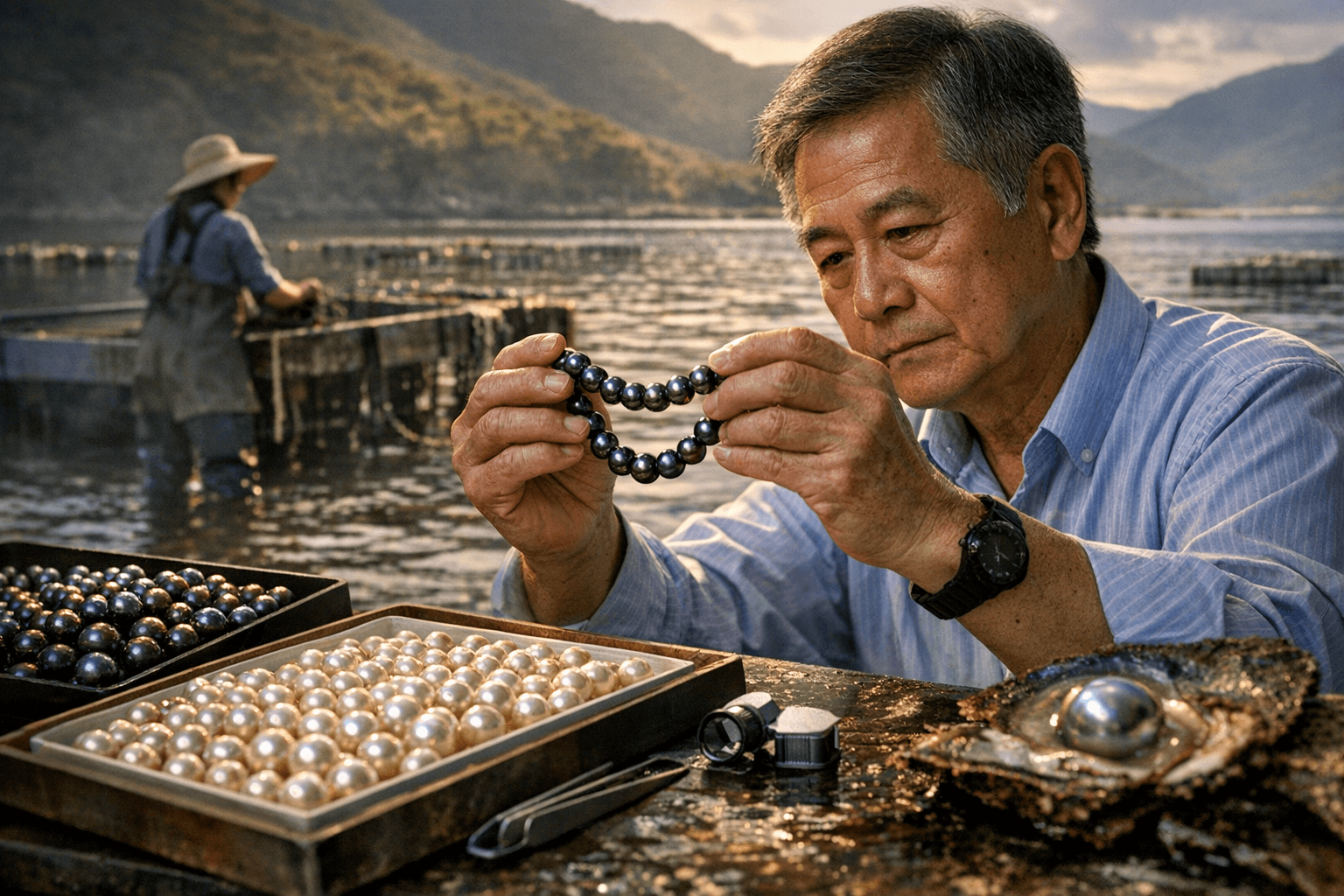
No one is better positioned to decode these conditions than Michael Sze, managing director of Hong Kong Heng Mei Group Ltd and president of the Hong Kong Pearl Association. Heng Mei operates across all four major pearl categories, freshwater, Tahitian, South Sea, and Akoya, with factories in mainland China employing over 800 workers. What Sze sees in 2026 is a market broadly upbeat but stratified in ways that matter at every price point.
Tahitian and Golden South Sea: Demand Is Outrunning Supply
The most immediate pressure is at the top tier. Tahitian pearls, valued for their naturally dark body colors ranging from deep charcoal to peacock green and aubergine overtones, are seeing renewed global demand that supply is struggling to match. Golden South Sea pearls, cultivated primarily in the Philippines and Indonesia by the Pinctada maxima oyster, face similar conditions. These are not theoretical market signals. They translate directly into constrained availability of top-grade matched strands, extended lead times for bespoke commissions, and upward price pressure at the finer end of both categories.
Tahitian pearls carry a built-in quality floor: French Polynesia requires a minimum nacre depth of 0.8mm per side before any pearl can be certified for export. That threshold means suspiciously cheap Tahitians arriving at retail should be treated as a warning, not a windfall. When Sze flags renewed global demand for these varieties, he is also, implicitly, signaling where price discipline matters most for buyers who want quality that lasts.
Freshwater's Quiet Ascent
Freshwater pearls have been closing the gap with saltwater varieties for years; in 2026, that story accelerates. Sze identifies improved quality and traceability as twin engines of steady freshwater growth. On the quality front, the development of beaded freshwater pearls grown over shell nuclei rather than tissue represents a significant commercial breakthrough. Where tissue-nucleated freshwater pearls tend toward oval or baroque forms, bead-nucleated specimens achieve the spherical geometry consumers associate with premium goods, and Chinese farms have become skilled at producing them in sizes from 5mm to 8mm and beyond.
The commercial significance is considerable. A nucleated freshwater strand now competes directly with Akoya pearls on roundness, whiteness, and luster, often at a fraction of the price. For buyers, the case for choosing Japanese Akoya over premium freshwater rests increasingly on provenance, certification, and the cultural weight that Japan's pearl tradition carries, not on purely visual grounds. That is a meaningful shift, and buyers who understand it are better equipped to assess whether they are paying for verified quality or for a label.
Traceability is becoming as important as price in this segment. Younger consumers who expect to know the origin of everything they wear are driving demand for freshwater pearls backed by clear farm-to-jeweler documentation. Suppliers who can provide that paperwork hold a competitive advantage, regardless of visual grade.
China's Automation Revolution and What It Means for Consistency
Sze's operational intelligence from China's processing floors points to automation as a structural change in how quality is achieved. Machines now handle both colour grading and drilling with a precision and throughput that manual processing cannot replicate at volume. Automated colour grading systems distinguish between subtle overtone differences, the distinction between a cream-white Akoya and a faintly rosé-overtone strand, for example, that affects retail price meaningfully and previously depended on the eye of an experienced sorter.
For buyers, this has a counterintuitive implication. Greater machine-driven consistency makes truly matched strands both more achievable and more expected, pushing the definition of premium upward at the high end. At the same time, automation compresses labor costs in mid-tier freshwater production, which should translate into better value in the $500 to $1,500 bracket. Buyers in that range stand to benefit most from 2026's factory-floor changes.
Sustainability as a Market Signal, Not a Marketing Badge
Pearl farming is, by its nature, among the most ecologically constructive forms of gem production: mollusks are filter feeders whose cultivation actively improves surrounding water quality. But the industry's environmental credentials have not always been legibly communicated to consumers. Sze points to growing buyer interest in sustainability as a differentiating factor, and 2026 marks a genuine turning point in this conversation.
China's government has spent years enforcing environmental regulations that dramatically curtailed freshwater pearl output in the mid-2010s, pushing farms toward fewer, higher-quality pearls cultivated in cleaner water. The result is a freshwater category that is, paradoxically, both more ecologically responsible and more premium than what preceded it. Buyers who ask about farm practices, water sourcing, and environmental compliance are not asking inconvenient questions. They are asking the ones that correlate most closely with product quality.
Who Wears Pearls Now: The Cultural Shift and the Design Divide
The pearl's transformation from heirloom staple to everyday fashion object is perhaps the most striking signal in Sze's 2026 assessment. What was once worn almost exclusively by women on formal occasions has become a statement piece across genders, styling contexts, and age groups. Sze identifies growing interest in gender-neutral pearl styling, a shift visible at retail in everything from oversized baroque Tahitian drops worn by men to layered freshwater chokers paired with streetwear.
This cultural broadening has produced a design divide with direct commercial consequences. Younger buyers favour minimalistic aesthetics: a thin gold bezel holding a single baroque pearl, or a deliberately mismatched pair of freshwater drops in contrasting sizes. The bezel setting, which encases the pearl's girdle in a continuous band of metal, suits this preference for architectural restraint far better than the traditional prong setting. High-end clients are moving in precisely the opposite direction, seeking bespoke commissions built around narrative: a golden South Sea pendant matched to a client's complexion, a strand incorporating a family heirloom clasp, or a Tahitian piece commissioned to document a specific moment in a life. Both impulses are commercially viable; what they require of jewelers, and buyers, is different.
Hong Kong's Role: Trade Infrastructure and the Greater Bay Area
Hong Kong remains the central hub for global pearl trading and distribution. Sze points to trade fairs and the Greater Bay Area's economic recovery as structural supports for Hong Kong's pearl sector in 2026. The city's role as a price-discovery mechanism for all four pearl categories means that the conditions Sze describes are not Hong Kong-specific forecasts; they are signals that propagate downstream to retail markets everywhere.
For buyers, a healthier Hong Kong trade environment translates into better-stocked inventories and more competitive wholesale pricing, particularly in the mid-tier freshwater and Akoya categories where the volume of goods moving through the city's channels is greatest.
Before You Buy: The Questions That Actually Matter
The intelligence Sze surfaces in 2026 distills into a practical checklist. Apply it at any price point.
- On origin and traceability:*
- Ask for country of origin, and for Tahitian pearls specifically, confirm French Polynesian certification. Akoya pearls from Japan should ideally note the growing region.
- Ask whether color is natural or treated. Freshwater pearls in vivid deep purples or metallic bronzes are sometimes dyed; natural color origin should be disclosed in writing.
- For South Sea pearls, clarify whether they are bead-nucleated or tissue-nucleated. Shell bead nucleation is standard for premium quality and produces rounder, more lustrous results.
- On grading consistency:*
- Ask which grading system the retailer uses and what tier you are being shown. GIA's 7 Pearl Value Factors provide the most standardized framework; A-AAA scales are widely used for Akoya and freshwater. Neither system is useful unless you can compare grades side by side at the same size.
- Evaluate luster under direct light. A mirror-sharp reflection indicates thick, well-formed nacre. A chalky, diffuse glow suggests thin nacre that will lose its surface finish over time.
- For any matched strand, ask to see it under both artificial and natural light. Overtone colors shift significantly between environments, and a golden South Sea strand that reads warm and luminous in a showroom may appear flat in daylight.
- On value at each price tier:*
- Under $500: Nucleated freshwater pearls offer the strongest optical quality per dollar. Expect near-round shapes, natural color variety, and improving consistency thanks to automation advances.
- $500 to $2,500: Akoya territory. Prioritize luster and matching uniformity over size. A 7mm matched Akoya strand with mirror-grade surfaces outperforms a 9mm strand with dull nacre at any price.
- Above $2,500: Tahitian and South Sea pearls reward patience and natural light. Never purchase a matched South Sea strand without seeing it against your skin. The pearl that sells itself in a display case may look entirely different as jewelry.
The pearl market of 2026 is not simply rising; it is reorganizing. Understanding where the supply pressure is, where the quality floor has shifted, and what a price actually signifies at each tier is the difference between buying well and buying twice.
This article was produced by Prism’s automated news system from verified source data, official records, and press releases, then run through automated quality and moderation checks before publishing. The system is built and supervised by the people who set the standards it runs under. Read our full AI policy.
Did this article answer your question?