How to Tell Real Pearls From Fakes: A Practical Buyer's Guide
Fake pearl listings are flooding online marketplaces and social commerce — run these five damage-safe home tests before your return window closes.
The Counterfeit Moment Nobody Warned You About
Before you clasp that new strand around your neck, consider this: estimates in the pearl trade suggest that as many as 70% of pearls sold online fail basic authenticity tests. Whether you bought from a marketplace listing, a social commerce drop, or a live "pearl party" on TikTok, the risk of receiving a plastic or glass imitation in a velvet pouch is higher right now than at any point in recent memory. The surge in social commerce, where viral aesthetics drive impulse purchases and returns are an afterthought, has made it easier than ever to sell convincing fakes to buyers who have no frame of reference for what a real pearl actually feels like.
Certified gemologists have specialized equipment that can definitively verify whether pearls are real or fake. But you don't always have time to book an appointment before a 30-day return window closes. What you can do is run a systematic, damage-safe authentication flow at home, one that takes roughly five minutes and requires nothing more than a loupe, good lighting, and your front teeth.
Your 5-Minute At-Home Authentication Flow
Work through these steps in order. Each one adds a layer of certainty. No single test is definitive on its own; together, they build a picture.
Step 1: The Surface and Luster Check
Hold the pearls under a lamp and rotate them slowly. Real pearls show complex, layered luster and depth, while imitation coatings look flat or plasticky under angled light. What you're looking for is orient, the subtle play of iridescent color beneath the surface that comes from light refracting through stacked layers of aragonite crystals. A glass bead painted with essence d'orient (a lacquer made from fish scales) can mimic surface shine, but it cannot replicate that inner glow. If the sheen looks painted on rather than emanating from within, treat it as a flag.
Real pearls also show minor irregularities. Slight variations in surface texture, tiny ridges, or barely-there blemishes are signs of organic formation. Flawless uniformity across an entire strand is itself suspicious.
Step 2: The Tooth Test
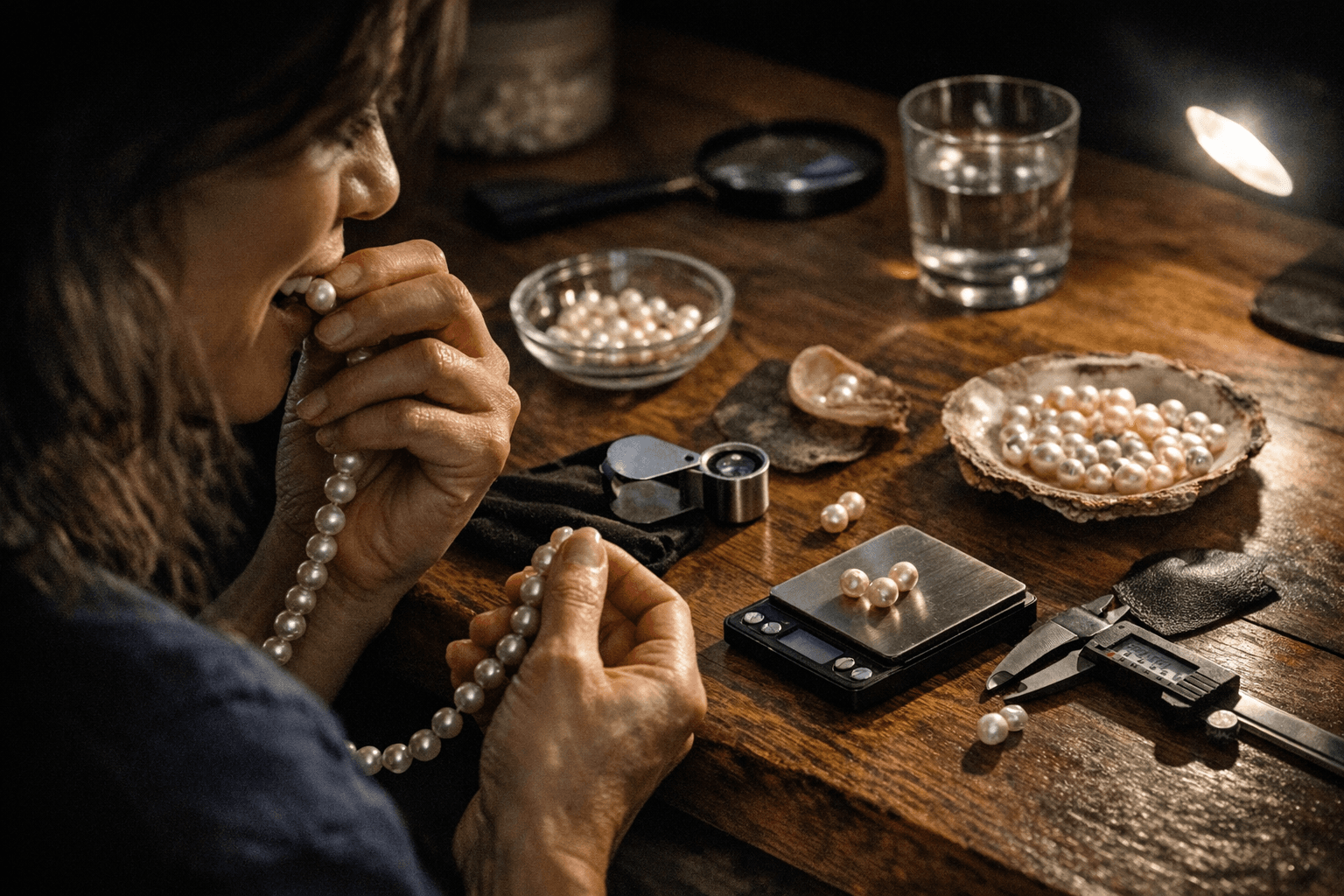
This is the test most buyers have heard of, and it works. Gently rub the pearl against the biting edge of your front tooth. A real pearl will feel slightly gritty, like sandpaper, because of the aragonite crystals in its nacre layers, while a fake pearl will feel smooth or glassy. Kevin Canning, founder of pearl specialist retailer Pearls of Joy, is direct about the threshold: "If you don't feel a noticeable gritty texture, they aren't real pearls."
Apply only the lightest pressure. You are not trying to damage the nacre; you're simply detecting surface texture. A smooth, frictionless glide against enamel is a near-certain sign of plastic or coated glass.
Step 3: Weight and Temperature
Pick the strand up and hold it in your palm for ten seconds, then set it down and lift it again. Real pearls are denser than imitations and feel briefly cool to the touch, while fakes warm immediately. The density of nacre gives a genuine strand a satisfying, substantive weight. Plastic beads, even well-made ones, feel hollow by comparison. If the pearls warm to body temperature almost instantly, the material is almost certainly synthetic.
Step 4: The Drill Hole Inspection
Use a jeweler's loupe (10x magnification is sufficient) and examine any drill holes closely. Natural and cultured pearls show nacre build-up and concentric layering around drill holes, while glass or plastic beads often reveal flaking or a perfectly uniform core. In a genuine pearl, the nacre layers are visible in cross-section at the drill site, sometimes described as looking like the rings of a cut tree trunk. In a coated bead, you may see the lacquer or resin peeling back from a smooth, featureless interior. Crisp edges, very fine chipping, and visible internal layers signal real pearls, while fakes may show dye build-up or a melted plastic appearance around the drill hole.
Step 5: Size, Shape, and the Rarity Logic Test
Apply some market knowledge before you move on. Perfectly matched, large, flawlessly round pearls are genuinely rare and command significant premium prices. A truly reliable report from an independent gemological lab such as GIA, AGS, IGI, or SSEF will include a unique report number you can verify on their website, detailed measurements covering size, shape, surface grade, and nacre thickness, as well as the lab's official seal and signatures. If a listing offers a strand of 9mm perfectly spherical South Sea pearls at a price that seems too good, it probably is. Akoya pearls in the 7–8mm range, Tahitians with clean surfaces and strong orient, and South Sea pearls above 12mm are all subject to significant natural scarcity. A price that ignores that scarcity is a red flag in itself.
Provenance and Paperwork
Once your at-home tests are complete, turn your attention to documentation. For any strand described as South Sea, Tahitian, or, critically, natural (meaning formed without human nucleation), ask the seller for origin and traceability data. For high-value pieces, request harvest and traceability data along with any existing lab reports. A certificate printed by the retailer on their own letterhead is not the same as a third-party lab report. A genuine lab report from GIA includes classification across what the organization calls the GIA 7 Pearl Value Factors: size, shape, color, nacre, luster, surface, and matching. That's a specific, standardized vocabulary, and a document that lacks it is worth scrutinizing.
GIA uses real-time microradiography equipment to measure nacre thickness of bead-cultured pearls when nacre appears thin or when requested by the client, and loose pearls requiring more detailed analysis may be assessed using computed micro-tomography. That level of technical rigor is what separates a genuine lab report from a seller's printout.
When to Stop DIYing and Call in a Professional
The at-home tests above are sufficient for ruling out obvious fakes. They are not sufficient for high-stakes decisions. Use this framework to decide when a professional appraisal is non-negotiable:
- Any strand described as "natural pearl": Natural pearls, formed without human nucleation, are extraordinarily rare and can be worth tens of thousands of dollars per strand. Only X-ray or micro-CT imaging can distinguish a natural pearl from a cultured one. No tooth test can do that.
- South Sea or Tahitian strands above $1,000: At this price point, secure an independent lab report from GIA, SSEF, or an equivalent institution that details size, nacre thickness, treatments, and origin. SSEF, the Swiss Gemmological Institute in Basel, is particularly respected for its natural pearl origin work.
- Inherited or estate pieces: Heirlooms may predate the modern cultured pearl market (roughly pre-1920s), which makes natural pearl status genuinely possible and genuinely consequential for insurance and estate purposes.
- Any listing that makes origin claims (Hanadama Akoya, Burmese natural, Australian South Sea) without supporting paperwork: Origin claims dramatically affect value, and they are easy to fabricate in a listing title.
The broader landscape of online pearl sales is not going to get less complicated. Social commerce platforms have made it trivially easy to list gemstone jewelry with professional photography and no accountability for material claims. The best protection is not skepticism alone; it's a systematic approach. Run the five steps above before your return window closes. If anything fails, or if the piece is valuable enough to matter financially, don't rely on instinct. A GIA Pearl Identification Report or SSEF evaluation is an investment in certainty, and for a strand that could anchor a collection or an estate, certainty is the only standard worth accepting.
This article was produced by Prism’s automated news system from verified source data, official records, and press releases, then run through automated quality and moderation checks before publishing. The system is built and supervised by the people who set the standards it runs under. Read our full AI policy.
Did this article answer your question?