JAPANESE AKOYA PEARLS – THE 2026 MOST COVETED NATURAL ASSET
Akoya pearl prices have reportedly doubled since 2023 as mass oyster mortality and warming Ago Bay waters shrink Japan's highest-grade supply to half of normal.
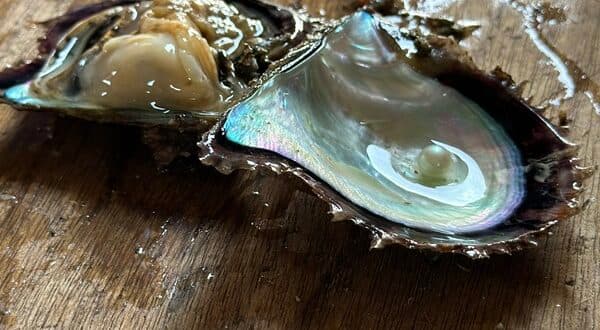
The sorting floors of Kobe tell the story plainly. Under calibrated light in the grading rooms where Japan Pearl Exporters' Association-affiliated houses assess and price their inventory, handlers are working with fewer high-grade Akoya pearls than at any point in recent memory — and charging considerably more for every one. In some top-tier categories, prices have reportedly doubled since 2023, a trajectory supported by JPEA export data showing value growth that has materially outpaced volume since the post-COVID recovery began.
The compression is biological and demographic in equal measure. Pearl farmers across Japan's major cultivation regions are contending with mass mortality events in the oyster beds, driven by an infectious agent that researchers have not yet identified. Disease pressure alone has pushed current production to roughly half of normal levels. Compounding the die-offs, warming seas are disrupting nacre deposition — the layering process that produces the Akoya's signature high-lustre surface. The Japan Meteorological Agency recorded sea surface temperatures running 2.59 degrees Celsius above normal, and summer readings in Ago Bay, Mie prefecture, have reached 30 degrees Celsius, well above the range in which Pinctada fucata performs optimally. When the animal is thermally stressed, nacre layers thin and lustre degrades, which is precisely the quality that separates a Hanadama-grade strand from a commodity one.
The shortfall lands hardest at the top of the quality spectrum. Supply of 8mm-plus rounds meeting Hanadama classification, the highest designation under the GIA Pearl Description System for Japanese Akoya lustre and surface quality, has grown particularly acute. These are the stones that luxury houses source for signature collections and that private collectors treat as benchmark acquisitions.
Demographic pressure amplifies the biological problem. Nucleation, the surgical insertion at the heart of cultured pearl production, requires a level of manual precision built through decades of practice. The workforce performing it is ageing rapidly across Mie and Ehime prefectures, where family-run farms have operated for more than a century without identifying qualified successors. Farm closures reduce not only current output but also future capacity, since the mollusk requires approximately two years from spat stage to the point of nucleation readiness.
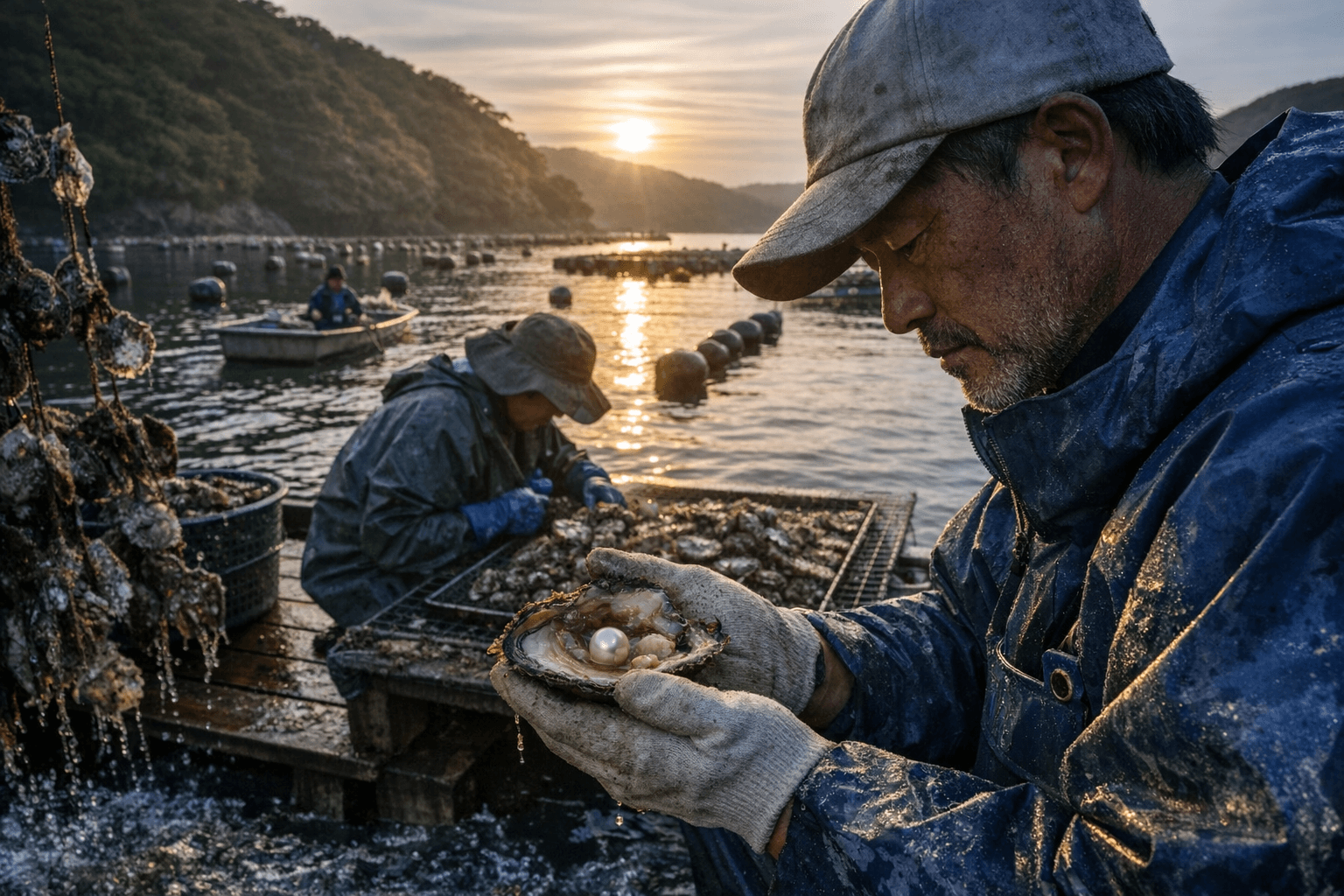
Demand, meanwhile, is running hard from two directions simultaneously. Chinese buyers, primarily operating through Hong Kong, have accounted for 81 percent of recent Japanese Akoya exports. Western collectors and luxury house buyers are also increasing positions, drawn by the supply narrative and by Akoya's standing as the most technically demanding of all cultured pearl categories. JPEA figures show export values climbing above their COVID-era lows even as unit volumes remain suppressed, confirming that the market is pricing in scarcity rather than simply recovering from a disruption.
The JPEA briefing that frames this market moment argues for a fundamental reorientation: Akoya should be understood not as a jewelry commodity but as a scarce, documentable natural asset. Kobe, as the global nerve centre for Akoya selection, processing, and grading, remains where that reclassification is either accepted or resisted — one calibrated pearl at a time. At harvest auctions in recent seasons, multiples reached between 180 and 200 percent above baseline in 2023 before settling to 140 percent in 2024, still dramatically above pre-shortage norms. For buyers and inventory managers who have not yet adjusted their sourcing assumptions, the 8mm Hanadama round is an object lesson in what happens when biological fragility, climate disruption, and generational transition converge in a single supply chain.
This article was produced by Prism’s automated news system from verified source data, official records, and press releases, then run through automated quality and moderation checks before publishing. The system is built and supervised by the people who set the standards it runs under. Read our full AI policy.
Did this article answer your question?