Kate Middleton Dazzles in First Tiara Appearance of 2026 at Nigerian State Banquet
Queen Mary's Lover's Knot Tiara, with its 19 arches and 28 pearl drops, opened 2026 in diamonds and emerald green at Windsor Castle's first Nigerian state banquet in 37 years.
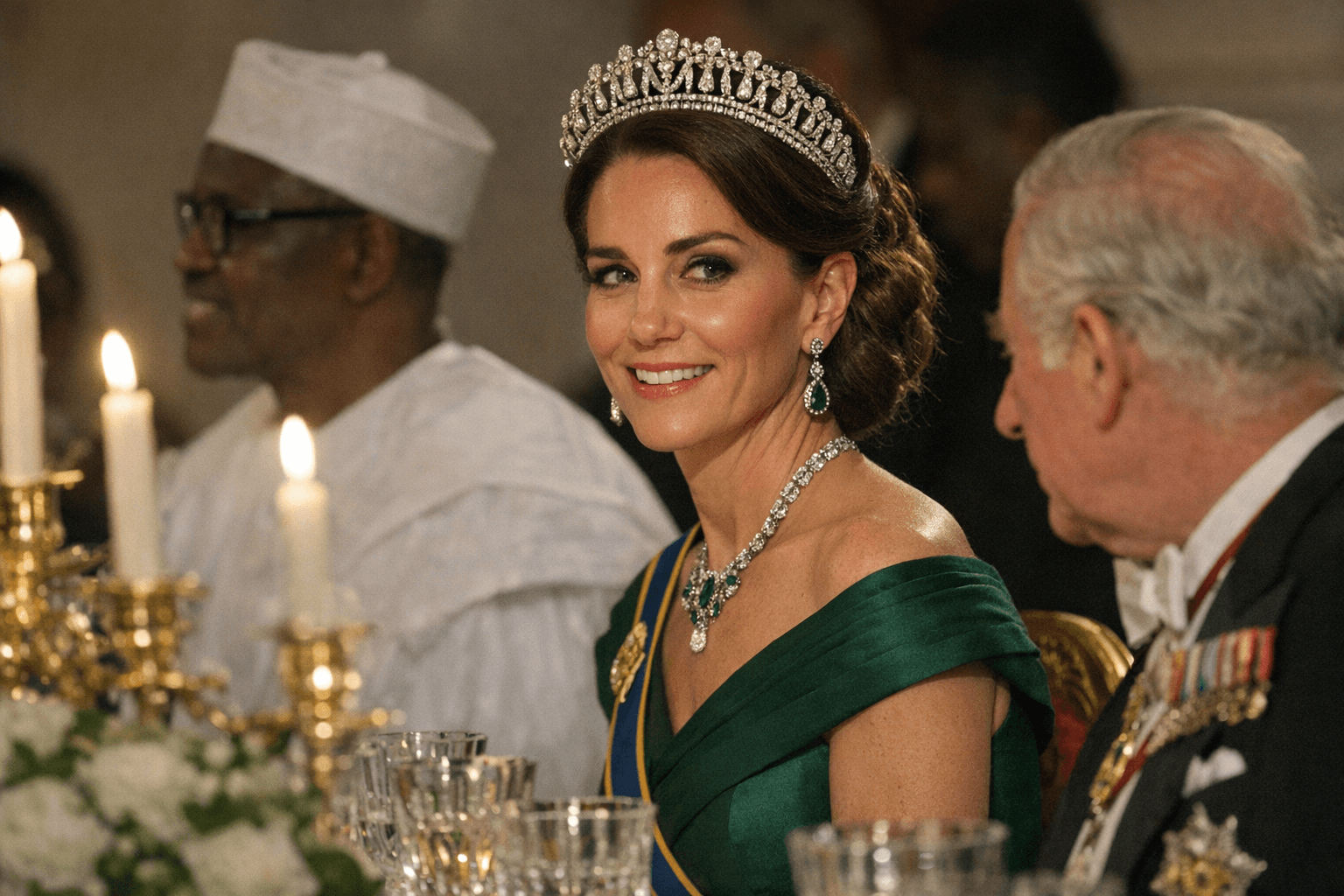
Queen Mary's Lover's Knot Tiara has been many things across its century of royal life: a commission by Queen Mary from Garrard using pearls and diamonds from her own family collection, a go-to of Princess Diana's throughout the 1980s, and now, undeniably, the signature crown of Catherine, Princess of Wales. At Windsor Castle on March 18, Kate re-wore the piece as she accompanied Prince William to a state banquet for Nigerian President Bola Ahmed Tinubu and his wife, Oluremi Tinubu. It was her first tiara outing of 2026.
The occasion was the first state visit to the UK by a leader of the west African nation in 37 years, and also the first incoming state visit by a Muslim leader during Ramadan in almost a century. The glittering state banquet was held in St George's Hall at Windsor Castle, attended by Queen Camilla and the Prince and Princess of Wales. Windsor Castle has hosted many of the recent state visits to the UK because Buckingham Palace is currently undergoing renovations.
The jewelry was immaculate in its layering. The Lover's Knot tiara features 19 arches and 28 drop-shaped pearls, its diamond-studded framework catching the candlelight of St George's Hall from every angle. Harper's Bazaar described Kate as "a vision in the gleaming diamond-and-pearl crown," which she coordinated with her Greville sapphire-and-diamond fringe drop earrings and a glittery gold clutch. The earrings hail from a suite that once belonged to Queen Elizabeth II's mother, the Queen Mother. Her blue sash carried her royal orders, including King Charles' Royal Family Order, a badge featuring the monarch's portrait, and the Royal Victorian Order sash and star.
The gown itself was a high-necked design by Andrew Gn in a shade of green that evoked the Nigerian flag, whose design is three stripes in a pattern of green and white. Kate kept the green theme with embellished Manolo Blahnik Hangisi pumps, completing the look with a sparkling Jenny Packham clutch and her hair down in long waves. Earlier that same Wednesday, Kate had already signaled her sartorial diplomacy when she wore an 80s-inspired gray coat by British-Nigerian designer Tolu Coker.
Though the Lover's Knot tiara is known to be a favorite of Princess Diana's, it also appears to be one of Kate's tried and true accessories; she has worn the diadem over a dozen times since debuting it in 2015. She wore it twice in 2025 alone, for the state banquets honoring the U.S. and French presidents' visits. Her third tiara moment that year came in December, when she wore her biggest tiara to date, Queen Victoria's Oriental Circlet Tiara, at the German state banquet. That choice carried its own diplomatic logic: the tiara was crafted in 1853 for Queen Victoria under the direction of her husband, Prince Albert, who hailed from Germany.
Two months after she dusted off that crown following 20 years in storage, the Oriental Circlet's own story deepened: commissioned by Prince Albert in 1853 and originally set with 2,600 diamonds and more than a dozen opals, the opals were replaced with rubies in 1901 by Victoria's daughter-in-law Queen Alexandra due to superstitions surrounding the milky white gemstones, according to its designer Garrard and Co.
The Lover's Knot, by contrast, needs no revision. Made for Queen Mary by the House of Garrard in 1914 using pearls and diamonds from her family collection, the piece was inspired by Queen Mary's grandmother, Princess Augusta of Hesse, who owned the original Cambridge Lover's Knot. That lineage, from a Hessian duchess to Princess Diana to the current Princess of Wales, is precisely the kind of provenance that makes a piece of jewelry more than ornament. At a banquet marking the first Nigerian state visit to Windsor Castle, it was also, like the emerald dress, a statement made in full view of history.
This article was produced by Prism’s automated news system from verified source data, official records, and press releases, then run through automated quality and moderation checks before publishing. The system is built and supervised by the people who set the standards it runs under. Read our full AI policy.
Did this article answer your question?