Los Angeles pearl seller turns livestreaming into sales engine
Pearls are becoming livestream stars because buyers want to judge luster, size and value in real time before they click. Pearl Paradise has turned that need into a repeatable sales ritual.

From its Los Angeles studio, Pearl Paradise tilts pearl strands into the light on livestream, compares sizes against a hand, and answers questions about color, sheen and value while the piece is in motion. Pearls can look fully formed in a still image and still leave buyers guessing; on live video, that uncertainty becomes an asset. Live video has become less a marketing flourish than a working sales channel.
Why pearls sell especially well on live video
Pearls ask for explanation in a way a diamond solitaire usually does not. Luster changes with movement, surface quality matters at close range, and subtle shifts in tone can disappear in a product photo, which is why real-time demonstrations matter so much for this category. Shoppers want to see how a necklace reads on skin, how big a pearl actually looks once it leaves the catalog page, and whether the price reflects the material in front of them.
That is where livestreaming solves a jewelry problem rather than simply creating entertainment. Live video commerce can turn a transaction that often stalls at a low online conversion rate into something far more persuasive, because the seller is doing two jobs at once: showing the jewel and teaching the buyer how to evaluate it. Immerss says live video commerce can move jewelry e-commerce from 1.46% conversion to double-digit conversion rates.
The format also compresses the old counter-service ritual into a screen-based version of trust. Audience questions replace the in-store back-and-forth, and urgency comes from the live moment itself, where a strand can be discussed, reserved or sold before the viewer leaves the stream.
How Pearl Paradise uses the camera as a storefront
Most of Pearl Paradise’s livestream broadcasts come from its studio, giving the brand a stable base for recurring education and product demos. It also takes viewers on the road to pearl farms and international trade shows in Japan and Hong Kong, which adds another layer: provenance. A pearl looks different once a viewer sees where it comes from, how it is presented in a farming or trade-show setting, and who is handling it.
That combination of studio control and field footage makes the merchandise feel less abstract. A pearl strand is not only a finished object, but part of a chain that includes cultivation, grading, selection and styling. Pearl Paradise’s livestream events page shows the company regularly uses live events as part of its sales and education strategy.
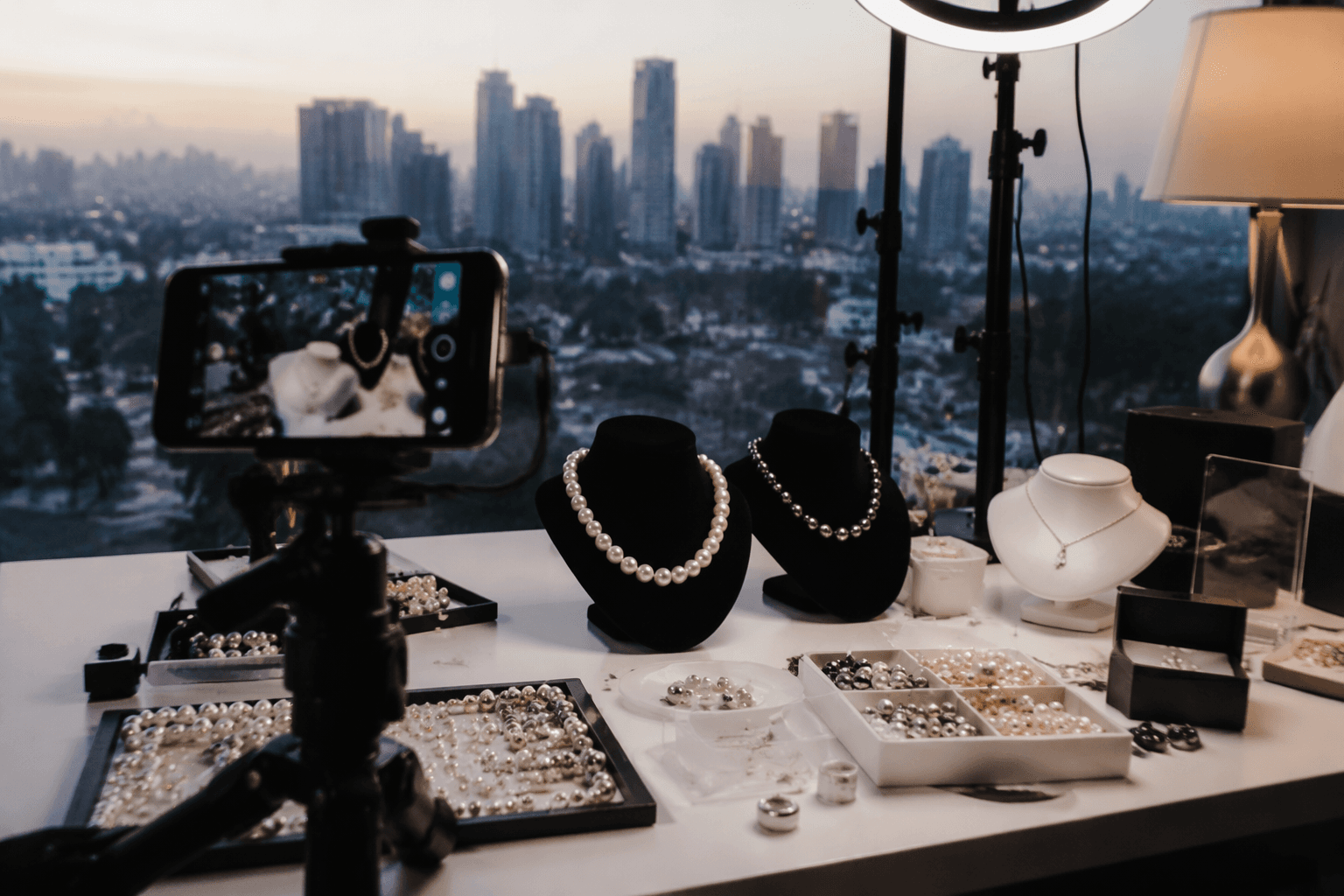
Pearls are often purchased on nuance rather than spectacle, so the seller who can repeatedly explain those nuances has an advantage over the seller who only posts polished stills. The brand also maintains a press page.
Pearls are being worn differently, too
The sales model works because the style story has shifted as well. JCK’s June 26, 2023 post, Pearls for Every Day (and Everyone), framed pearls not as formal dress jewelry, but as something that can sit comfortably in daily rotation. That repositioning matters for live commerce because the viewer is not imagining a single special occasion. The pearl can be shown with a T-shirt, a blazer or a simple neckline, and the argument becomes one of versatility rather than ceremony.
That broadened styling range also sharpens the livestream demo. When a presenter shows a strand at different lengths or demonstrates how a pearl pendant reads against the body, the piece stops feeling like an heirloom locked away for best and starts feeling current.
A model with numbers behind it
The appeal is not confined to one Los Angeles seller. In 2021, Business Insider estimated livestream shopping as a potential $6 billion U.S. market. Jewelry is especially well suited to the format because the purchase depends on visual confidence, and confidence tends to build when the seller can answer objections in real time.
Pearl jewellers in China and the United States are using livestreaming and e-commerce to drive revenue. JewelleryNet has tracked the same shift. Harvard Business School’s 2025 working paper, *Incumbent’s Advantage via Expertise Asymmetry: Revitalization of the Chinese Pearl Industry with Livestreaming*, ties livestreaming to the revival of the Chinese pearl industry.
This article was produced by Prism’s automated news system from verified source data, official records, and press releases, then run through automated quality and moderation checks before publishing. The system is built and supervised by the people who set the standards it runs under. Read our full AI policy.
Did this article answer your question?