Pearls from ancient luxury to cultured icons of modern jewelry
Cultured pearls changed pearls from a ruler’s rarity into a jewelry category people could actually wear, without erasing the centuries of status and symbolism behind them.
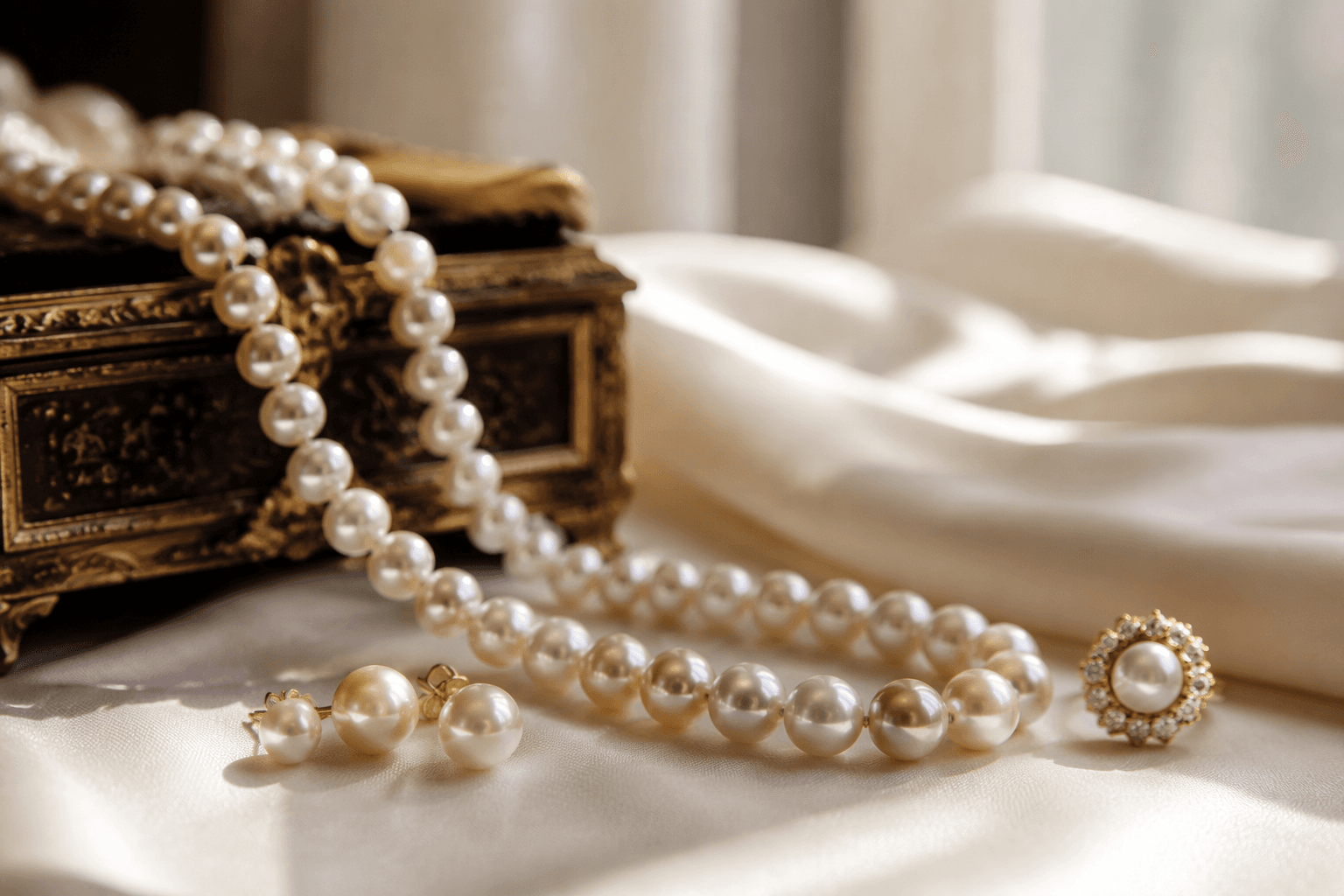
Pearls have one of the longest paper trails in jewelry: a Chinese historian recorded natural pearls in 2206 BC, and for centuries they sat at the center of royal wardrobes across Asia, Europe, and the Middle East. The decisive break came when cultured pearls emerged in Japan, turning a gem once governed by chance into something modern buyers could actually buy, wear, and collect without losing its prestige.
The ancient language of pearls
Pearls were never merely decorative. GIA’s history and lore material describes them as symbols of wealth and status for thousands of years, which is why they appear so early in written records and so often in the visual culture of power. Their appeal was social as much as aesthetic: a pearl signaled rank, access, and refinement long before it became a retail category.
Classical history gave pearls some of their most durable legends. GIA connects them to Cleopatra-era lore, Roman pearl jewelry, and the story of Cleopatra VII and Mark Antony, while Pliny the Elder’s account of Cleopatra and the pearl banquet keeps returning in scholarship and popular retellings because it captures pearl excess in a single scene. By the medieval period, pearls had taken on lives beyond adornment, circulating as symbols and as objects with supposed medicinal uses, evidence of how deeply they were folded into court culture, religion, and elite dress.
The Victoria and Albert Museum frames that breadth well in its pearl history film, which begins around 1,000 BC and moves through Antiquity, the Middle Ages, the Renaissance, the Victorian era, the Jazz Age, Chinese and Indian history, and Mikimoto’s cultured pearls. That sweep matters because pearls have always been more than a style note. They have been a measure of status, a material for ceremony, and a shorthand for polished restraint.
The pearl rush of the New World
The Renaissance changed both the scale and the politics of pearl wealth. Around 1500, Spanish explorers’ discoveries of pearls, gold, and spices in the New World helped drive Spain’s expansion, and the Pearl Coast in what is now eastern Venezuela, along with nearby offshore islands, became a major source of wealth. Pearl extraction in Venezuela and neighboring waters played a central role in early Spanish colonial fortunes, which is why pearls belong as much to economic history as they do to the jewelry box.
That wealth came with a brutal infrastructure. Historical scholarship on the Spanish colonial period describes pearl-fishery exploitation in terms of labor, diving methods and equipment, taxes, and production, showing how the trade was organized around extraction rather than romance. Even the language remembers this period: Smithsonian Ocean links the English word baroque to a Spanish term used in the New World pearl trade for an irregular pearl shape, a reminder that the vocabulary of pearls still carries the imprint of colonial commerce and value-making.
European portraiture and court dress absorbed that abundance quickly. Pearl necklaces, pendants, and ornaments became visible markers of power because they carried both rarity and global reach. A pearl from the Americas could end up on a European sovereign, and the material’s journey was part of its meaning.
Mikimoto and the cultured-pearl revolution
The modern pearl story turns on Kokichi Mikimoto. GIA’s historical reading list says he began experiments around 1890 in Ago Bay, Japan, first produced cultured pearls in 1893, and produced round cultured pearls in 1905. GIA’s history of cultured pearls adds that round cultured pearls appeared on the market for the first time in 1921, after Mikimoto continued refining the seeding process.
That sequence altered pearls more profoundly than any stylistic shift ever could. Before 1893, only naturally occurring pearls existed, so the market was constrained by chance, labor, and sheer scarcity. With culturing, pearls remained precious but became reproducible enough to move from the domain of the ultra-elite into a broader jewelry market, while roundness, matching, and consistency made them easier to design with and easier to sell.
The Japan Patent Office identifies Kokichi Mikimoto as the originator of cultured pearls, and the Victoria and Albert Museum treats his work as revolutionary in the context of pearl history. That is the crucial pivot: cultured pearls did not make pearls ordinary. They made their beauty legible at a different scale, preserving the pearl’s aura while changing who could own it and how often it could be worn.
Why pearls keep returning
Pearls still resonate because they are anchored in a story that runs from ancient record to modern technique. Few gems can claim a written mention as early as 2206 BC, a place in Cleopatra lore, a role in Spanish colonial wealth, and a technical breakthrough that reshaped the jewelry market in the 20th century. That continuity gives pearls a kind of authority that does not depend on trend cycles.
It also explains why pearls keep reading as relevant when fashion swings back toward heritage, authenticity, and craftsmanship. A pearl strand or pair of drops carries visible evidence of lineage: ancient prestige, colonial history, and Japanese innovation all sit inside the same material. Pearls endure because they were never just beautiful objects. They were, and remain, objects with history built into their luster.
This article was produced by Prism’s automated news system from verified source data, official records, and press releases, then run through automated quality and moderation checks before publishing. The system is built and supervised by the people who set the standards it runs under. Read our full AI policy.
Did this article answer your question?