Modern Pearl Styling: Mixing Shapes, Metals, and Types for Today's Look
Pearls have shed their grandmother's-jewelry-box reputation; the real question now is which shape, type, and metal pairing unlocks the look you actually want.

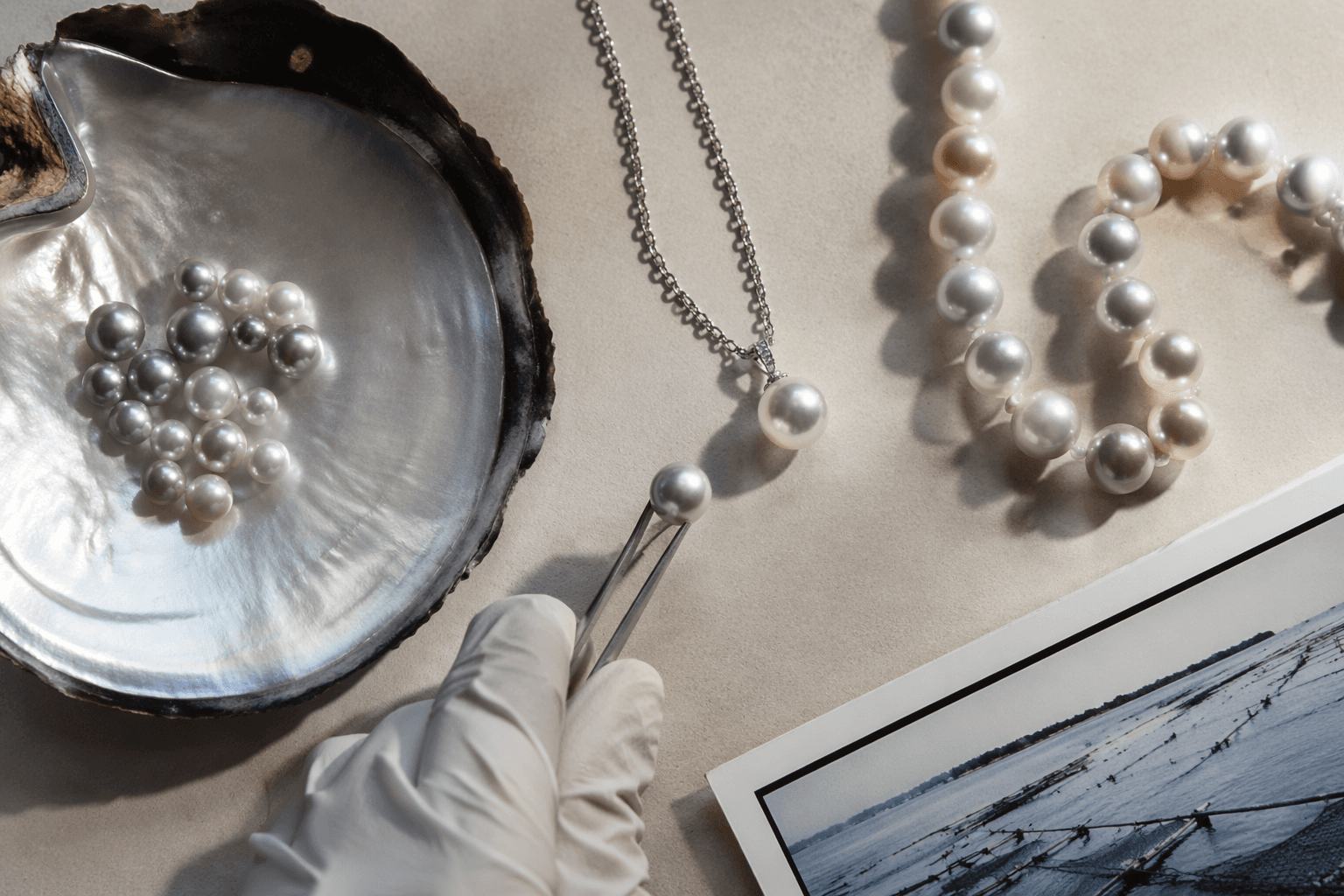
Pearls are having a moment that feels less like a revival and more like a permanent reappraisal. The stiff single strand, worn with a twinset and sensible shoes, has given way to something far more interesting: baroque drops layered over chunky chains, asymmetric ear stacks mixing Akoya studs with Tahitian dangles, South Sea spheres set in oxidized silver alongside yellow gold. The vocabulary of pearl dressing has expanded, and understanding the raw materials, literally the types of pearls themselves, is the best place to start.
Round vs. Baroque: Choosing Your Shape
The round pearl is what most people picture when they think of the category: perfectly spherical, uniform, and luminous. Akoya pearls, cultivated primarily in Japan, are the archetype. They typically range from 6mm to 9mm, and their defining quality is a sharp, almost mirror-like luster that catches light with unusual precision. A classic Akoya strand delivers exactly that crisp, high-contrast glow. For a more formal or architectural look, round pearls in matched sets reward the eye with their symmetry.
Baroque pearls are the opposite proposition. Irregular, freeform, and entirely non-uniform, they suit a sensibility that finds beauty in variation. No two baroque pearls are identical, which is precisely the point. Freshwater pearls, grown in mussels in China, produce baroque shapes abundantly and at accessible price points, making them the natural starting place for anyone experimenting with the looser, more sculptural end of pearl styling. Their surfaces often show ripples, ridges, or elongated forms that look striking when clustered together or hung as a single asymmetric drop.
Understanding the Four Main Pearl Types
Before mixing pearl types in a single look, it helps to understand what distinguishes them.
- Akoya: Japanese saltwater pearls, typically 6-9mm, valued for exceptional roundness and intense luster. White and cream are standard; silver-pink overtones are prized.
- Freshwater: Chinese cultured pearls grown in freshwater mussels. They come in the widest range of shapes, from near-round to deeply baroque, and in natural pastel tones including white, lavender, and peach. Generally the most accessible price point.
- South Sea: Grown in the large Pinctada maxima oyster in waters off Australia, Indonesia, and the Philippines, South Sea pearls are the giants of the category, ranging from 9mm to 20mm. Their satiny luster differs from Akoya's sharp reflectivity; it is deeper, more diffuse. White and golden South Sea pearls are both produced, with gold South Sea among the rarest and most valuable of any pearl type.
- Tahitian: Cultivated in the black-lipped Pinctada margaritifera oyster in French Polynesia, Tahitian pearls are the only naturally dark pearls. Their color range is extraordinary: green, peacock, aubergine, silver, and deep charcoal all occur naturally without treatment. They run 8mm to 18mm and carry a moody, dramatic quality that makes them particularly compelling in contemporary mixed-metal settings.
Mixing Pearl Types: The Layering Logic
The most interesting pearl dressing happening right now involves combining these types in a single look rather than wearing matched sets. The key is understanding contrast. Pairing the sharp white luster of Akoya studs with the dark iridescence of a Tahitian pendant creates a tonal conversation that a monochromatic strand cannot. Freshwater baroque shapes layered with round South Sea pearls play with scale and form simultaneously.
When layering pearl necklaces, consider varying length aggressively: a short Akoya strand at the collarbone reads very differently when a longer freshwater baroque rope falls below it. Three to four inches of separation between layers keeps each piece visible. Mixing pearl sizes within a single necklace, small freshwater rounds graduating toward a large South Sea center, is a more formal version of the same instinct.
The Mixed Metal Question
For years, pearls were almost exclusively set in yellow gold or silver, each carrying its own social coding. Yellow gold with Akoya pearls meant a certain kind of dressed-up occasion. Sterling silver with darker pearls suggested something cooler, more downtown. Contemporary pearl styling refuses that either/or logic.
Mixing metals in a pearl look works best when there is an intentional material anchor. Wearing a yellow gold Akoya pendant with sterling silver chain layers, for example, lets the pearl itself serve as the unifying element rather than the metal. Oxidized silver, which has a dark, almost graphite finish, pairs particularly well with Tahitian pearls because the tonal relationship between metal and pearl is cohesive without being matchy. Rose gold has found a natural home with freshwater pearls in pastel tones, particularly lavender and peach, because the warmth of the metal amplifies rather than fights the pearl's overtones.
The more adventurous option is vermeil or gold-fill chain layering, where the weight and texture of the chain becomes as important as the pearl itself. A thick cable chain in yellow gold alongside a delicate Akoya strand creates a tension between refined and industrial that feels very current.
Asymmetric Ear Stacks and Single-Ear Styling
The ear stack has become the most democratic form of jewelry self-expression, and pearls are central to it. The asymmetric approach, wearing different pieces on each ear, is particularly well-suited to pearls because their natural variation makes matching less important than it would be with, say, diamonds.
A practical approach to building an asymmetric pearl ear look:
1. Start with a foundational stud, typically an Akoya or freshwater round, in the first lobe position.
2. Add a second, different pearl, whether in size, shape, or type, in a second piercing or as a jacket behind the first.
3. Use a single elongated baroque drop, ideally a Tahitian or large freshwater, in a third position or as the sole piece on the opposite ear.
4. Introduce a non-pearl element, a small gold hoop or a geometric stud, somewhere in the stack to prevent the look from reading as a matching set.
Single-ear styling, a statement baroque drop on one side with nothing or a plain stud on the other, is the most architectural approach and works especially well with pearls whose irregular shapes make them sculptural objects in their own right.
Practical Considerations: Care and Provenance
Pearls are organic gems and require more care than most stones. Their nacre, the calcium carbonate coating that creates their luster, can be damaged by acids including perfume, hairspray, and even perspiration. The standard guidance is to put pearls on last when dressing and take them off first. Wipe strands with a soft cloth after wearing.
On the question of provenance, the pearl industry carries some of the same complexity as other luxury materials. Freshwater pearl farming in China is the world's largest segment of pearl production, and farming practices vary considerably. Certifications specific to pearl farming are less standardized than, for example, diamond certification, so provenance questions deserve direct attention. When buying, ask specifically which farm or region the pearls come from, whether the seller has visited or vetted the farm, and what the culturing conditions were. For South Sea and Tahitian pearls, farm-of-origin documentation is increasingly available from conscientious retailers and is worth requesting.
The best pearl you can buy is not necessarily the most expensive or the most perfectly round. It is the one whose origin you can trace and whose luster, assessed in natural light with the pearl held close, genuinely moves you. That standard holds whether you are building an asymmetric stack for a Tuesday or commissioning a South Sea strand you intend to wear for decades.
This article was produced by Prism’s automated news system from verified source data, official records, and press releases, then run through automated quality and moderation checks before publishing. The system is built and supervised by the people who set the standards it runs under. Read our full AI policy.
Did this article answer your question?