Natural Pearl Necklace Among Key Lots at Sotheby's Paris Fine Jewelry Sale
A natural pearl necklace with a largest pearl of 16.15 mm anchors Sotheby's Paris Fine Jewelry sale on March 31, estimated at EUR 130,000–260,000.
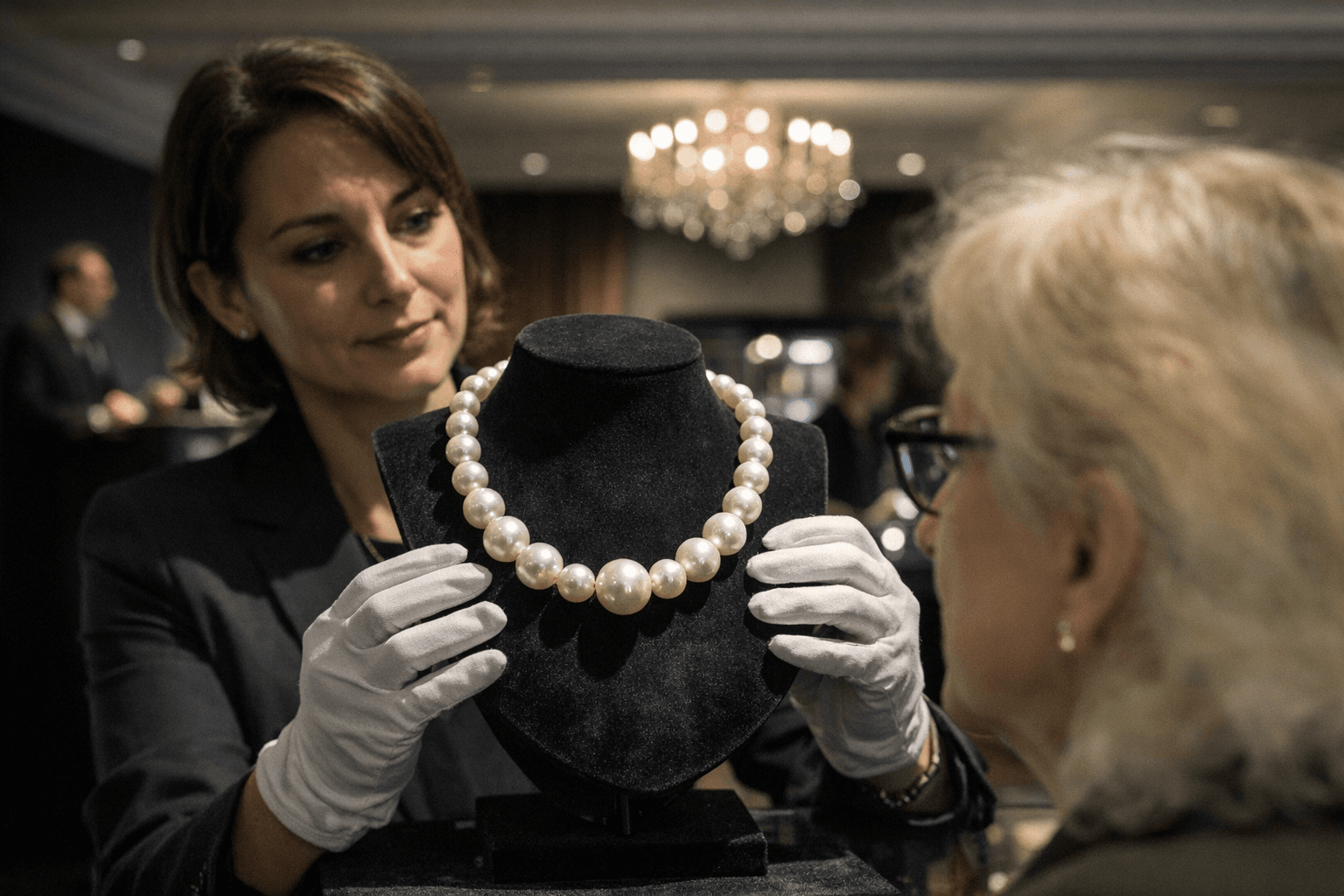
Sotheby's Paris Fine Jewelry sale, set for March 31 at 83 rue du Faubourg Saint-Honoré, brings together works from Cartier, Van Cleef & Arpels, Chaumet, Harry Winston, Graff, and Marchak — but it is a natural pearl necklace, not a signed piece, that makes the most compelling case for where the secondary market's attention should be focused.
The necklace comprises a row of 33 rounded, oval, button, and drop-shaped natural pearls, completed by a clasp bearing an octagonal rhodolite garnet and circular-cut diamonds, estimated at EUR 130,000 to EUR 260,000 (approximately $150,695 to $301,390). The variety of pearl shapes within a single strand is significant: it signals a pre-Mikimoto provenance, assembled in an era when natural pearls were collected one by one for their individuality rather than matched for uniformity. The largest pearl in the necklace measures 16.15 mm in diameter — a dimension that, in natural-pearl terms, speaks to extraordinary rarity. Cultured pearls of that size exist; natural ones of that diameter are vanishingly uncommon.
The rhodolite garnet clasp deserves its own reading. Rhodolite, with its purplish-raspberry hue, was a favored accent stone among Edwardian and early Art Deco jewelers, who understood that its warmth complemented the cool overtones of Persian Gulf and Ceylonese pearls. The choice to retain the original clasp, rather than replace it with diamonds or a signed maker's mark, suggests the necklace has passed through careful hands.
Despite the pearl necklace's considerable interest, the technical top lot of the sale is a cushion-shaped, 7.39-carat, D-color, internally flawless diamond ring from Van Cleef & Arpels, carrying an estimate of EUR 330,000 to EUR 550,000. Also within the top tier is a ring showcasing an antique cushion-cut, 4.32-carat Kashmir sapphire in an old-cut diamond surround, estimated at EUR 130,000 to EUR 280,000. Cartier contributes a pendant featuring a pear-shaped, 12.76-carat Ceylon sapphire suspended from a brilliant-cut diamond surmount, estimated at EUR 110,000 to EUR 220,000.
The sapphire concentration is notable: six of the ten highest-estimated lots in the sale are sapphire-focused, reflecting a broader collector shift toward unheated, origin-certified colored stones in the post-pandemic market. Kashmir and Ceylon sapphires, in particular, have seen consistent price appreciation as supply from both historic sources remains effectively closed.
The 218-lot sale will also feature a fine selection of jewels from the Art Deco movement, including a fully articulated diamond bracelet by Cartier and a large brooch depicting a landscape animated by Chinese figures, which was exhibited at the 1925 International Exhibition of Modern Decorative and Industrial Arts. That exhibition provenance is not a minor footnote: the 1925 Paris exposition defined Art Deco as a global design language, and pieces that appeared there carry both historical and market weight.
In the early 1900s, natural pearls were the height of fashion, commanding the kind of prices that led Pierre Cartier to famously purchase his firm's future New York headquarters on Fifth Avenue for $100 and a strand of 128 natural pearls. The necklace going to auction on March 31 belongs to that same lineage of extraordinary organic material: formed without human intervention, shaped by time and tide, and now, once again, subject to the competitive logic of the auction room.
This article was produced by Prism’s automated news system from verified source data, official records, and press releases, then run through automated quality and moderation checks before publishing. The system is built and supervised by the people who set the standards it runs under. Read our full AI policy.
Did this article answer your question?