Rare Natural Pearls Highlight Phillips Hong Kong Jewels Sale This March
Three natural pearl lots hit Phillips Hong Kong today, and knowing what 'natural' really means without a lab report could change everything about how you bid.
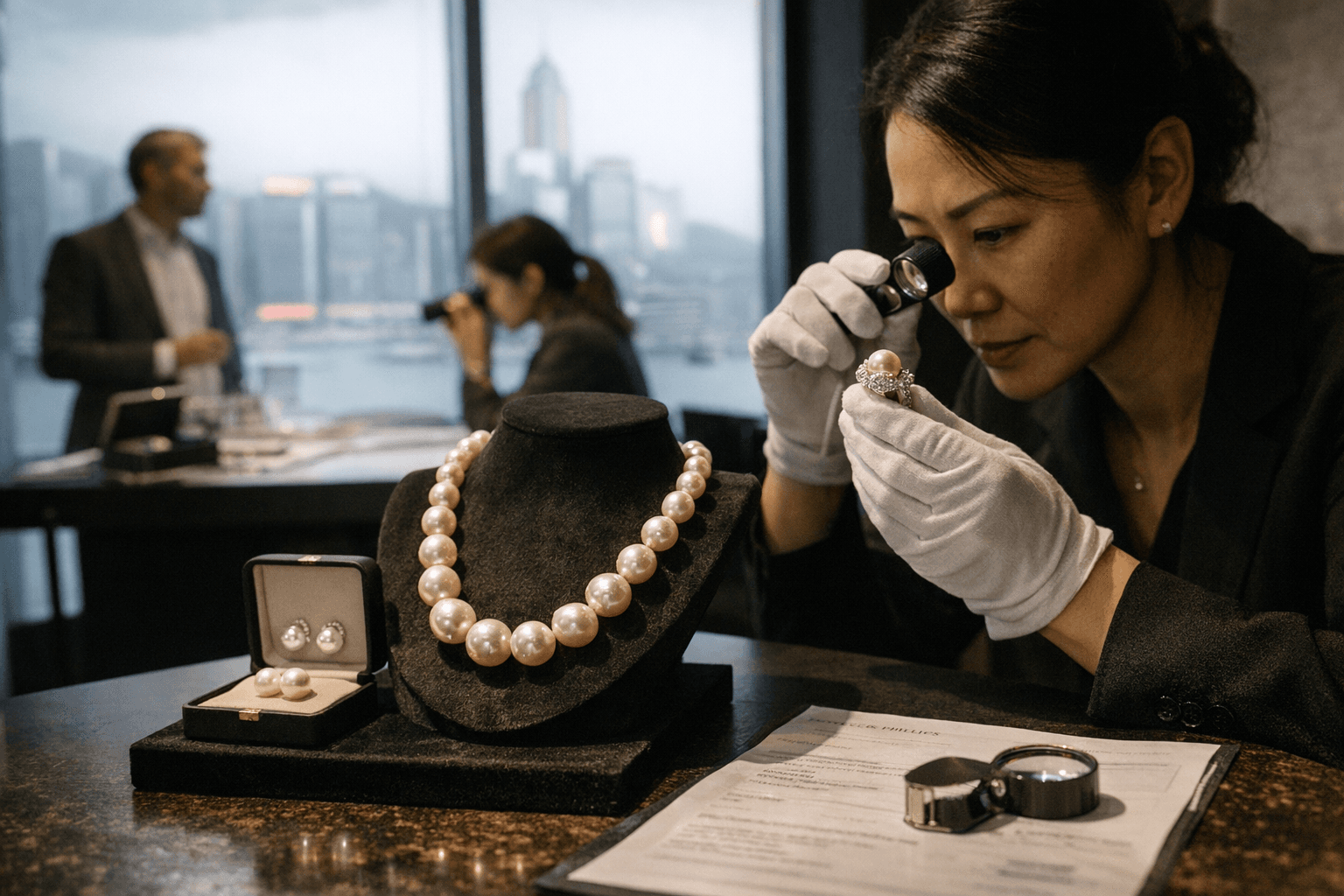
Fewer than one in a hundred pearls sold at auction today formed without any human intervention. That single statistic reframes everything the moment the word "natural" appears in a sale catalog, and it makes the cluster of pearl lots going under the hammer this morning at Phillips' Hong Kong Jewels auction worth examining in close detail, piece by piece, criterion by criterion.
The March 30 auction, held at Phillips' Asia headquarters during Hong Kong Art Month, assembles coloured gemstones, diamonds, jadeite, and a set of natural pearl pieces that range in form from a tiara designed for a Victorian forehead to a pendent necklace suited to a contemporary collar. Three lots in the pearl section stand out on their own terms: Lot 525, the Natural Pearl, Seed Pearl and Diamond Bandeau Tiara, estimated at HK$320,000 to HK$480,000; Lot 526, the signed Retzignac Natural Pearl and Diamond Brooch, estimated at HK$140,000 to HK$180,000; and Lot 527, the Natural Pearl and Diamond Pendent Necklace, estimated at HK$95,000 to HK$120,000. Ahead of today's sale, FCRF published a specialist pre-sale analysis on March 27 flagging each of these lots and noting that certain pieces could outperform their estimates based on rarity, provenance, or quality that catalogue photographs only partially convey.
For professional buyers who attended the preview or followed by phone, the FCRF notes served as a structured grading guide. For everyone else, they point to a methodology that applies far beyond today's saleroom. Learning to read pearl lots the way a specialist reads them means working through a specific set of criteria in order, before an estimate ever enters the calculation.
Documentation comes first, and it is the criterion most likely to mislead a buyer who moves too quickly. The word "natural" in an auction catalogue describes a pearl that formed without human nucleation: no bead or shell nucleus was surgically introduced to initiate growth. What "natural" does not automatically provide, however, is independent scientific verification of that fact. A seller's estate representation of a pearl as natural is not equivalent to a GIA, SSEF, or Gübelin certificate confirming natural origin through radiographic testing. X-ray analysis is the definitive method for distinguishing natural from cultured pearls, because the internal architecture tells the true story: natural pearls show concentric growth rings throughout, while cultured pearls reveal a visible nucleus at the centre, surrounded by a thinner nacre coating. A catalogue entry that reads "natural pearl" without a corresponding lab report reference is not an automatic red flag, but it is an invitation to call the specialist before the sale opens.
Once documentation is confirmed, pearl type and formation history shape how a piece should be valued. Natural pearls form in wild mollusks across the Persian Gulf, the waters of Ceylon, the South Pacific, and the rivers of Europe and North America. The geographic specificity matters because the oyster beds that produced the finest Basra and Gulf pearls in the Victorian and Edwardian periods have been largely depleted, making period pieces with credible provenance to those origins genuinely scarce in the modern market. This is precisely where Lot 525, the Natural Pearl, Seed Pearl and Diamond Bandeau Tiara, becomes so instructive as a case study.
The tiara is set with five graduated natural pearls, highlighted by variously cut diamonds and framed with seed pearl borders. The bandeau form places it almost certainly in the late Victorian or Edwardian era, when the conversion from tall tiara to low bandeau format was fashionable and natural pearls from the Gulf were at the peak of their social value. Five graduated pearls in a period piece of this kind represent a meaningful sourcing achievement: achieving consistent colour, a smooth size graduation, and matching surface quality across five wild-harvested stones required access and patience that even significant wealth could not always guarantee. On a piece designed to sit against the forehead, luster is not decorative detail; it is the primary visual argument. Specialists evaluating this lot in the preview room would look for the characteristic "orient," the iridescent shimmer that shifts across the surface of fine natural pearls and cannot be replicated in cultured alternatives. The seed pearl borders on this bandeau, small as they are, also warrant scrutiny: do they retain their original nacre surface, or does surface erosion from decades of skin contact dull the overall visual coherence of the piece?
Matching, as a standalone criterion, is one of the most consistently underestimated factors in multi-pearl auction lots. Even among pearls of the same natural origin, achieving a consistent body colour, overtone, and graduation across several stones required selecting from a much larger group. A bandeau where one pearl reads slightly more cream against its more silver neighbours is not a damaged piece; it is simply a piece where the matching premium is qualified. Recognising that distinction is what separates bidders who know what they are buying from those surprised by the result.
Luster and nacre quality are best evaluated together, because they are functionally inseparable in natural pearl grading. Nacre, the aragonite crystalline structure deposited by a mollusk over time, is the entire body of a natural pearl, not a coating over a foreign nucleus. Thick, well-formed nacre produces the deep, warm luminosity that experienced collectors call a "glow from within." Thin nacre, even in a certified natural pearl, produces a flatter, more surface-level reflection that reads as bright but not deep. For phone bidders following today's sale without the ability to inspect the pieces in person, the FCRF technical notes provided visual reference for assessing these qualities from catalogue images, which is not a trivial service in a category where photographs routinely fail to capture the depth of a fine natural surface.
Lot 527, the Natural Pearl and Diamond Pendent Necklace estimated at HK$95,000 to HK$120,000, represents a different kind of argument. At roughly US$12,000 to US$15,500, it sits at the accessible entry point of a category where certified pieces regularly trade at multiples of that level. The pendent format, a single natural pearl suspended from a diamond setting, carries no matching burden and no period-authenticity complexity. The stone is evaluated purely on its own: size, shape (round, drop, button, or baroque), luster depth, and surface clarity. A pendent necklace with a well-documented natural pearl of strong luster at this estimate is precisely the kind of lot that the FCRF analysis flagged as a potential outperformer.
Lot 526, the Retzignac brooch, adds a third variable to the framework: the signed maker. The French jeweler's twin-flower design centres each bloom on a button-shaped natural pearl set within single-cut diamond petals, with a baguette diamond stem. A signed piece of this construction carries provenance that extends beyond the pearl itself: Retzignac's attribution provides a maker, a design tradition, and a set of auction comparables in the signed-jewel market that run parallel to the pearl valuation. The estimate of HK$140,000 to HK$180,000 reflects both the pearl and the signature, and buyers evaluating it should consider which element is driving the majority of the value.
Settings, generally the last item on the specialist checklist, can either reinforce or complicate a pearl lot's case. Period metalwork, whether yellow gold, platinum, or a mixed construction, dates a piece almost as reliably as the pearl itself. And original, undisturbed settings carry a conservation argument: pearls that have never been removed from a mount retain their original drill channels and surface condition in ways that re-mounted stones may not.
The broader picture for natural pearl buyers engaging today's Phillips sale, or any auction catalog where the word "natural" appears without further qualification, is this: catalogue language has never been a substitute for a laboratory certificate, but it is also not meaningless. A description as specific as "five graduated natural pearls... to the seed pearl borders" is a more grounded claim than a general "pearl necklace." The question is always whether the specificity of the description is matched by the specificity of the documentation. In the current natural pearl market, where verifiable period pieces from historic saltwater beds have become genuinely finite, that documentation is not merely a formality. It is the difference between owning a natural pearl and owning a piece of paper that says you do.
This article was produced by Prism’s automated news system from verified source data, official records, and press releases, then run through automated quality and moderation checks before publishing. The system is built and supervised by the people who set the standards it runs under. Read our full AI policy.
Did this article answer your question?