Seven Key Factors Buyers Should Know When Grading Pearl Quality
GIA recognizes seven factors that determine pearl value, and only 5% of pearls meet the top grade — here's what each factor means for your purchase.
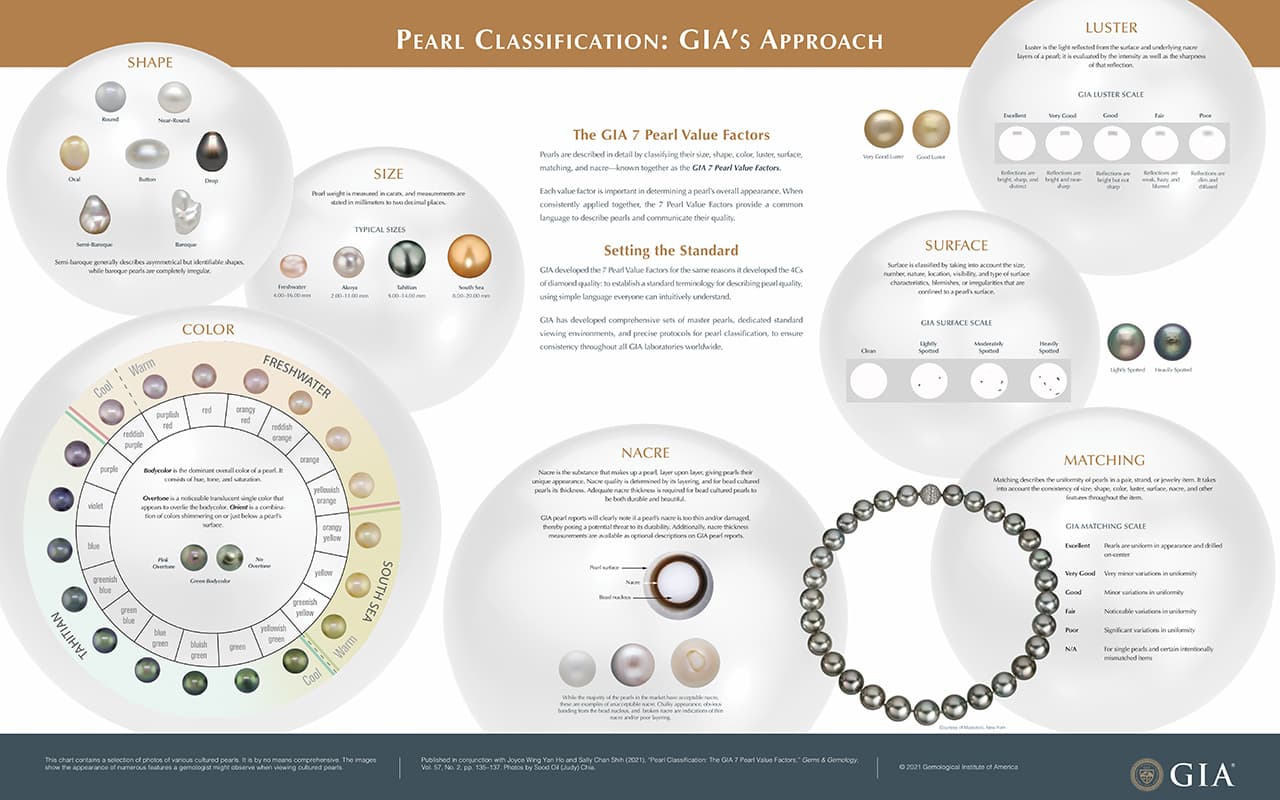
The GIA Pearl Description System gives buyers a rigorous framework for understanding why one strand of pearls commands ten times the price of another. Seven value factors govern every assessment: Size, Shape, Colour (subdivided into bodycolour, overtone, and orient), Lustre, Surface, Nacre quality, and Matching. Understanding each one transforms you from a passive shopper into an informed buyer who can interrogate a seller's grading policy with confidence.
One honest caveat before diving in: as Pure Pearls puts it bluntly, "Pearl grading standards are a MESS." Standards vary from seller to seller, farmer to farmer, and auction to auction, and navigating an industry trade show can mean encountering as many as 30 different grading scales in a single day. The seven GIA factors provide the most authoritative organizing framework available, but the numeric thresholds attached to each factor differ across retailers. Knowing the framework protects you; knowing its limits protects you even more.
Lustre
Every expert source converges on the same conclusion: lustre is the most consequential of the seven factors. Nashelle describes it precisely: "Luster is the deep inner glow of the pearl and its brilliance to the human eye. Luster is the most important indicator in evaluating quality as it separates the ordinary from the extraordinary. It is the very soul of this unique ocean gem that separate pearls from other gems." At its simplest, lustre is glow and reflection — the quality that makes a pearl look lit from within rather than coated on the outside.
The industry grades lustre on a five-tier scale: Excellent (or Exceptional), Very High, High, Medium, and Poor. At the top end, reflections on the pearl's surface are crisp and easily recognizable. At AA quality, those same reflections become blurry. The difference is not subtle; it is visible to the naked eye and is the single fastest way to assess a pearl's worth at a glance.
Nacre Quality
Lustre and nacre are inseparable. Nacre is the layered aragonite secretion that the mollusc deposits around an irritant over months or years, and its thickness and uniformity determine how light travels through and reflects off the pearl. Thin nacre, a common issue with Akoya pearls at lower grades, produces a chalky, lifeless surface. Solid nacre, as seen in top-grade freshwater pearls, supports that deep inner glow. When evaluating nacre, the practical test is to look for the blurring or sharpness of your own reflection in the pearl's surface: sharp reflections signal dense, well-formed nacre layers beneath.
Surface
Surface quality, sometimes called surface perfection or cleanliness, measures the extent to which blemishes, pits, bumps, or scratches interrupt the pearl's exterior. The practical rule of thumb, as applied by Mikimoto, is unambiguous: if imperfections are found on more than 10% of the pearl's surface, the grade drops. That 10% threshold aligns with Nashelle's description of top-tier A-quality pearls (GIA AA), which are "entirely smooth and with no more than one or two imperfections confined to less than 10% of its surface."
Retail grading scales translate this into percentage-clean figures, though the exact numbers differ between sellers. Pure Pearls places AAAA pearls at 98% or more clean, AAA at 90 to 95%, AA+ at 85 to 90%, AA at 80% or better, and A at 70% or better. Pearlsofjoy sets its AA threshold slightly lower, at 75 to 80% clean, reflecting the reality that vendor definitions are not standardized. Nashelle maps its grades to GIA codes: B-quality (GIA A+) pearls show imperfections across less than a third of the surface; C-quality (GIA A) pearls may have light blemishes across up to two thirds; D-quality (GIA A1) pearls show light imperfections over 60% of the surface with up to 20% deep imperfections. When shopping, ask any seller to specify their surface-cleanliness threshold in percentage terms and compare it against these benchmarks.
Shape
Perfectly round pearls are the most prized, and the grading scales reflect this directly. Pure Pearls designates AAAA pearls as perfectly round; AAA as round to near-round; AA+ as mostly round; AA as off-round; and A as off-round to baroque. Mikimoto's guidance reinforces the hierarchy: larger, perfectly round pearls are the most valuable. That said, shape carries a degree of subjectivity that the other factors do not. Baroque and semi-baroque forms have their own aesthetic appeal, and jewelers who work with them would argue that an organically shaped pearl worn as a pendant can be more visually interesting than a symmetrical round specimen. Shape matters to value, but it also matters to personal taste.
Colour
The GIA framework divides colour into three distinct components: bodycolour, overtone, and orient. Bodycolour is the dominant hue of the pearl itself — white, cream, golden, silver, or black. Overtone is the secondary colour that floats over the bodycolour when light hits the surface at certain angles, producing the characteristic rose, green, or blue tints associated with Akoya, South Sea, and Tahitian pearls respectively. Orient is the iridescent shimmer that appears to move across the surface, produced by the diffraction of light through nacre layers.
The key quality indicator across all three components is evenness. An even colour distribution around the entire pearl is the defining characteristic to assess, regardless of the specific tone. Uneven bodycolour, a blotchy overtone, or an orient that appears only on one hemisphere signals uneven nacre deposition and will affect both the visual appeal and the grade.
Size
Size is straightforward in one direction and counterintuitive in another. Larger pearls generally command higher prices, because producing a pearl of significant diameter requires more time in the mollusc and a correspondingly lower survival rate during cultivation. For Tahitian pearls, common sizes run from 8 to 10mm. The exception that illustrates the rule: Nashelle notes that their 7mm Tahitians, smaller than the standard range, are actually rarer and more expensive precisely because of that rarity. "The more rare, the more the pearl will price for," as Nashelle puts it. Size, therefore, should always be read alongside provenance and production context rather than as a simple linear scale.
Matching
Matching is the factor that governs strands, pairs, and sets rather than individual pearls. A necklace of thirty pearls is only as good as the consistency of its components, assessed across size, shape, colour, overtone, lustre, and surface quality. At the AAA level, Pearlsofjoy specifies that there should be "virtually no difference between each pearl in a necklace, bracelet or matched set" for Akoya pearls, with reflections that are easily recognizable across every bead. At the AA level, matching tolerates more variation, and freshwater pearl sets at this grade will show differences in shape, size, and surface across the strand.
One important practical nuance: full-strand grading often involves mixing grades deliberately to achieve visual coherence. Pure Pearls notes that layouts frequently combine AAA and AA quality pearls, or AAA and AAAA, "to maintain a consistent 'tone' throughout the necklace in terms of matching for size, overtone or luster, and also to ensure price points remain reasonable." This is standard industry practice, not a quality compromise, but it means a strand labeled AAA may contain pearls graded below that threshold at the individual level. Ask your seller to clarify how strand grades are determined.
How to Use These Factors When Buying
The seven factors work as a system, not a checklist. A pearl with exceptional lustre but heavy surface blemishes is not a top-grade pearl. A perfectly round specimen with poor nacre will disappoint in daylight. When evaluating any piece:
- Ask the seller to specify their grading thresholds in writing, including the surface-cleanliness percentage and the lustre grade assigned to each tier.
- Apply the 10% surface-imperfection rule of thumb as a quick field test: any reputable seller of top-tier pearls should be able to confirm their stones clear this threshold.
- Examine matching by looking at a full strand or pair under consistent lighting — the pearls should read as a unified set, not a collection of individuals.
- Consider that price and value are not the same thing. A well-matched AA strand with high lustre will outperform a nominally AAA strand with poor matching and weak overtone every time.
The rarity statistics underscore what all of this means in practice. Top-tier A-quality pearls, classified as GIA AA, represent only 5% of total production. Their surface is virtually flawless, their lustre is graded Very High, and their price reflects both qualities. Understanding the seven factors means understanding why that number is so small — and being able to judge, when you hold a pearl, whether the price being asked is warranted by what you see.
This article was produced by Prism’s automated news system from verified source data, official records, and press releases, then run through automated quality and moderation checks before publishing. The system is built and supervised by the people who set the standards it runs under. Read our full AI policy.
Did this article answer your question?