Sri Jagdamba Pearls Offers 2X Exchange Vouchers, Positioning Pearls as Appreciating Assets
A ₹10,000 pearl set bought before April 2025 became ₹20,000 in store credit at Sri Jagdamba Pearls' first-ever exchange program, but three conditions determined who actually qualified.
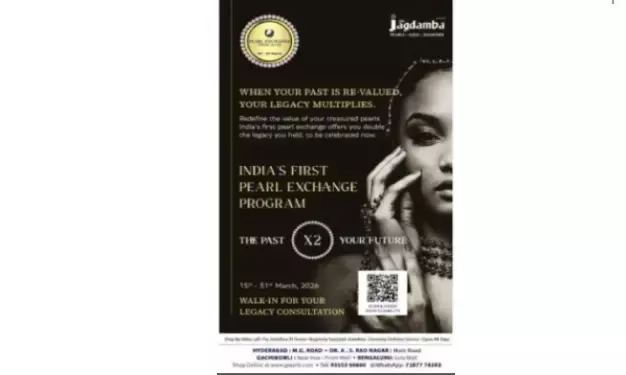
A pearl set purchased for ₹10,000 before April 2025 could be handed over at any Sri Jagdamba Pearls counter and leave as ₹20,000 in store credit. That is the arithmetic at the center of the Pearl Appreciation & Exchange Program, which the Hyderabad-based retailer (established 1924) ran from March 15 to March 31, closing its counter yesterday.
Billed as India's first exchange program of its kind for pearl jewellery, the initiative positioned pearls alongside gold and diamonds as retained-value assets rather than sentimental keepsakes. The company framed the scheme not as a seasonal promotion but as a structural repositioning of how pearls are perceived in the fine jewellery market. "We provide 2X the original invoice value because we want to reward our loyal customers who purchase jewellery from us while showing that Sri Jagdamba pearls maintain their value throughout time," the company stated in its official announcement.
The mechanics are worth parsing precisely. The 2X multiplier was calculated on the original invoice price of the specific piece chosen for exchange, not the combined total of any multi-item purchase. A customer who bought a ₹15,000 necklace and ₹5,000 earrings together could surrender the necklace for ₹30,000 in credit while keeping the earrings. The resulting voucher was issued as digital store credit to the registered email and phone number, applicable across jpearls.com and in-store, with no disclosed ceiling on what it could fund.
Three gatekeeping conditions determined eligibility, and each carries a lesson that extends well beyond this particular window.
The piece had to be at least 12 months old, purchased on or before April 1, 2025. This minimum aging requirement prevented the exchange from functioning as a rapid resale loop; it was calibrated for customers with existing holdings. The jewellery had to be structurally intact: no missing pearls, no broken clasps, no physical damage. Natural discolouration, however, was explicitly accepted. That distinction is the condition most likely to surprise owners of vintage or gifted pieces. A strand held in dry storage or exposed to years of perfume may pass on colour but fail on structure, even while retaining genuine market appeal.
Documentation was the third and most consequential hurdle. The original Sri Jagdamba Pearls invoice was required to establish purchase date and price. If that invoice was lost, the company offered an alternative: submit a registered mobile number or invoice number alongside photographs, and the internal records team would search for verification. If no match was found, the piece was deemed ineligible. Only one item per customer was accepted during the window. Customised pieces and jewellery set in gold, silver, or diamonds were categorically excluded; the program applied solely to pearl and gemstone jewellery purchased through official channels, whether at retail locations, jpearls.com, or authorised marketplace listings. Pieces sourced from unauthorised resellers did not qualify.
Before the 2X figure becomes a decision tool, it needs context. The multiplier was applied to the original rupee invoice price, reflecting what you paid, not what a comparable strand costs in 2026 or what the piece might fetch in a secondary market. If a ₹10,000 pearl set from 2022 has appreciated in resale value to ₹13,000, the exchange offer remains favourable. But the program's deeper value is in trust, convenience, and access to the retailer's current catalogue, which ranges from collections under ₹2,000 to investment-grade necklaces at the flagship 6,500-square-foot store on MG Road, Secunderabad. Customers applying the credit toward significantly more expensive pieces would top up the difference at checkout.
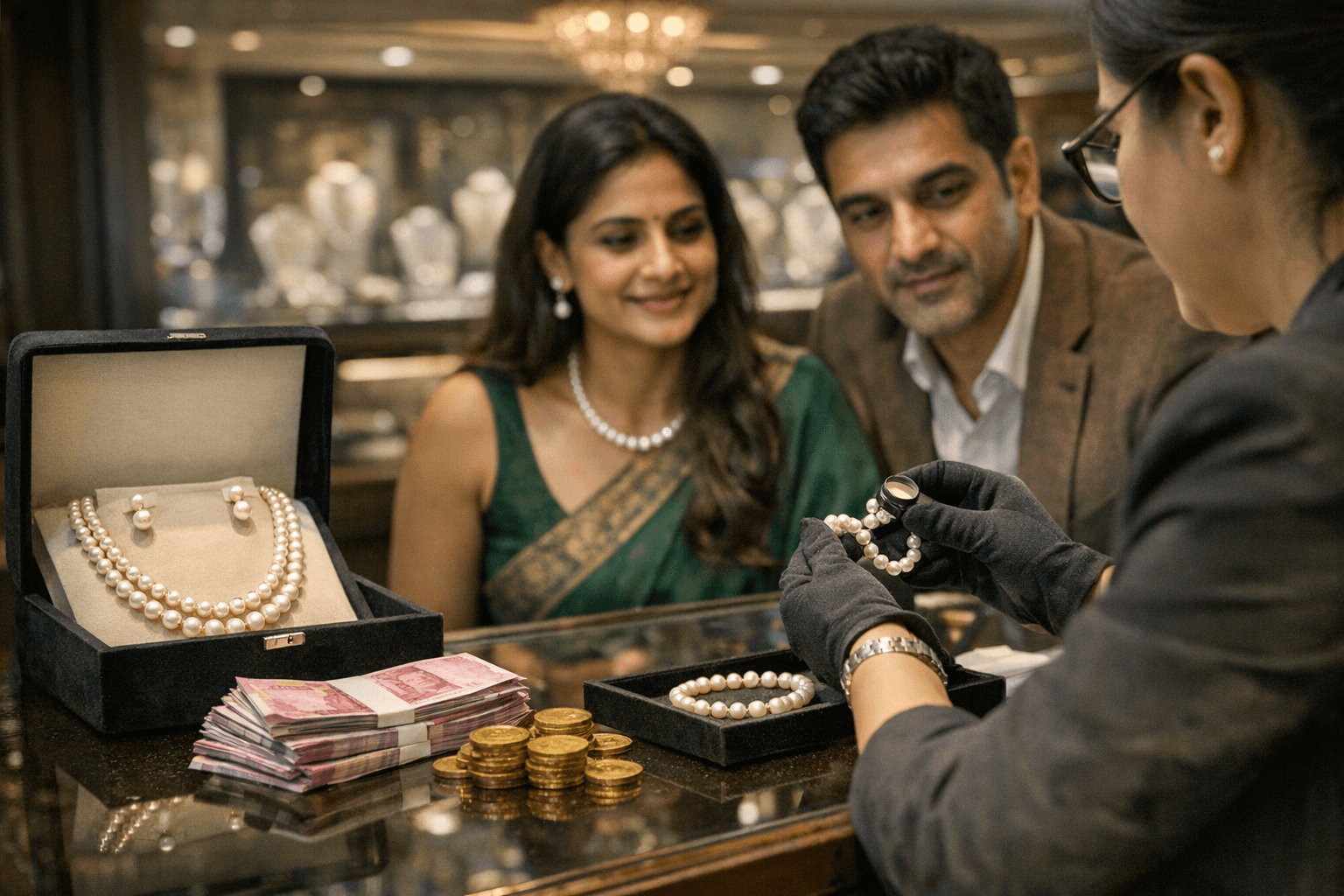
When a retailer offers an exchange program of this kind, the right course of action depends entirely on the outcome you are actually seeking. If the goal is to upgrade within the brand's range, a 2X voucher at a retailer with showrooms across Secunderabad, Gachibowli, AS Rao Nagar, and Bengaluru's Lulu Mall in Rajajinagar represents substantive purchasing power. The arithmetic is clean: surrender an older piece, receive double its original invoice value, apply that credit toward something you will wear. If a new strand is priced at ₹40,000 and your voucher covers ₹20,000, you pay exactly half.
If the goal is a clean financial exit from pearl jewellery, an exchange program is the wrong instrument. The voucher is store credit, not cash. Twenty thousand rupees in exchange value exists only inside that retailer's catalogue. Selling through estate jewellers, auction platforms, or peer-to-peer channels would convert the piece to unrestricted liquidity, albeit likely at a lower headline figure.
If the instinct is to hold, that is frequently the correct answer for well-maintained pieces. Pearls are organic and degrade under conditions that most storage habits produce: low humidity, proximity to perfume, contact with abrasive surfaces. A piece you are caring for correctly may carry both sentimental and material value that no single exchange window can fully price.
Before approaching any retailer running a comparable program, six questions determine whether the exchange works in your favour. What is the precise eligibility cutoff, measured from purchase date or delivery date, and is that reflected on the invoice? Is the multiplier applied to the original invoice price or to current catalogue value? Can a piece fail a condition check after it has been collected for inspection, and if so, is it returned undamaged? Is the resulting credit time-limited or permanently available, and can it be transferred to another purchaser? Are there excluded categories, such as customised pieces, online-only purchases, or items received as gifts, that would disqualify your specific piece? And if the original invoice is missing, what is the exact verification path, and at what point does the retailer render a final ineligibility decision?
Sri Jagdamba Pearls drew on a century of provenance data, retail infrastructure, and customer records to make this program operationally credible. Whether participation was broad enough to justify an annual repeat, or whether the March 31 deadline was genuinely final, has not been disclosed. What the initiative confirmed is that the documentation habits most jewellery buyers dismiss as administrative detail, keeping original invoices, registering purchases to a phone number, photographing pieces at acquisition, are not formalities. In any exchange scheme worth entering, they are the precise difference between walking out with double your money and being turned away at the counter.
This article was produced by Prism’s automated news system from verified source data, official records, and press releases, then run through automated quality and moderation checks before publishing. The system is built and supervised by the people who set the standards it runs under. Read our full AI policy.
Did this article answer your question?