Personalized jewelry shaped identity, memory and status in 19th-century America
A monogrammed locket could say as much as a profile bio. In 19th-century America, jewelry carried love, mourning, status and ownership in tiny codes.
Inherited lockets, signet rings and engraved bands still read like small biographies. The Metropolitan Museum of Art treats nineteenth-century American jewelry as both useful and status-bearing, with inscriptions and monograms doing the work of identity, memory, ownership and taste. That language was already present in colonial America, where the earliest jewelry made and worn in America often pointed to courtship, marriage, death and mourning.
Jewelry that could be read
Personalization was not a decorative afterthought. It was the grammar that let a brooch, chain or ring speak in public without saying a word, whether the message was family name, marital tie, inheritance or refined self-possession. The Met’s collection makes that legible through objects that still preserve initials, engraved text and monograms, showing how Americans used jewelry as a portable form of authorship.
The vocabulary was broad. By the mid-nineteenth century, American jewelers were supplying gold and silver jewelry, medals and hair jewelry as the industry grew from small workshops toward larger factories. A jewelry design in the Met’s records also points to the professional circulation of style through the Jewelers Circular and Horological Review, established in 1869 and devoted to jewelry, clocks, watches and silverware. By then, monograms had moved well beyond a private flourish and into a shared visual code.
The monogram as a personal language
A monogram could function like a signature, but softer and more intimate. It could announce a surname, compress a marriage, or mark an object as an heirloom long before modern branding made initials a design trope. The Met’s examples show that monograms appeared on lockets, brooches, chatelaines, watch chains and other keepsake pieces, turning everyday adornment into a readable record of the wearer’s life.
That is what makes the history feel so current. Personalized jewelry did not begin as a lifestyle category; it emerged as a way to manage identity in a world with no digital profile, no social feed and no easy public archive of the self. The object itself had to carry the meaning, which is why the details mattered so much: the script, the placement, the metal, the clasp, the chain.
A tortoiseshell locket that still speaks
One of the clearest examples is a ca. 1870 locket and chain made of dark-colored carved and molded tortoiseshell. The locket attaches to the chain with a hook and two intertwined loops, and its surface is carved with a superimposed monogram, possibly reading MVEC. Even the material tells a story. Tortoiseshell was popular with American jewelry and comb manufacturers in the nineteenth century, and it was imported to the United States from China and the West Indies.
The craftsmanship reinforces the intimacy. The Met notes that tortoiseshell jewelry could be carved by hand or inlaid with gold, which places personalization inside technique rather than outside it. A monogram on tortoiseshell was not just a mark added at the end; it depended on the same skilled hands that shaped the shell itself. That mix of imported material, careful carving and coded initials gives the object its force: it is at once a fashion piece, a trade object and a private declaration.
Love, mourning and the emotional code of inscription
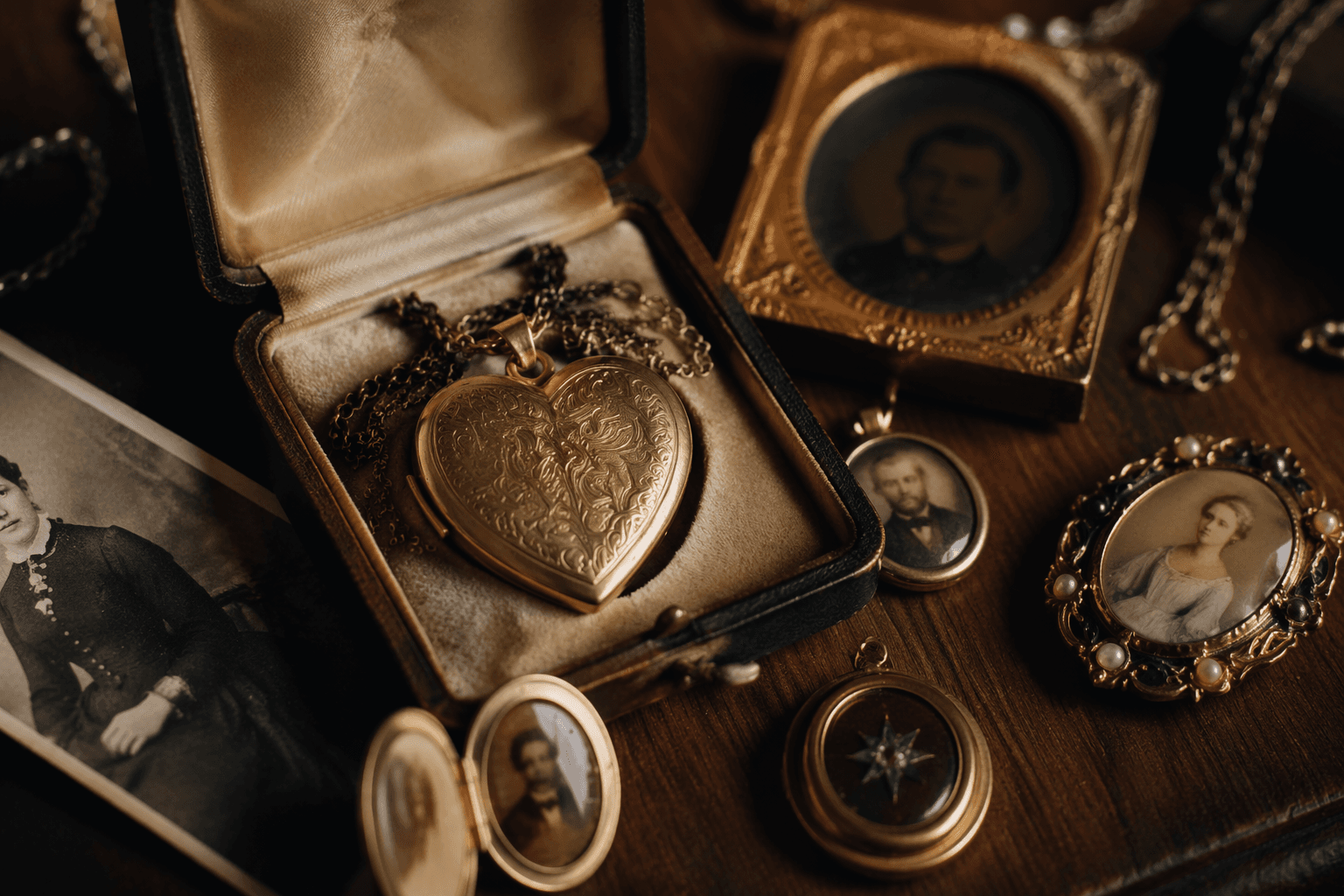
The oldest American jewelry in the Met’s records already ties adornment to feeling. A 1706 locket notes that the earliest jewelry made and owned in America was often sentimental, linked to courtship and marriage or to death and mourning. That continuity matters, because it shows that personalization was never only about vanity or display. It was also about holding relationships in view.
A mid-19th-century mourning brooch in the collection makes that even more explicit. The Met says mourning jewelry was commonly commissioned by nineteenth-century Americans, and engraved inscriptions often indicated whether a piece was intended as mourning jewelry or as a token of love. Hair under crystal, a dark material palette, or a careful inscription could all signal grief without naming it outright. In that sense, jewelry became a coded social language for life events that were too intimate, too formal or too public to state directly.
Gold rush abundance and the rise of a wider market
The personalized piece did not exist outside the industrial boom that made it possible. The Met places the American jewelry industry’s expansion alongside steam-powered machinery, the California Gold Rush, the discovery of silver in Nevada’s Comstock Lode and the transcontinental railroad. Those forces helped transform a trade of small workshops into a larger, more mechanized industry with a wider reach and a worldwide clientele.
The timing mattered. After the 1849 California gold discovery, Gold Rush jewelry became popular in the early 1850s, and rings, brooches, hair combs and belt buckles entered the market, some made for the tourist trade. This was abundance with a personal edge. The same market that could produce more jewelry for more people also made room for pieces that carried initials, inscriptions and sentimental cues, proving that mass production and intimate meaning were not opposites in nineteenth-century America.
Why the old codes still feel modern
The appeal of personalized jewelry today is not newness. It is readability. A monogrammed band, a name necklace or a locket with hidden contents still works because it lets the wearer decide what is private, what is public and what should be carried forward. The Met’s American Wing, with a collection spanning some 20,000 works, places jewelry inside that larger story of American art and identity, where small objects reveal how people wanted to be seen.
That is the real inheritance of nineteenth-century American personalization: jewelry learned to speak in shorthand, and the shorthand still works. A ring can hold a name, a locket can hold a memory, and an engraved band can turn metal into a sentence you can wear.
This article was produced by Prism’s automated news system from verified source data, official records, and press releases, then run through automated quality and moderation checks before publishing. The system is built and supervised by the people who set the standards it runs under. Read our full AI policy.
Did this article answer your question?