Why nameplate jewelry endures as identity and style statement
Nameplate jewelry lasts because it turns a name into a public claim to personhood, from scripted pendants to bejeweled rings, while carrying a long debate over taste and identity.

A nameplate necklace does more than spell out a name. It turns identity into something visible, wearable, and unmistakably personal, which is why the form keeps returning long after any single trend cycle has passed. Isabel Flower and Marcel Rosa-Salas place nameplate jewelry at the intersection of identity, style, and power, and that tension explains its staying power across necklaces, rings, and earrings.
A name in public, a style with rules
Flower and Rosa-Salas describe nameplates as living in a space of “simultaneous conformity and nonconformity,” which is the key to understanding why the category endures. The piece is deeply specific to the wearer, yet instantly legible to everyone else, so it can declare personhood in public while still moving within a shared visual language. That balance gives the format its charge: it is personal without becoming obscure, and recognizable without becoming generic.
The essay also traces the style’s genesis in mass American culture, which matters because it keeps the nameplate from being reduced to sentiment alone. Criticism of its alleged “tackiness” is tied to race, class, and gender politics, making taste part of the story rather than a neutral measure of quality. In other words, the argument over nameplates has never been only about aesthetics; it has also been about who gets to define refinement in the first place.
The category is bigger than the classic necklace
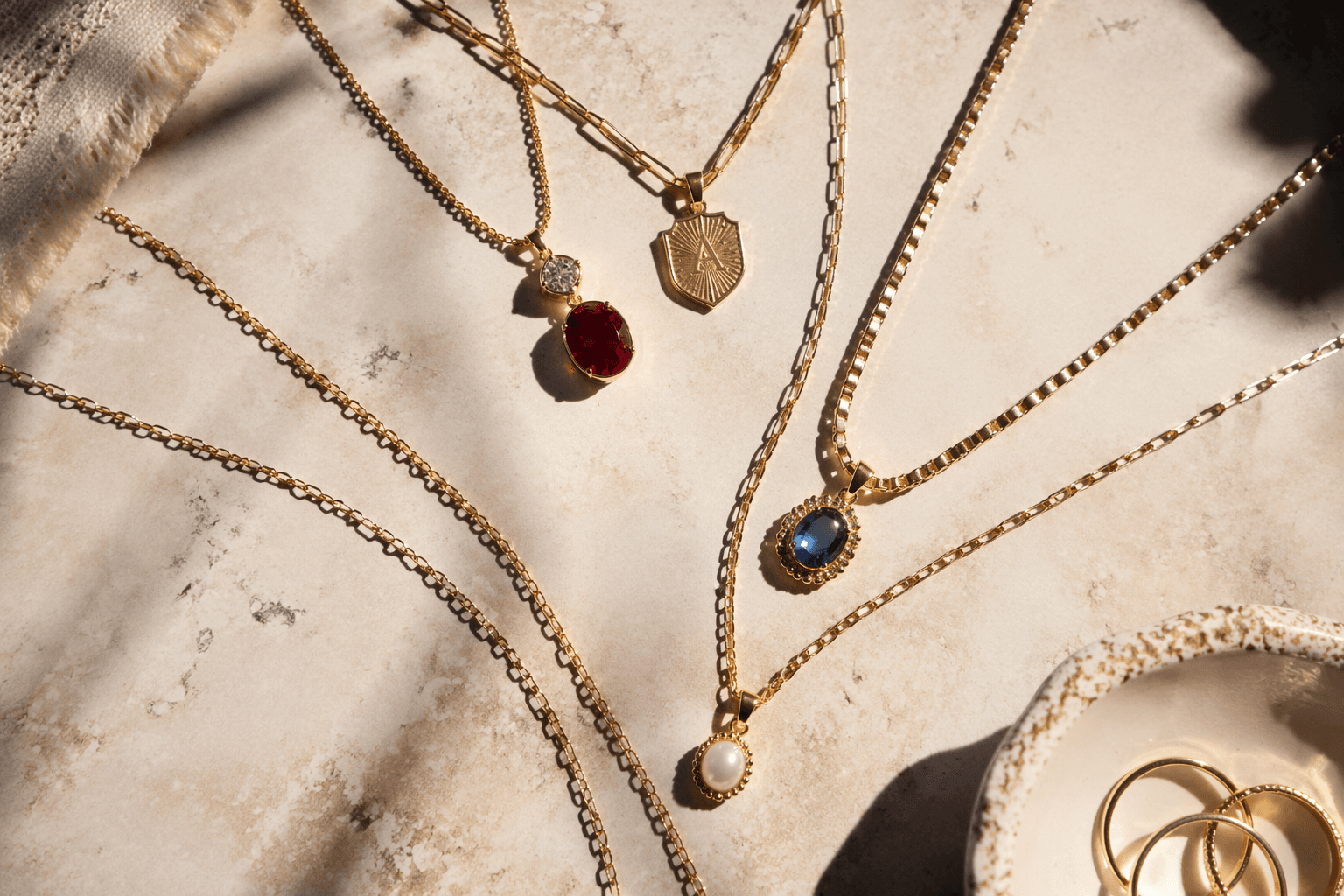
The nameplate is often shorthand for a name on a chain, but the category is broader and more adaptable than that single image. The Museum of Arts and Design describes nameplate jewelry as ranging from simple scripted pendants to bejeweled rings, belts, and bracelets, made in gold, silver, and acrylic. That breadth is part of its appeal: the same core idea can be translated across formats and materials without losing its meaning.
That flexibility is also what allows the piece to keep evolving. A nameplate can stay close to the original necklace form or move into a ring or bracelet, and each shift changes how the name reads on the body. The material choice does the same work. Gold brings weight and visibility, silver reads cooler and leaner, and acrylic pushes the category beyond precious-metal territory while keeping the emphasis on identity front and center.
Why taste keeps circling back to nameplates
The form’s cultural persistence is inseparable from the arguments around it. Flower and Rosa-Salas do not treat nameplate jewelry as a cute nostalgia object; they treat it as a cultural object with a social history. That makes the category useful for reading how personal adornment can expose inherited ideas about classed, raced, and gendered taste.
The phrase “tackiness” keeps resurfacing around nameplates because the jewelry sits in a contested space between intimate self-expression and highly visible public style. That friction is precisely what makes it durable. It can be read as bold, sentimental, status-conscious, or deeply local, sometimes all at once, and that instability is part of its cultural meaning.
Museums have been treating the form as serious design for years
The Museum of Arts and Design says the creators of *The Nameplate: Jewelry, Culture, and Identity* spent years researching the multifaceted history and overlooked significance of the form, and that the pieces tell stories about identity, community, memories, and legacies. That framing pushes the nameplate beyond novelty and into the language of design history. It also explains why the subject keeps returning in museum programming rather than disappearing into fashion’s cycle of revivals.
MAD’s own history supports that approach. Its 1956 inaugural exhibition, *Craftsmanship in a Changing World*, gave many Americans their first exposure to metalsmiths challenging conventional jewelry norms. That lineage matters because nameplate jewelry belongs to a wider tradition of makers reshaping what jewelry can look like and what it can say.
The Metropolitan Museum of Art places that same impulse inside a much longer arc. The museum says jewelry has been worn for millennia to adorn, empower, and protect wearers, and its *Jewelry for America* exhibition spans three hundred years of American jewelry from the early eighteenth century to the present. The Met first acquired American jewelry in 1883, and by spring 1926 it had already mounted a small jewelry exhibition, evidence that the field was being treated as a serious collecting category long before personalization became a market keyword.
Hip-hop gave the form another cultural engine
Nameplate jewelry also carries the imprint of hip-hop, which is central to how the piece is read in contemporary style culture. Smithsonian coverage notes that hip-hop culture was created and defined by young people, not by the institutions that later packaged it, and that the genre grew into a billion-dollar industry. That history helps explain why nameplates are rarely seen as purely decorative: they sit inside a broader story of youth culture, self-definition, and public visibility.
That context matters because nameplates are often worn as signs of belonging as much as signs of individuality. The same pendant can read as family reference, neighborhood marker, or a statement of style depending on who wears it and how it is built. The form survives because it can hold those meanings without collapsing them into one another.
The modern version is still handmade, researched, and culturally loaded
The current life of the category shows no sign of shrinking into nostalgia. MAD’s 2024 talk on *The Nameplate* centered on a project that has been researched for years, and the museum’s 2026 teen studio program offers participants a custom nameplate necklace handmade in Brooklyn, New York. That detail is telling: the piece is still being taught, collected, and remade as an object of identity design.
Nameplate jewelry endures because it lets a wearer say something direct without needing to explain it. It is a name, but it is also a decision about material, shape, and cultural position. That is why the form keeps outlasting the trends that surround it: it remains one of the few jewelry categories where style, self-definition, and social meaning are built into the same object.
This article was produced by Prism’s automated news system from verified source data, official records, and press releases, then run through automated quality and moderation checks before publishing. The system is built and supervised by the people who set the standards it runs under. Read our full AI policy.
Did this article answer your question?