Antique diamond cuts reveal the era, value of vintage jewelry
Rose, old mine and old European cuts can point you to the right era, but the setting and repairs tell you whether the jewel is truly antique.

How to read a vintage diamond without mistaking the stone for the whole jewel
When you inherit a ring or pick up an estate-sale brooch, the diamond cut is often the fastest clue in the room. Cut style, unlike shape alone, tells you how the facets were arranged and angled, which means it can point you toward a Georgian, Victorian, or later life for the jewel before you ever open a box of papers.
That shortcut matters, but it is only a shortcut. The most convincing antique pieces often combine an older stone with a later mount, a replaced shoulder, or a repair that changed the look without erasing the history. The Sutherland Diamonds, for example, survive as a historic necklace and earrings that were worn, adapted, and reworked over time, a reminder that the age of the diamond and the age of the setting are not always the same thing.
The practical cheat sheet
Rose cut diamonds usually point furthest back. GIA traces them to the 1500s and describes them as a typical product of the 16th and 17th centuries, with faceting that lacks a flat table and forms a domed top. If you see a rose-cut stone in a later jewel, that does not make the piece fake; a mourning ring from England, about 1787, shows rose-cut diamonds still being used well into the Georgian era.
Old mine cut is the workhorse of antique diamond dating. GIA says it was one of the most common diamond cuts from the early 18th century to the late 19th century, and it appears most often in Georgian and Victorian jewelry. Look for the telltale profile: usually 58 facets, a soft squarish outline, a smaller table, a larger culet, a higher crown, and short lower-half facets. That chunky, hand-shaped look is exactly why old mine cuts still feel intimate in a ring on the hand or a pendant near the collarbone.
Old European cut comes later, as cutters moved toward a rounder, more standardized style. It bridges old European-looking antiques and the modern round brilliant, emerging as diamond-cutting technology advanced in the late 1800s and early 1900s. By 1900, the circular saw made it easier to split octahedral rough crystals, and by 1902 many in the trade recognized that sawing saved weight, shifting the emphasis from maximizing retained rough to shaping beauty and proportion.
What the old cuts are telling you
The old mine cut is not just romantic shorthand; it is a window into how diamonds were valued before modern precision took over. In the GIA’s account, cutters worked slowly, and every bit of material mattered. That is why old mine cuts tend to feel deeper and a little less uniform than modern rounds, and why they often show up in Georgian and Victorian jewels, where hand work and small-scale production left visible character in the stone.
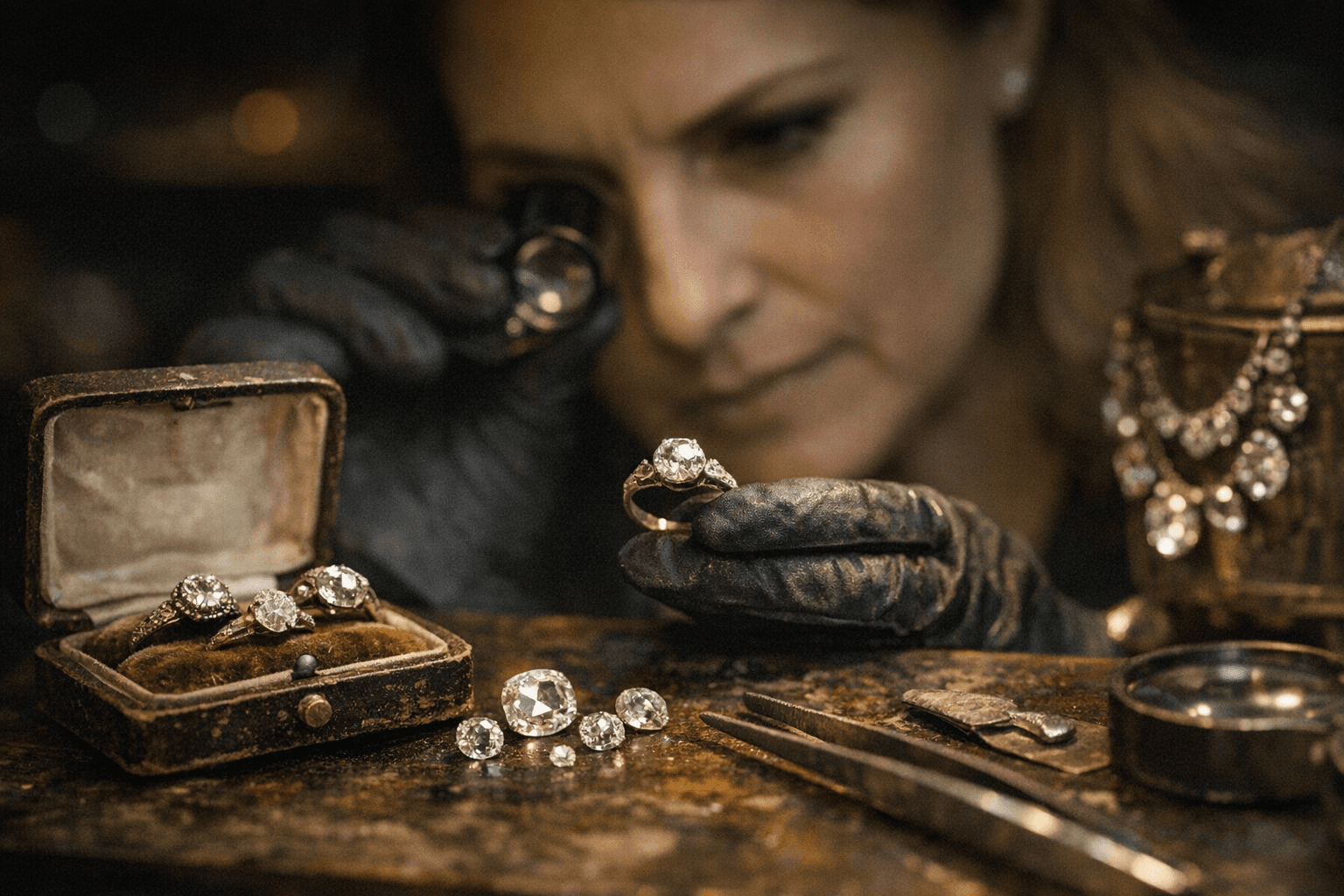
The old European cut tells a different story. It belongs to a moment when cutters began chasing a more standardized round outline without fully abandoning the antique depth and larger culet that give older stones their warmth. If you are comparing two rings that look similar at a glance, the old European cut usually reads as the more polished transition piece, while the old mine cut keeps the softer, more cushion-like geometry of an earlier hand.
Rose cuts sit even farther back in the decorative vocabulary of jewelry. The Victoria and Albert Museum notes that 18th-century jewelry saw the development of the brilliant cut with multiple facets, and that diamonds came to dominate jewelry design in that century. Yet the museum’s collections also show rose-cut stones surviving in later pieces, which means a rose cut can mark either an early jewel or a later design borrowing an earlier look.
How to date the whole jewel, not just the stone
Start with the stone, then move to the setting. A rose-cut diamond in a silver-backed cluster can fit a Georgian look, but a later shank or replacement clasp may tell you the ring has been altered. An old mine cut in a Victorian mount may be original, but if the shoulders, gallery, or prongs look fresher than the center stone, you are probably holding a piece that has traveled through more than one era. The Sutherland Diamonds are a useful model here: the jewels are historic, but the mounting history is part of their identity, not a flaw in it.
Pay attention to whether the metal and the stone seem to belong to the same visual language. The V&A’s 18th-century objects show how diamonds were often mounted in silver to intensify their white sparkle, while the Sutherland necklace survives in silver-topped gold collets, a setting that reveals both the prestige of the stones and the practical craft of securing them. A jewel that mixes metals, stones, and construction styles may still be authentic, but it asks for a more careful read.
Why these cuts still matter for value
Collectors pay for story as much as sparkle, and old cuts supply both. An intact old mine or old European cut can strengthen attribution because it fits a narrower historical window, while a rose cut can anchor a piece to an earlier decorative tradition. Value rises when the cut, the mount, and the wear pattern all agree, and it softens when a jewel has been heavily recut or rebuilt in a way that blurs its period identity.
The larger lesson is simple: a vintage diamond should be read like evidence, not decoration. The cut can tell you when the stone was likely shaped, the setting can tell you when the jewel was worn, and the repairs can tell you how many hands kept it alive. That is where the real value sits, in the visible record of how beauty moved across centuries and still survived.
This article was produced by Prism’s automated news system from verified source data, official records, and press releases, then run through automated quality and moderation checks before publishing. The system is built and supervised by the people who set the standards it runs under. Read our full AI policy.
Did this article answer your question?