Hancocks London spotlights Charles Holl 1950s Draperie necklace for £45,000
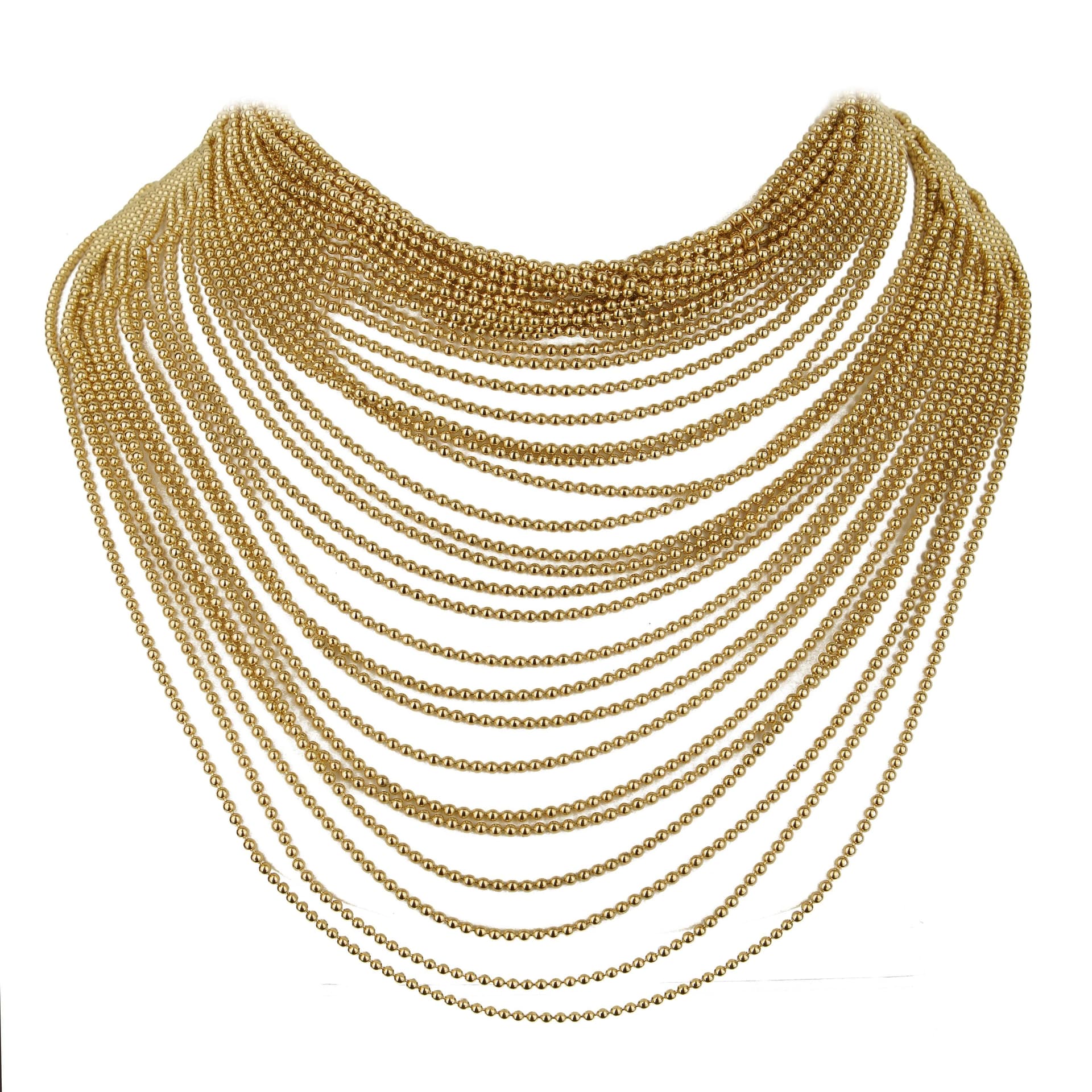
Charles Holl’s 1950s Draperie necklace shows how Cartier-adjacent craftsmanship turns gold into fabric, with Hancocks pricing the gem-set piece at £45,000.
Why Charles Holl still matters
A necklace can look like a flourish and still read like an archive. Hancocks London’s 1950s Draperie necklace, priced at £45,000, is one of those pieces: 18k gold, chain fringe, and over a carat’s worth of diamonds, but the real value sits in the engineering. Charles Holl was the kind of maker insiders study because his name sits close to the work of Cartier and Van Cleef & Arpels, and that association still tells collectors where to look for quality: in the joints, the settings, and the way a jewel moves.
That is why his pieces surface as evidence rather than just decoration. Holl’s maker’s mark was registered on 15 May 1917, and his Paris workshop, first at 20 rue des Victoires and later on rue Volney, was employed by Cartier and Van Cleef & Arpels to make handbags, boxes, cases and jewels. Christie’s places the founding of Holl’s firm in May 1917 and notes later workshops in Strasbourg and New York City in the 1930s, while Bonhams describes him as a master setter commissioned by leading Parisian jewelry houses. For collectors, that combination matters: it places Holl in the network of makers whose technical skill was trusted by the maisons that defined twentieth-century luxury.
How the Draperie necklace is built
The charm of the Draperie necklace is not merely that it resembles fabric, but that it behaves like it. The design uses articulated quatrefoil-shaped panels, which let the gold drape with a supple movement rather than sit rigidly against the neck. Those panels alternate between pleated and spherical motifs, a mid-century construction choice that adds rhythm and makes the surface feel alive when it catches light.
The diamond section is just as exacting. A crescent of round brilliant-cut diamonds is claw-set in platinum and accented with rope-twist gold detailing, surrounding a central knot that gives the whole composition a formal, almost tailored center point. Chain fringe adds a final layer of motion, so the piece does not simply hang, it settles, sways, and folds like couture translated into precious metal. Amy Burton, Hancocks London’s creative director, said the piece has “a distinct softness that feels almost textile in nature,” and that is exactly the kind of tactile description collectors should listen for when a jewel is being described honestly rather than merely marketed.
What to inspect if you are trying to authenticate the look
A necklace like this teaches a practical lesson in identification. Mid-century revival pieces often imitate the silhouette of 1950s jewelry, but they rarely reproduce the subtleties that make the original convincing. In Holl’s case, the signs are structural as much as visual.
- articulated construction that allows real movement rather than a fixed, decorative curve
- quatrefoil panels with alternating pleated and spherical surfaces
- a diamond crescent set in platinum, not simply mounted for sparkle
- rope-twist gold accents that frame the stones instead of overpowering them
- a central knot that anchors the design and keeps the drape balanced
- chain fringe that feels integrated into the architecture of the jewel, not added as afterthought
Look for:
Those details help separate a true period jewel from later homage pieces. The difference is often in the touch: a vintage piece by a maker like Holl tends to feel engineered, not assembled.
Why the price is more than the gold content
At £45,000, the necklace is not priced as bullion or even as a simple diamond jewel. It is priced as a documented piece of mid-century design by a maker with strong workshop credentials and recognizable institutional history. Hancocks London, a Mayfair jeweler offering fine antique, vintage and contemporary jewellery since 1849, is not presenting the necklace as an ordinary sale item but as its April Jewel of the Month, which places it in a curated category where provenance and craftsmanship carry real weight.
The value proposition is clear when compared with anonymous vintage necklaces built from similar materials. Plenty of 18k gold pieces contain diamonds and movement; far fewer combine articulated construction, platinum-set stones, and a maker whose workshop was trusted by Cartier and Van Cleef & Arpels. That is the hidden premium collectors pay for when they buy name, technique, and traceable workmanship rather than surface glamour alone.
The historical trail collectors should remember
The strongest vintage jewels usually leave behind more than a signature. They leave a trail of workshops, commissions, and cross-pollinated expertise. Holl’s story runs from Paris to Strasbourg and New York City, which suggests a maker whose operations scaled beyond one city while keeping a high-end client base. That matters in the vintage market because it helps explain why his name appears in serious jewelry contexts rather than in decorative-footnote territory.
The Draperie necklace also captures a postwar sensibility that still feels modern: clean geometry softened by movement, precious metal treated like a textile, and diamonds used as punctuation rather than excess. It is the sort of piece that rewards close looking, because the most persuasive clue is not the headline price but the way the necklace behaves in space. That is where the lesson lies: in vintage jewelry, the makers trusted by Cartier and Van Cleef & Arpels are often the ones whose work reveals itself only when the clasp opens, the links flex, and the surface starts to move.
This article was produced by Prism’s automated news system from verified source data, official records, and press releases, then run through automated quality and moderation checks before publishing. The system is built and supervised by the people who set the standards it runs under. Read our full AI policy.
Did this article answer your question?