Barrie Artisan Transforms Thrifted Silverware Into Meaningful Wearable Keepsakes
A Barrie artisan turns thrifted spoons and forks into wearable silver keepsakes, guided by health challenges that reshaped what she makes and why.
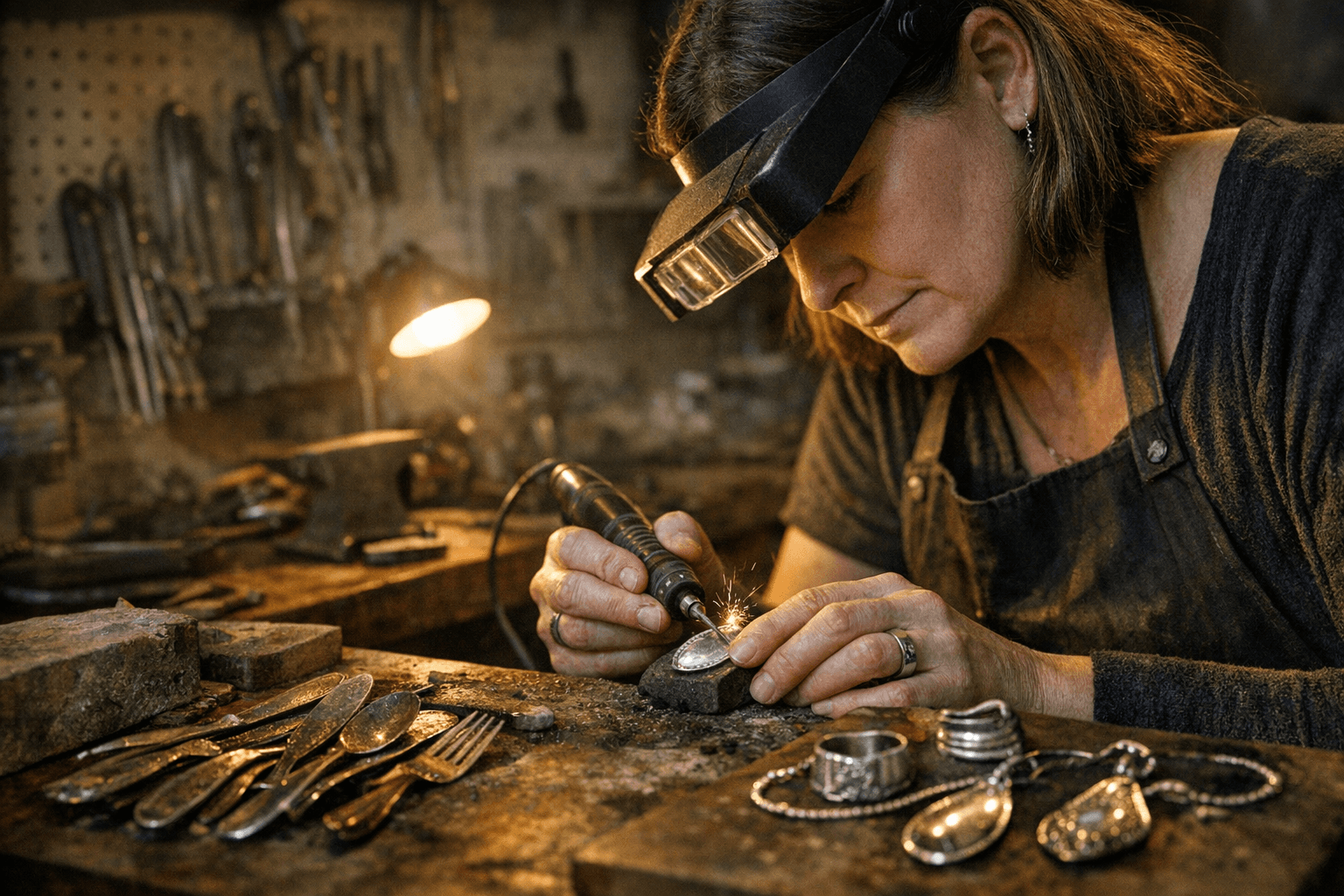
Pick up a tarnished teaspoon from a thrift store bin and you are holding someone's table setting, possibly someone's inheritance, certainly someone's forgotten past. Jessica "Jessie" Ferreira holds those spoons differently. She sees the scroll of a Victorian handle and imagines a ring; she traces the stem of a demitasse fork and pictures a pendant. For the Barrie, Ontario artisan behind Silverware Treasures, that act of seeing differently turned into a craft business and, during a difficult period of health challenges, a lifeline.
Ferreira's process starts at the thrift shop, where she scours bins and shelves for vintage flatware, concentrating on pieces with ornate handles and distinctive patterns that will survive the forming process without losing their character. Not every piece makes the cut. Before anything reaches her bench, it passes a material check that any buyer should understand: sterling silver, stamped "925" or "Sterling" on the reverse side of the handle, bends more forgivingly and wears safely against skin. Silver plate, often marked with the initials "EP," "EPNS," or "IS," carries a nickel-containing base metal beneath its silver coating that can trigger contact dermatitis in sensitive wearers. Knowing what you are buying matters as much as what you are wearing.
Once sourced, the cleaning stage is quiet and deliberate. Warm water, mild dish soap, and a soft cloth lift grime without stripping the patina Ferreira deliberately preserves. That darkening in the recesses of a scrolled handle is not tarnish to be erased; it is contrast, the thing that makes an ornate period pattern legible on a finished ring. Chemical dip cleaners, which professional silversmiths broadly caution against, scour that depth away in seconds and cannot be reversed.
The forming itself, bending spoon handles into ring shanks or curving fork tines into pendant frames, requires graduated pressure and patience. Teaspoons and demitasse spoons with medium-gauge handles tend to be the most workable for rings; thinner plate can crack under repeated stress, while very heavy sterling blanks resist hand-forming. Highly detailed handles with scrollwork, monograms, or floral motifs convert particularly well into pendants, where the original ornamentation becomes the focal point rather than just a surface detail. The bowl of the spoon is typically cut away entirely, leaving just the handle to be shaped.
The profile, published April 8, 2026, framed Ferreira's practice as both an environmental act and a personal one. The work began in earnest during a period when health challenges disrupted her daily structure, and the rhythm of thrifting, cleaning, and forming gave her days a shape that illness had taken away. The silverware she rescues from donation bins was itself often discarded after its original purpose disappeared. The parallel surfaces naturally in the finished pieces, which carry the weight of their previous lives in every preserved hallmark and original engraving.
Local demand in Barrie for one-of-a-kind repurposed pieces has grown steadily, and Silverware Treasures occupies a specific niche within it: not reproduction silver jewelry, but genuine antique flatware with verifiable provenance, converted into something wearable. If you are sitting with a drawer of inherited flatware and wondering whether it belongs on a jeweler's bench or in a donation bag, start by turning each piece over. The stamp on the underside tells you nearly everything: what it is made of, how it will behave under pressure, and whether it is safe to wear. The object in your hand has already outlasted the table it was set on.
Know something we missed? Have a correction or additional information?
Submit a Tip