How to Spot Valuable Vintage Jewelry at Thrift Stores and Estate Sales
Thrift stores hide a surprising number of genuine vintage jewelry finds — here's how to decode hallmarks, clasps, Bakelite, and signed makers before you reach the checkout.
Pick up the brooch. Turn it over. Run your thumb along the back, feel its weight, tilt it toward the light and look for a stamp smaller than a grain of rice. What you're holding isn't just a piece of costume jewelry donated to a thrift store: it might be a signed Miriam Haskell, a sterling silver Art Deco clip, or a slab of carnival-colored Bakelite that collectors would drive three hours for. The difference between walking past it and buying it for two dollars is knowing exactly what to look for — and that knowledge fits in a jacket pocket.
Reading Hallmarks: Your First 30 Seconds
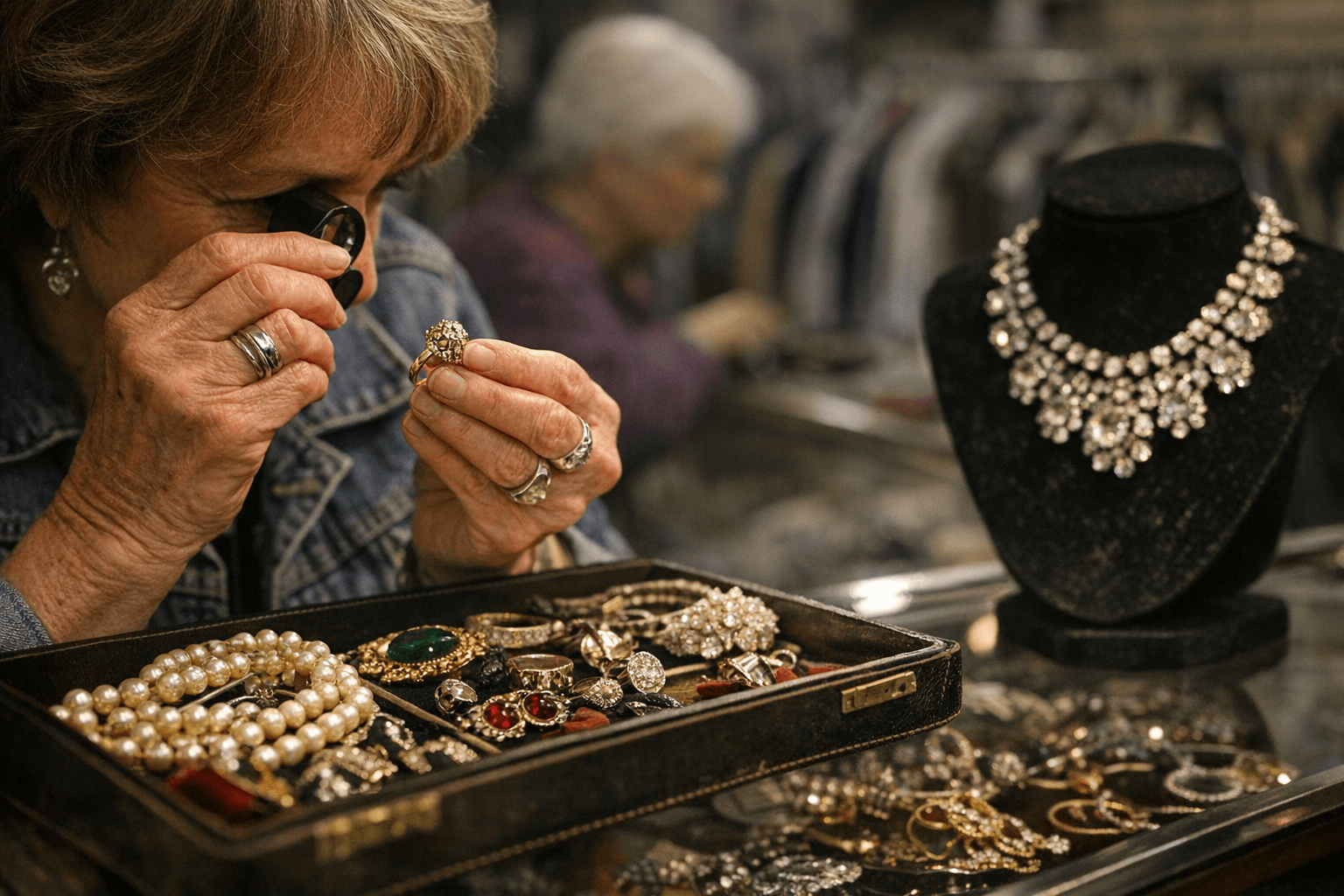
Before anything else, flip the piece over and reach for a loupe. A 10x magnifier is the single most useful tool you can carry to an estate sale, and the marks it reveals are the closest thing jewelry has to a birth certificate.
Hallmarks are stamped marks that confirm the purity of the metal used in the jewelry. "925" indicates sterling silver, and "750" indicates 18K gold. On American pieces, you'll also see "10K," "14K," and "18K" stamped inside ring shanks or on the tongue of a clasp. Maker's marks identify the item's manufacturer, designer, or retailer, providing a direct link to its creation history.
Gold-plated pieces are labeled "GP" for Gold-Plated or "HGE" for Heavy Gold Electroplate, indicating a thin layer of gold over another type of metal. A step above plating is gold-filled, which carries marks like "1/20 12K GF" — meaning the gold layer constitutes at least one-twentieth of the item's total weight, mechanically bonded rather than electroplated, and far more durable. Solid gold it is not, but gold-filled American pieces from the 1930s through 1960s hold their finish and their value in a way that plated pieces simply don't.
Hallmarking in Great Britain dates back to the 14th century, and any piece of British jewelry made prior to 1999 was required to include a date letter stamp, a letter corresponding to the year it was registered with the assay office. The United Kingdom has four assay offices: London uses a leopard's head, Sheffield a rose, Birmingham an anchor, and Edinburgh a castle. Spotting an anchor on a silver bangle tells you it was assayed in Birmingham; from there, the date letter narrows the decade. Jewelry marks in France date back even earlier, with a maker's mark framed within a lozenge — a diamond-shaped charge — required from 1797.
Plated, Filled, or Solid: The Distinction That Changes Everything
The weight of the jewelry can be a clue: vintage pieces made with solid gold or silver tend to feel heavier than their plated counterparts. Pick up two superficially similar brooches and bounce them gently in your palm. The denser one almost always wins. Plating also wears through at high-contact points — the back of a ring, the edges of a bracelet — revealing a coppery or silver-toned base metal underneath. That wear tells you what you're holding; a piece with consistent color even at its edges is far more likely to be filled or solid.
The abbreviation "STER" is shorthand for sterling and appears frequently on mid-century American silver. European silver often reads "800" rather than "925," indicating 80% silver content, common in Scandinavian and German pieces from the early twentieth century. Neither mark is as obvious as a full word stamp, so slow down and look at every flat surface on the reverse.
Bakelite and Early Plastics: The Smell Test
Bakelite was first used in 1907. The chunky bangles, carved brooches, and polka-dot clips it produced have developed a devoted collector following, and fakes — or more often, later plastics confused for Bakelite — are everywhere. Three tests, used together, are reliable.
The most accessible is the hot water test. Dip your item into hot water or create friction by rubbing it on a piece of clothing. Authentic Bakelite will have a chemical smell of formaldehyde. The smell is distinctive: faintly acrid, phenolic, impossible to confuse with anything modern. If your nose isn't sensitive, move to the Simichrome test. Apply a very small amount of Simichrome polish to a cotton swab, then rub it on the piece. The Simichrome, which comes out of the tube a very light pinkish color, will turn yellowish on the swab if the piece is Bakelite. Simichrome will strip the patina off your piece if used too vigorously; use it sparingly and if at all possible, test on the reverse side. The third indicator is weight: real Bakelite feels heavier and denser compared to lightweight plastic imitations.
Signed Costume Makers Worth Knowing by Name
The costume jewelry market is enormous, but a small group of signed makers consistently outpaces the rest. Learn their signatures and you can scan a tray of tangled pieces in under a minute.
Miriam Haskell jewelry, working commercially by 1925 and founded in New York in 1926, is known for its interesting designs and quality electroplating and beadwork. European beads and Bohemian crystals were the norm for Haskell. While many of the components were die-stamped metal, including filigree backings used extensively from the late 1940s on, each piece displays hand-manipulated construction. Individual components were wired together by hand. Look on the clasp, pin back, or other area of Haskell jewelry to confirm its origin. The signature "MIRIAM HASKELL" appears impressed or raised, and after the war the company introduced a distinctive hook-and-tail clasp with a decorated, signed hook at one end and a pearl or bead extender at the other. The Miriam Haskell company was sold in 1990.
Alfred Philippe designed many iconic Trifari pieces during the 1930s-1960s golden era. Trifari's crown logo, stamped alongside the brand name, is one of the most recognizable marks in signed costume jewelry. Ciner, founded in 1931 as a fine jewelry company, transitioned to high-end costume jewelry during the Depression. Early 1930s pieces used sterling silver and often went unmarked. By the 1940s, pieces were clearly marked "Ciner" with copyright symbols becoming standard. Kramer of New York operated from 1943 to 1980, specializing in high-quality rhinestone sets and parures. Marks include "Kramer," "Kramer of NY," and "Kramer of New York." Other names that reward quick recognition: Weiss (1942-1971), known for aurora borealis rhinestones; Lisner, for mid-century lucite leaf pieces; and Eisenberg, for bold, heavily jeweled brooches that have never stopped climbing at auction.
Clasp Dating: The Overlooked Era Clock
The clasp on the back of a necklace or bracelet is one of the most reliable era indicators on the piece, and most shoppers never look at it.
Spring ring clasps date back to the early 1900s. They're circular, with a small lever that slides back to open the ring — secure and elegant, still used today, but their presence alone doesn't date a piece. More diagnostic is the fishhook clasp: fishhook clasps were commonly used from the 1920s to 1950s and feature a hook inserted into a tube or barrel-like enclosure. A box clasp, where a flat tab presses into a decorated rectangular housing, is associated with Victorian and Edwardian jewelry and was still common through the 1950s on higher-quality pieces. Hook clasps were often used on multi-strand necklaces from the 1950s and 1960s.
The single most useful elimination rule: lobster claw clasps were invented in 1996, so they are not found on vintage pieces unless the clasp has been changed at some point. If a necklace carries a lobster claw and is being sold as "1940s," the clasp has been replaced or the dating is wrong. Neither is necessarily fatal to the piece's appeal, but it changes your read entirely.
Several chain styles can help determine a piece's timeframe. Chains involving non-metal materials such as Bakelite were fashionable during the early and mid-20th century, while brick-style chains gained popularity in the 1940s.
Your Pocketable Checklist
Carry these tools and run through this sequence at any thrift store or estate sale table:
- 10x loupe: check inside ring shanks, clasp tongues, pin backs, and bracelet links for hallmarks
- Bounce test: solid and gold-filled pieces feel noticeably heavier than plated; trust your palm
- Wear check: plating reveals base metal at high-contact points; sterling and solid gold stay consistent
- Clasp read: lobster claw means post-1996; fishhook means 1920-1950; spring ring is pre-WWII until now
- Signature scan: check the clasp face, the pin back oval, the cartouche on a brooch stem
- Bakelite rub: friction from your thumb on a suspected piece; if it smells faintly chemical, test further with Simichrome
- Weight plus density: Bakelite is heavier than later acetate plastics; solid metals outweigh hollow or plated ones
Three Cleaning Mistakes That Permanently Damage Vintage Pieces
Getting a piece home and reaching for the cleaning cabinet is instinctive. These three mistakes are irreversible.
Ultrasonic cleaners on foil-backed rhinestones. The vibrations that work beautifully on a modern diamond solitaire will shatter the silver or gold foil backing on vintage rhinestones, turning a bright, mirror-like stone permanently dull. There is no repair. Foil-backed stones in Art Deco and mid-century pieces should only be wiped gently with a dry cloth.
Chlorine bleach on gold alloys or organic materials. Bleach pits and permanently stresses the alloy structure of karat gold, and it destroys pearls, coral, turquoise, and amber on contact. A single soak can turn an iridescent freshwater pearl chalky and opaque. For metal cleaning, lukewarm water and a few drops of mild dish soap, applied with a soft toothbrush, is the only safe general-purpose method.
Soaking any glued construction. Costume jewelry from the 1940s through 1960s, including most Trifari, Ciner, and Kramer pieces, used adhesive to seat prong-set and channel-set stones. Soaking dissolves that adhesive, and stones begin falling out hours or days later — sometimes after the piece has already been resold. If you can see adhesive residue around the bezel of a stone, treat the whole piece as moisture-sensitive and clean only the metal surfaces.
The most significant finds at estate sales are rarely the obvious ones laid out under glass. They're in the tray of tangled chains, the cardboard box of brooches with bent pins, the bag of bangles shoved to the back of a shelf. What separates the collector who spots the signed Haskell from the one who walks past it is not luck. It's thirty seconds, a loupe, and knowing which side of the piece to turn over first.
This article was produced by Prism’s automated news system from verified source data, official records, and press releases, then run through automated quality and moderation checks before publishing. The system is built and supervised by the people who set the standards it runs under. Read our full AI policy.
Did this article answer your question?