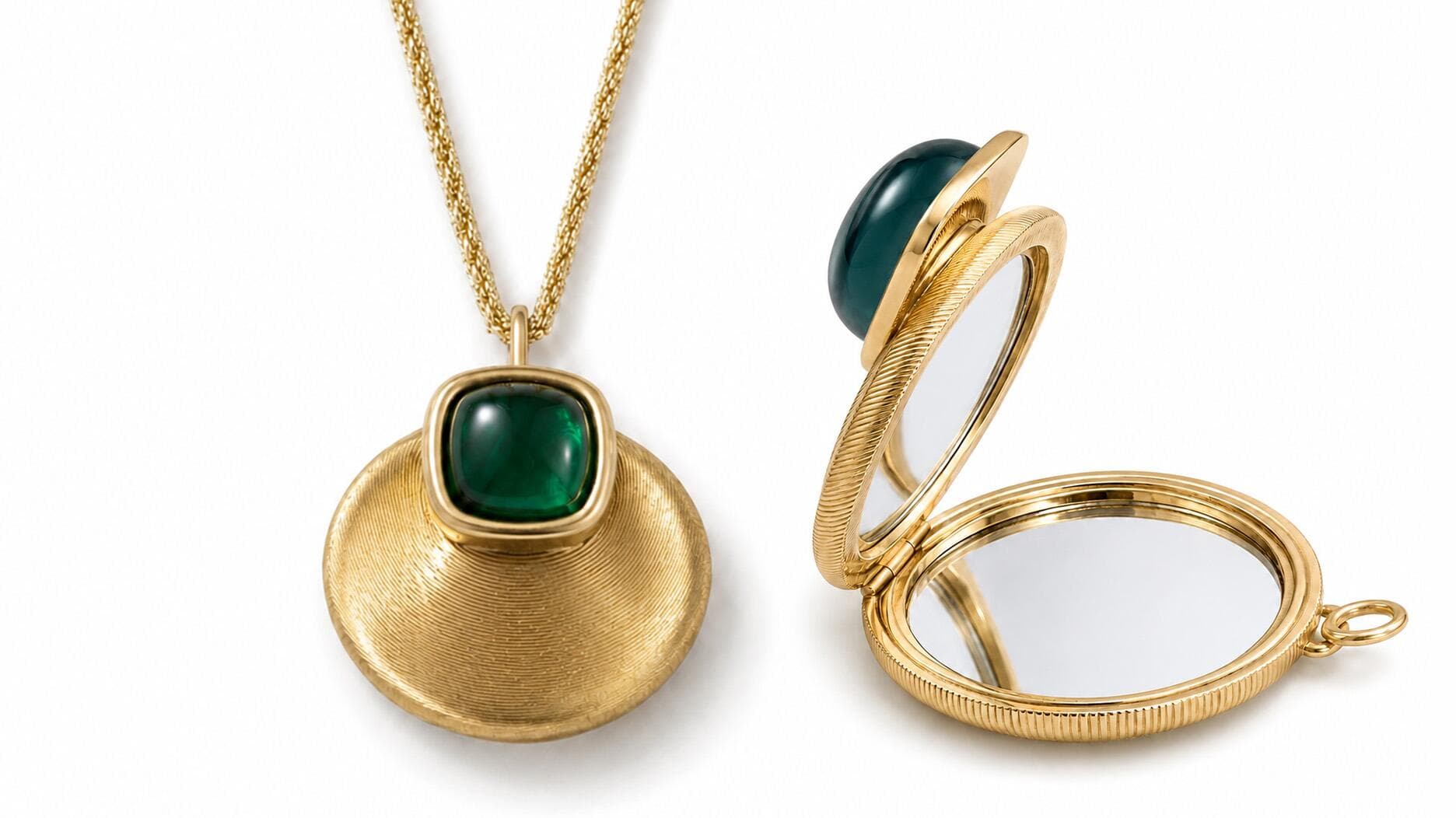
Casey Perez’s Loma pendant blends vintage curves, botanical form
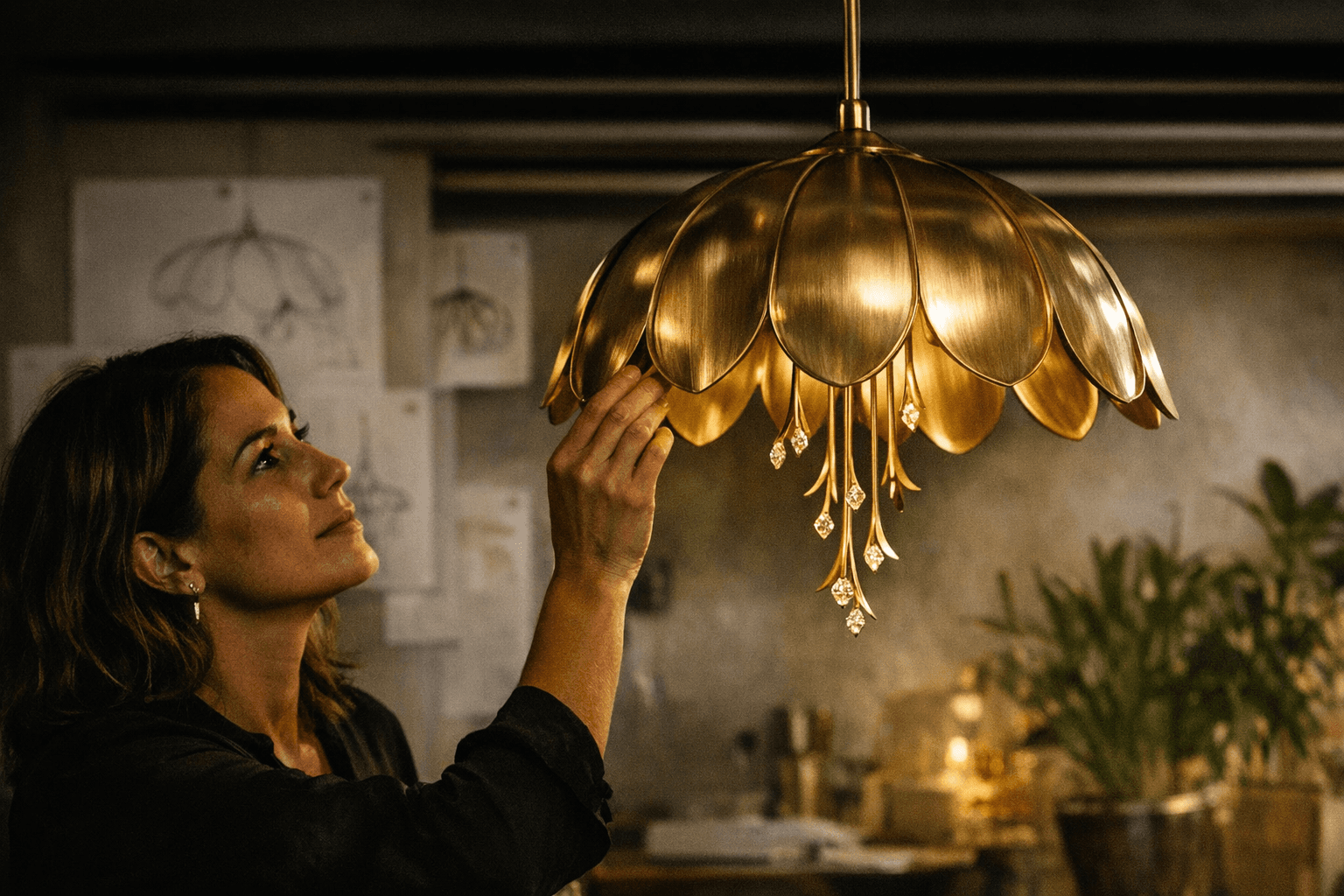
Casey Perez’s Loma pendant turns a scalloped lampshade into a gold study in contour, botanical rhythm, and natural diamonds. It shows how to read vintage shape language.
The curve that does the storytelling
Casey Perez’s Loma pendant looks gentle at first glance, then reveals how carefully it is built. Its softly contoured gold silhouette takes its cue from a vintage scalloped lampshade, but the piece does more than borrow a pretty outline. It translates domestic form, botanical rhythm, and a sense of movement into something that sits close to the body and reads as both sculptural and wearable.
The name sharpens that idea. Loma comes from the Spanish word for hill or slope, a choice that quietly suggests contour, rise, and the easy lift of a line that never feels forced. Perez has described the pendant as “soft yet structural and easy to wear,” and that balance is exactly why the piece feels familiar to anyone who has studied vintage jewelry closely: it has the hush of an older object without the stiffness of a reproduction.
Why the Loma pendant feels like a vintage object, not a copy
The best vintage-inspired jewelry rarely quotes a single source too literally. Instead, it absorbs a family of shapes, and Loma does that well by moving between a scalloped lampshade, botanical structure, and the rounded logic of domestic objects made precious. Perez has said her wider practice is about translating architecture, objects, and natural forms into wearable pieces that feel personal and lived with, and that approach is visible here in the pendant’s soft edges and measured contour.
That same logic helps explain why the piece feels collectible rather than trendy. Collectible vintage pendants and lockets often share this quiet tension between utility and ornament: a scalloped rim, a domed face, a softened border, or a surface that suggests petals, leaves, shells, or the curve of a household object. Loma belongs to that lineage because it asks the eye to notice shape before shine.
Botanical structure gives the gold its rhythm
Perez first encountered Karl Blossfeldt while studying art history, and his photographs of plants’ architectural structure shaped the way she thinks about rhythm, repetition, and sculptural presence in jewelry. That influence matters here because Blossfeldt’s lens was never just about decoration. It was about the internal order of a leaf, stem, or bud, and Loma echoes that idea in the way its contours feel organized rather than merely ornamental.
For readers trying to decode similar pieces in vintage cases, that is a useful clue. Botanical influence in jewelry is not always obvious flower petals or vine motifs. Sometimes it is the underlying cadence of a form, the repeated swell of a rim, the suggestion of growth in a rounded profile, or a softened edge that looks as if it could have opened or unfolded.
Gold and natural diamonds carry the material story
Perez has said that gold carries “warmth and lineage,” and that phrasing gives the piece a second layer of meaning. Gold is not just chosen for color here; it is chosen for how it stores memory, weight, and continuity. Paired with natural diamonds, the pendant gains a material seriousness that feels especially apt for a design so interested in time and inheritance.
Natural diamonds bring their own appeal because, as Perez has put it, they were formed over spans of time far beyond our own. That geological scale adds mystique and gravity to a jewel that is otherwise visually soft. In a pendant like Loma, the contrast matters: the visual language is tender, but the materials ground it in permanence and old-world heft.
Casey Perez’s path shows in the precision
Perez is Brooklyn-based, but her story reaches back to Dallas, where she grew up as a first-generation Mexican American. She studied psychology and art history at New York University, and that combination helps explain why her work feels both analytical and intimate. She began her jewelry career as a bench jeweler at Pamela Love in 2011, then moved to Joomi Lim in 2013, building a foundation in the physical realities of making before establishing her own voice.
That insistence on direct contact with the work still defines her practice. Perez has said she started her own company because she wanted designs to emerge through hands-on work with metal, wax, or clay, and even when she collaborates with other craftspeople, she stays closely involved in prototyping, soldering, polishing, and stone-setting. That level of involvement shows up in the finish of a piece like Loma, where the smoothness is clearly earned rather than machine-perfect.
Her earlier career milestones also help place her within a larger design conversation. In 2022, she was part of the Emerging Designers Diamond Initiative cohort, which included a $20,000 diamond credit, mentorship, and retail opportunities. The program launched its second cohort exclusively on 1stDibs beginning June 17, 2022, and Perez said the experience mattered because it let her show work alongside admired art and design figures, including Dorian Webb, Malyia McNaughton, Jameel Mohammed, Ruben Manuel, Mckenzie Liautaud, Halle Millien, Corey Anthony Jones, and Lana Ogilvie.
How to spot the same language in vintage pendants and lockets
Once you know what Loma is doing, older pieces become easier to read. The pendant teaches a useful set of visual cues: softer outlines, scalloped borders, botanical echoing, and forms that feel lifted from the domestic world rather than designed only from jewelry convention. Vintage pendants and lockets often hide their strongest character in these small decisions.
Look for these details:
- Scalloped or petal-like edges that soften the frame without making it fragile.
- Domed or low-relief surfaces that suggest a shell, seed pod, lampshade, or flower bud.
- Botanical rhythm, meaning repeated curves, radiating lines, or organic symmetry rather than stiff geometry.
- Domestic-object inspiration, where the silhouette feels borrowed from a lamp, dish, clasp, mirror, or box.
- A back side that tells its own story through wear, hinge placement, or maker’s marks, which often matter as much as the face of the jewel.
That is the larger value of Perez’s Loma pendant. It is not simply a new jewel with vintage references. It is a lesson in how design lineage survives through contour, and how a softly shaped object can carry both the memory of the home and the authority of precious material.
This article was produced by Prism’s automated news system from verified source data, official records, and press releases, then run through automated quality and moderation checks before publishing. The system is built and supervised by the people who set the standards it runs under. Read our full AI policy.
Did this article answer your question?