Flower and Petal Motifs Bloom Across Fine Jewelry Collections
Flower jewels are reading like vintage codes again, from Victorian pansies and daisies to Art Nouveau curves, Retro scale, and modern gemstone drama.
A floral jewel gives itself away in the petals before it ever reaches the ear, wrist, or collarbone. This spring’s collections make that easy to read, from Oscar Heyman’s one-of-a-kind high jewelry to Tacori’s layered blooms and a wide sweep of daisy, rose, and petal forms that borrow openly from the past.
The new bloom is a clue, not a cliché
The strongest sign that floral jewelry is having a serious season is the range. National Jeweler notes an increase in 2026 collections centered on flower and petal designs, and the motif is moving well beyond predictable spring prettiness. Gold and diamonds still anchor the category, but florals are now appearing in titanium, suede, horn, and hand-painted porcelain, which tells you that brands are treating the bloom as a structure, not just a surface decoration.
That broader mood matches the rest of spring 2026 jewelry, where WWD points to self-expression, heirloom references, color boosts, minimal lines, and statement pieces as the season’s key currents. Florals fit that landscape because they can be read in two directions at once: as romantic shorthand and as a test of craftsmanship. The best versions are not about copying a blossom. They are about turning a blossom into a design language.
Oscar Heyman’s workshop-made flowers set the tone
Oscar Heyman’s first spring catalog, launched on March 30, is built like a collector’s field notebook. It presents 35 one-of-a-kind pieces made in the brand’s Madison Avenue workshop in New York City, and the company frames it as a preview for 2026 ahead of Couture in Las Vegas. Oscar Heyman has been creating jewelry since 1912, and every piece is signed and numbered, which gives its floral work the kind of identity record collectors like to see.
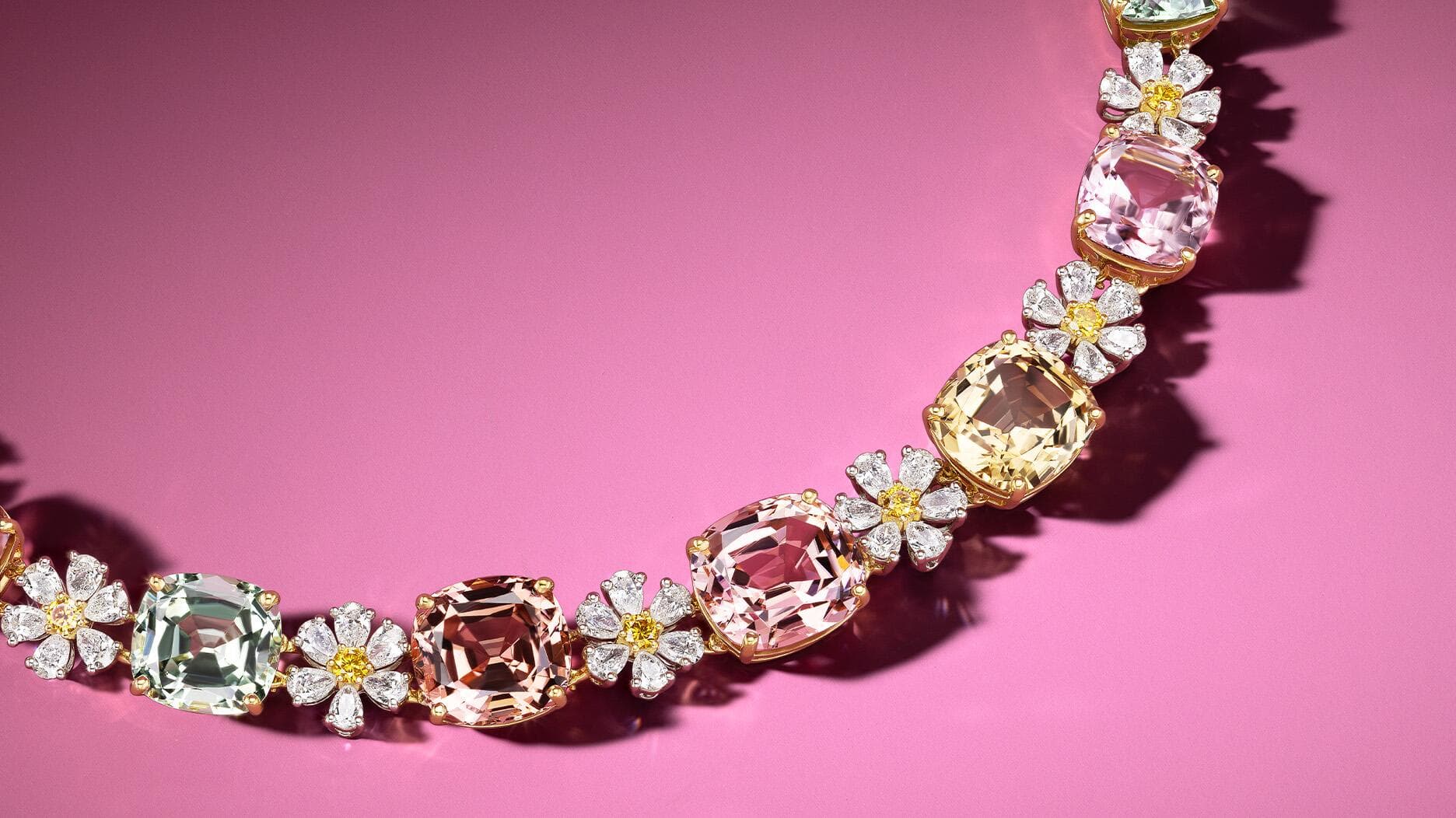
The standout is the platinum and 18-karat yellow gold Flower necklace, priced at $400,000, with cushion-cut multi-color tourmalines, pear-cut white diamonds, and round-cut fancy color diamonds. That mix is useful to study because it shows how a floral jewel can read as a gemstone study rather than a literal bouquet. The catalog also brings in rare stones including sphene, unheated spinel, Paraíba tourmaline, cat’s eye, star rubies, star sapphires, and black opals, all of which push the flowers toward high-jewelry seriousness instead of decorative novelty.
Oscar Heyman’s Pansy earrings belong to the same vocabulary. Pansies have long carried symbolic weight in jewelry, and when a house with this kind of workshop lineage chooses that motif, the result feels less seasonal than archival. The flower is not just the subject. It is the signature.
How to read the older codes inside the 2026 bloom
Victorian floral jewels are usually the easiest to recognize because they tend to be sentimental, compact, and rich in meaning. Look for daisies, pansies, and roses; yellow gold or two-tone metal; cluster settings; and stones that feel lush rather than sparse. Monica Rich Kosann’s Loves Me daisy necklace is a direct example of that language, with sterling silver and 18-karat yellow gold, a center bezel-set yellow sapphire, and white sapphire petals. The childhood “he loves me, he loves me not” reference makes the piece feel personal, which is exactly how Victorian-inspired jewelry often works.
Art Nouveau florals read differently. They are less about perfect symmetry and more about movement, carved surfaces, and a sense that the jewel grew instead of being assembled. Emily P. Wheeler’s Flower Bolo captures that mood with an antique turquoise flower carving, rubellite, diamond pavé, and an adjustable suede cord. The Flower Bolo and the Tiare ring show how floral jewelry can feel sculptural and tactile without becoming fussy. If a piece seems hand-shaped, slightly asymmetrical, and materially mixed, you are probably closer to this lineage.
Retro floral jewelry favors scale and drama. The petals get bigger, the color gets louder, and the silhouette is designed to be seen across a room. Boochier’s Rainbow Flower Puff bracelet and Flower Puff pendant fit that reading with rainbow sapphires, diamonds, and flower elements measuring 10 mm wide. Adam Neeley’s Callara earrings and Rosa Petula necklace go in a more poetic direction, but the brand’s description of Rosa Petula as modern botanical jewelry inspired by a rose’s final breath of beauty signals the same instinct: take the flower, enlarge its emotional charge, and let the form feel deliberately theatrical.
Mid-century floral jewels tend to simplify the bloom into a cleaner, more architectural shape. Petals still matter, but they are often stylized, layered, and easier on the eye than the tightly packed bouquets of earlier periods. Tacori’s Dahlia Fine Jewelry Collection fits that category neatly. The brand says it is inspired by layered blooms and built around deconstructed petals, with the idea that petals gently enfold one another to form a network of beauty and support. The Dahlia engagement ring, in 18-karat yellow gold with a round-cut diamond and diamond pavé, is priced at $16,990 without the center stone, and its floral silhouette feels polished rather than ornate.
The rest of the field is widening the motif
The floral story is not confined to a few headline names. Monica Rich Kosann’s sterling silver Flower studs, Boochier’s Flower Puff pendant, and Pippa Small’s Flora Flower fringe necklace and Flora multi-drop studs show how the motif moves from high jewelry into pieces that can still carry personality without becoming costume. Nada Ghazal’s My Muse ring belongs to the same emotional territory, where the flower is less a literal botanical study than a private emblem. Tacori’s broader floral engagement-ring assortment also keeps the code alive, describing floral rings as petal-inspired designs with diamonds and metalwork that create a romantic, feminine silhouette.
That range is what makes the current floral wave worth reading closely. When a motif shows up in a $400,000 Oscar Heyman necklace, a daisy necklace with a bezel-set sapphire center, a suede-cord bolo, and a 10 mm rainbow flower bracelet, it is no longer a trend in the shallow sense. It is a vocabulary. The collector’s eye can see the difference immediately: Victorian sentiment in the symbolism, Art Nouveau in the handwork, Retro in the scale, and mid-century polish in the clean petal lines. In 2026, the best floral jewels are blooming because they know exactly which era they are speaking to, and which one they are leaving behind.
This article was produced by Prism’s automated news system from verified source data, official records, and press releases, then run through automated quality and moderation checks before publishing. The system is built and supervised by the people who set the standards it runs under. Read our full AI policy.
Did this article answer your question?