Hysteria turns Victorian symbols and reclaimed cameos into modern jewelry
Hysteria recasts cameos, corsetry, and the word hysteria itself as modern talismans, giving vintage symbolism a sharper, feminist edge.
A revival built on reclamation
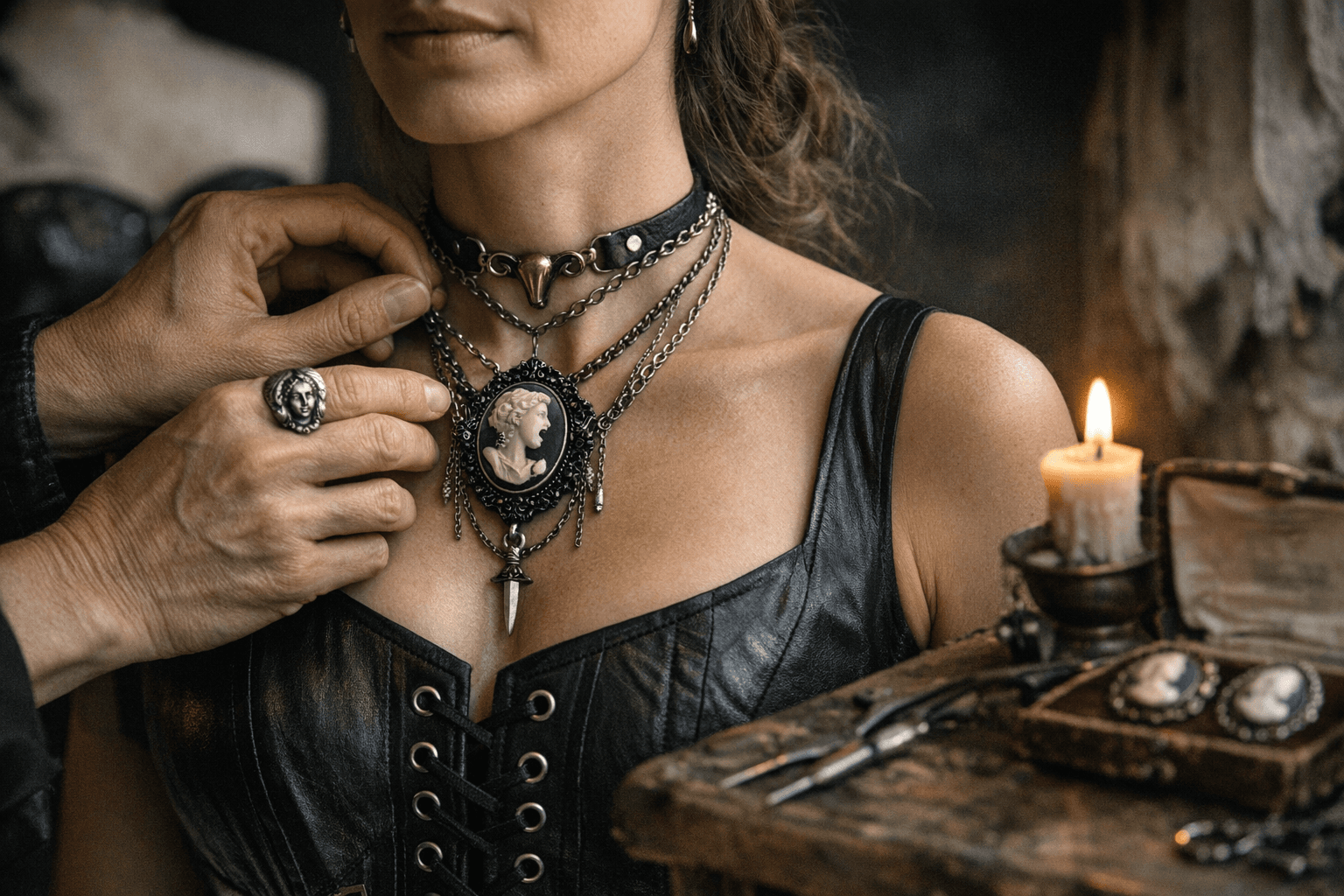
A cameo has always been more than decoration. In the right hand, it reads like inheritance, memory, and identity compressed into a small oval of relief, which is exactly why Jackie Ansell has made it the language of Hysteria. Her brand turns one of vintage jewelry’s most recognizable forms into a collector’s entry point, where Victorian imagery becomes less costume than code.
The name matters as much as the objects. Hysteria is meant to reclaim a word once used to dismiss women and turn it into a symbol of power and defiance, a reversal that gives the jewelry its charge before you ever fasten a clasp. Ansell has also said the brand draws on a much older history, one that links hysteria to ancient Egypt, to the Greek word hystera, and to a long tradition of women being defined by systems that misunderstood them. That tension, between being labeled and being self-authored, is the engine behind the collection.
How to read a cameo now
The appeal of reclaimed cameos is that they already know how to speak. Cameos date back to the ancient Mediterranean, then surged again in the Victorian era, when jewelry often carried moral, romantic, or memorial meaning in miniature. A profile in relief, especially a woman’s profile, is rarely neutral. It can evoke antiquity, femininity, restraint, grief, or idealized beauty, depending on what surrounds it and how severely the silhouette is cut.
That is why Hysteria’s cameos feel so legible. In Victorian jewelry, female imagery often carried layered symbolism: the serene face could stand for virtue, silence, or composure, while the overall form could soften or complicate that message with lace, bows, or mourning-black accents. When you see a cameo today, read it the way you would read a hallmarked ring: as a record of taste, era, and intent. A classical profile suggests revivalism, while a more stylized, theatrical or deliberately restrained face pushes the piece toward commentary rather than nostalgia.
Victorian symbols, reworked
Hysteria’s debut collection, The Awakening, officially launched in January 2026, and the brand describes it as a reinterpretation of Victorian corsetry and lacework as symbols of elegance and quiet power. That framing is smart because it turns the language of constraint into ornament. Corsets, lace, and tight framing once signaled discipline and decorum; Hysteria translates those ideas into jewelry that feels structured without being brittle.
The collection’s imagery is not a literal copy of the past. Instead, it treats Victorian symbolism as raw material. The brand’s own description of the line positions these forms as something once used to confine, now recast as modern adornment. In the current jewelry market, where many brands lean on clean geometry or overt luxury cues, that choice gives Hysteria a distinct point of view: historical, but not precious; feminine, but not passive.
The pieces that define the story
The clearest example is the Shackle of Ophelia necklace, priced at $575. Ansell has described it as a reimagined functional, antique-inspired padlock that becomes armor, and that idea lands because it balances delicacy with restraint. At that price, the necklace sits firmly in demi-fine territory: serious enough to imply craftsmanship and concept, but still within reach for a buyer looking for a statement piece with narrative weight.
The same logic shapes the rest of the shop. The Cinched Cameo Earrings, at $345, and the Cinched Cameo Ring, at $295, bring the cameo from collector’s object to everyday signifier. They are the kind of pieces that let a wearer participate in the antique language without needing a full estate jewel on the wrist or neckline. The Keeper of All Treasures Charm Necklace Set, priced at $990, is the most ambitious of the current offerings and the most overt in its symbolism. Hysteria says it is inspired by the shape of a uterus and includes every charm in The Awakening collection, which makes it less a single jewel than a wearable manifesto.
Why the craftsmanship matters
Hysteria says its demi-fine jewelry is designed in New York and hand-crafted in Rhode Island, a combination that places the brand within the current American revival of small-scale, design-led jewelry production. Its stones are sourced from around the world, and the bone-carved stones are ethically produced by skilled female artisans in Bali. JCK also reports that the brand’s cameos are created by female artists in Bali, which matters because the gendered authorship is not just a branding flourish. It reinforces the collection’s central argument: women are not only the subjects of the imagery, they are the makers of it.
That is one reason the brand feels more convincing than a straightforward Victorian pastiche. The making process is part of the message. A cameo carved by women and a motif chosen to honor women’s history do not merely decorate the concept, they complete it. The result is jewelry that looks antique in spirit but contemporary in ethics and authorship.
The personal story behind the mythmaking
Ansell’s background helps explain why the brand feels so layered. She has said her path spans art, design, psychology, and technology, and that a childhood steeped in creativity was reinforced by a summer job at an art museum, where she learned that the work behind beauty is rarely glamorous. That sensibility shows in Hysteria’s balance of elegance and message. The jewelry is polished, but the ideas underneath are sharpened.
Her personal life also sits inside the brand. Ansell has tied Hysteria to her sister’s experience with myalgic encephalomyelitis/chronic fatigue syndrome, describing the company in part as an ode to her sister and to the broader female experience. That gives the collection a quieter emotional anchor beneath its mythology. The jewelry is not only about the public history of women, but also about private endurance, care, and recognition.
From side hustle to brand statement
Ansell built Hysteria while balancing a side hustle with full-time corporate work for years, until Walmart asked her to relocate from New York City to Arkansas, which she described as the signal to move forward. That trajectory is familiar to many independent designers, but Hysteria benefits from the tension it creates: the brand is polished enough to enter the market as a fully formed identity, yet personal enough to feel lived in.
JCK says Ansell was preparing to exhibit the brand at Brand Assembly in New York City later that month after the January launch, which positioned Hysteria not as a nostalgia project but as a contemporary label entering the trade conversation. That is the larger point of the collection. Reclaimed cameos are not interesting because they are old. They are interesting because they let a modern wearer decode a symbol of femininity, read its history, and decide whether to keep the old meaning or turn it inside out. In Hysteria’s hands, the cameo becomes less a relic than a declaration.
This article was produced by Prism’s automated news system from verified source data, official records, and press releases, then run through automated quality and moderation checks before publishing. The system is built and supervised by the people who set the standards it runs under. Read our full AI policy.
Did this article answer your question?