How to Read UK Gold Hallmarks, Fineness Marks Reveal Vintage Purity
A tiny fineness mark can tell you if a vintage ring is 9ct, 18ct, or 22ct, and the date letter can turn a guess into a narrow age range.
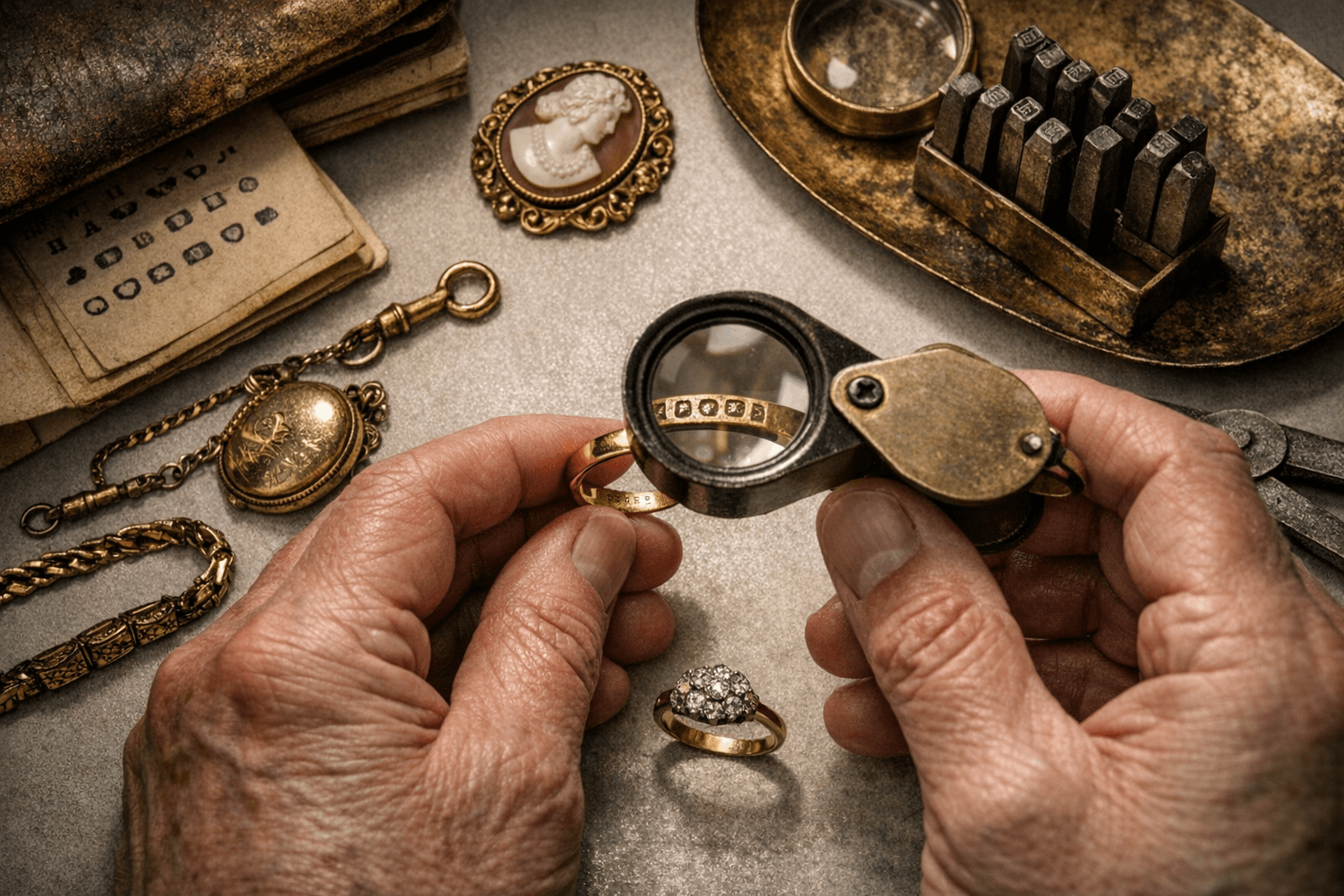
An inherited brooch or an estate-sale ring is a small archive. The first thing to read is not the sparkle, but the stamp: on UK gold, that little cluster of marks is a legal record that the piece was independently tested, meets purity standards, and carries clues to where it was marked and who submitted it.
Start with the fineness mark, not the date letter
When you are decoding vintage gold, the purity number comes first. UK hallmarks use fineness marks that translate the metal content into a plain numerical code, and that code is the fastest way to separate a true 18ct piece from something lighter or heavier. In collector terms, this is the difference between guessing and reading the object correctly.
Look for the number stamped into the gold, then match it to its karat equivalent:
- 375 means 9ct gold
- 585 means 14ct gold
- 750 means 18ct gold
- 916 means 22ct gold
- 999 means the metal is as pure as it can be
There is also 990 under convention rules, which sits close to the top of the purity scale and is part of the official system for gold. For a buyer or heir, this matters immediately: a 750 mark tells you you are handling 18ct gold, while a 916 mark points to 22ct gold, which is richer in gold content and often softer in wear.
What the stamp is really saying
A UK hallmark is not a decorative flourish. It is a set of component marks that work together, and each part adds a layer of meaning. One mark identifies the fineness, another identifies where the piece was hallmarked, and another points to the sponsor, the person or business that submitted it.
That is why hallmarks are so useful on vintage and estate pieces. They do more than verify metal. They turn a ring, chain, or cuff into something traceable. In a market full of vague descriptions and optimistic listings, a clear hallmark is one of the few clues that cuts through the noise.
Then use the date letter as the second filter
Once you know the fineness, the date letter helps narrow the age. The letter changes every year, and in modern practice it changes on 1 January, so it can turn a broad period into a much tighter estimate. For vintage jewelry, that second step is where the story deepens: the same 750 mark can appear on many different decades of gold, but the date letter helps place the piece on a timeline.
The catch is that the system is not universal across all eras. Before 1975, each UK assay office used its own date-letter system. After 1975, the offices adopted the same lettering system, which makes later pieces easier to read at a glance. If you are trying to identify a piece struck before 1975, the assay office matters as much as the letter itself, so the hallmark must be compared against the correct published table for that office.
A modern example helps show how the system works: the date letter for 2024 was a lower-case z. That annual change is the key logic behind the mark. It is not there to decorate the gold. It is there to date it.
Why older hallmarks need a collector’s eye
Hallmarking in London goes back more than 700 years. The hallmarking statute was passed in 1300, and the London Assay Office was established at Goldsmiths’ Hall in 1478. That long paper trail is part of why UK gold remains so readable today: the system was built to protect buyers, enforce standards, and preserve trust in precious metal.
For historic pieces, the Goldsmiths’ Company Library and Archive can help identify hallmarks struck before 1975, especially when the marks are clear enough to examine in image form. That is the right mindset for inherited jewelry: the stamp is not a mystery to rush past, it is evidence to study carefully.
What this means for provenance, authenticity, and everyday buying
The practical value of a hallmark is simple. It tells you when and where an item was tested and marked, what metals it contains, their purity or fineness, and who submitted it. That is provenance in miniature, and it is exactly why serious collectors treat hallmarks as part of a jewel’s biography.
The scale of the system shows how central it remains. The London Assay Office hallmarks around 3 million precious-metal items a year and holds more than 10,000 active sponsor’s marks. That is not a niche antiquarian practice. It is a living trade structure, still shaping how gold is verified in the UK market and beyond.
A practical way to inspect a vintage piece
If you are looking at a ring, brooch, chain, or pair of earrings, use the marks as a sequence rather than a jumble:
1. Find the stamp cluster on the most likely hidden surface, such as the inside of a shank, the clasp, or the post.
2. Read the fineness number first, because that tells you the purity category.
3. Match 375, 585, 750, 916, 990, or 999 to its gold content and karat equivalent.
4. Use the date letter as the second filter, then compare it with the correct assay-office table for the period.
5. If the piece appears to predate 1975, treat the office identification as essential, not optional.
That sequence prevents one of the most common misreads in vintage buying: assuming that a date letter alone tells the whole story. It does not. Purity comes first, age comes second, and only together do they make the piece legible.
Why the legal framework still matters
The Hallmarking Act 1973 remains the main legal framework for UK hallmarking, and the British Hallmarking Council sits inside the official guidance system that supports it. For imported and exported jewelry, convention hallmarks also matter, because they allow gold to be recognized across borders under shared fineness standards.
For collectors, that has a direct payoff. A well-read hallmark can confirm whether a piece is truly 9ct, 18ct, or 22ct, help distinguish later work from earlier estate finds, and support the case for authenticity when the listing language is vague. In vintage gold, the smallest marks often carry the clearest truth.
This article was produced by Prism’s automated news system from verified source data, official records, and press releases, then run through automated quality and moderation checks before publishing. The system is built and supervised by the people who set the standards it runs under. Read our full AI policy.
Did this article answer your question?