Oscar Heyman’s flag brooch, a patriotic classic since 1917
Oscar Heyman’s flag brooch began as a 1917 wartime commission and became a signed house motif. Its museum provenance and repeated design keep it collectible.
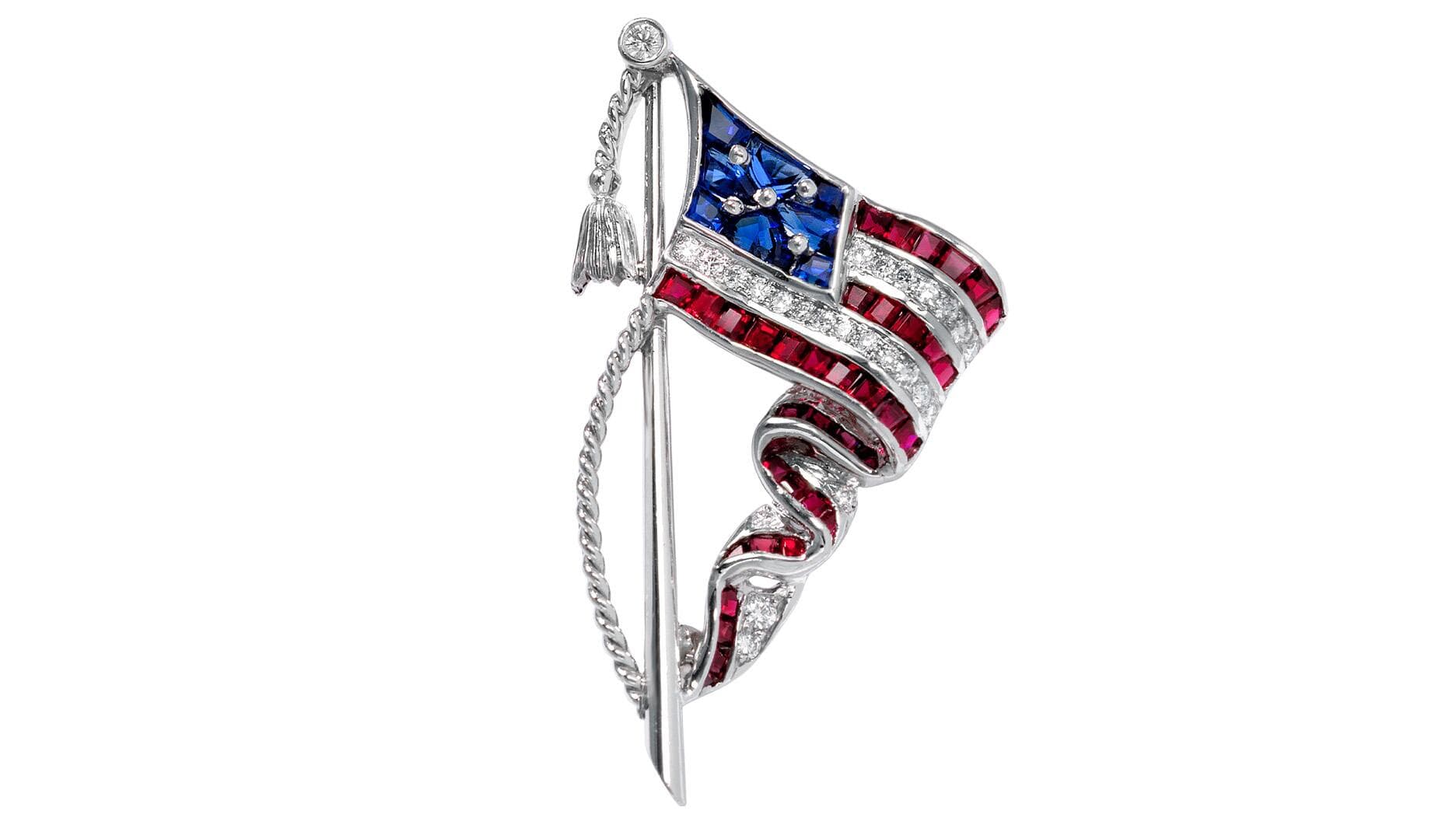
Oscar Heyman has been making its American flag brooch since 1917, and the first version, now in the Museum of Fine Arts, Boston, reads like a miniature archive of American jewelry history. Set with 125 French-cut rubies, 125 square antique-cut diamonds, 13 diamond-set stars, and a field of 36 square-cut blue sapphires, it is less a novelty than a precise, repeatable house signature that has outlived the moment that created it.
A wartime commission that turned into a house code
Oscar Heyman & Brothers was founded in 1912 by Oscar, Nathan, and Harry Heyman at 47 Maiden Lane in New York’s jewelry district, a location that placed the firm at the center of the city’s diamond and gemstone trade. Five years later, the company made its first American flag brooch for Black, Starr & Frost, a retailer whose lineage reaches back to Frederick Marquand’s New York firm of 1823. The brooch was intended to be auctioned in support of the World War I war effort, which gives the design an origin story far richer than simple patriotic decoration.
The Museum of Fine Arts, Boston identifies textile manufacturer Frederick C. Fletcher as the commissioner of that original brooch. That detail matters to collectors because named commission history gives a jewel a traceable life before it entered a public collection. A patriotic brooch is one thing; a patriotic brooch tied to a specific patron, a major retailer, and a wartime fundraising purpose is another entirely.
What makes the original so distinctive
The object itself is a lesson in the discipline of house design. The American flag is rendered with exacting gemstone counts rather than broad color blocking, and the stones are cut to create crisp geometry at a small scale. The rubies form the stripes, the diamonds create the white fields and stars, and the sapphires provide the blue canton, giving the brooch the visual authority of an emblem and the craftsmanship of fine jewelry.
That precision is one reason the design has endured. Oscar Heyman’s current history says the flag brooch remains a popular style today, and the company’s contemporary version retails for $24,000. That price places the brooch firmly in the territory of serious signed jewelry, where the market is paying not only for precious materials but for continuity of design, maker recognition, and the reassurance that comes with a house that has repeated the same idea for more than a century.
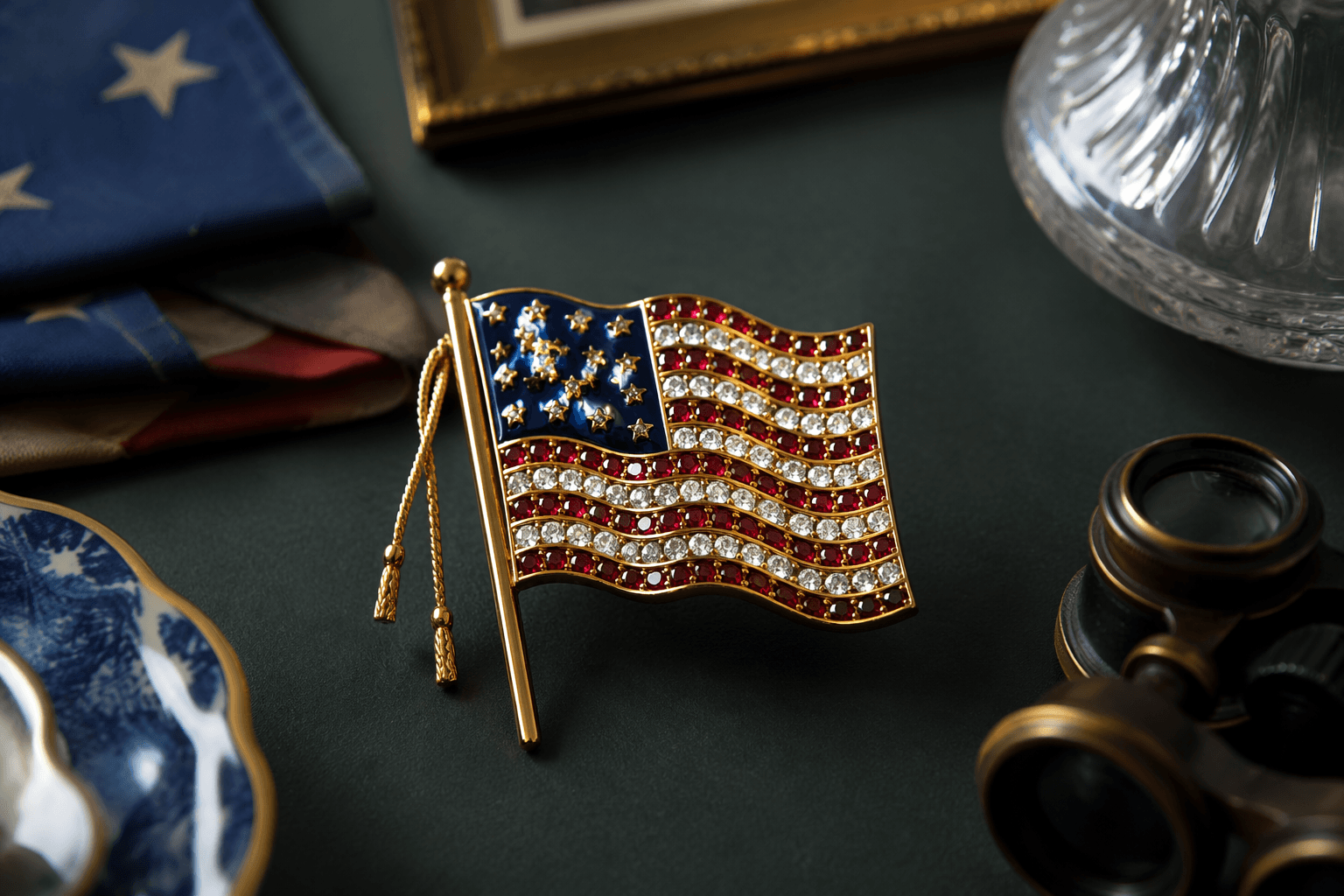
For collectors, that continuity is the point. A one-off patriotic piece can be charming; a design that a firm has returned to since 1917 becomes part of the brand’s visual language. In vintage jewelry, signatures like that are powerful because they turn a decorative object into a recognizable type. Buyers do not have to guess whether the motif belongs to a house or was simply borrowed from the culture at large.
Why museum provenance changes the equation
The original brooch’s life in the permanent collection of the Museum of Fine Arts, Boston lifts it from the category of attractive antique to documented reference point. The museum published Oscar Heyman: The Jewelers’ Jeweler in 2017, the first illustrated history of the company, with Yvonne J. Markowitz and Elizabeth Hamilton as authors. That kind of institutional attention does more than celebrate a brand. It gives collectors a framework for dating, comparing, and valuing later examples.
Oscar Heyman has long been known for designing for elite jewelry houses since 1912, and that reputation matters in the resale market. A house that has supplied other houses usually builds a stronger premium around signature workmanship, because the pieces are judged not just by the name on the jewel but by the consistency of the craftsmanship beneath it. In practice, that means a signed Oscar Heyman brooch often carries more weight than an unsigned patriotic jewel with a similar layout.
The market behavior around the design confirms it. Dealer and auction listings continue to feature Oscar Heyman American flag brooches and related patriotic variations, which suggests the motif has moved beyond a wartime curiosity and into the realm of a collectible recurring form. That is the kind of pattern collectors watch closely: repeated appearances in the trade usually indicate recognition, liquidity, and enduring demand.
What collectors should watch for
The strongest vintage value in this category tends to come from the details that can be documented and compared. When a brooch has a named maker, a clear design lineage, and a museum-recognized prototype, it becomes easier to assess against the market.
- Maker recognition: Oscar Heyman signatures matter because the firm has a documented history dating to 1912 and a reputation for work for elite houses.
- Production era: Early examples linked to the 1917 wartime origin carry different appeal from later versions, even when the motif is the same.
- Provenance: A piece connected to Black, Starr & Frost, Frederick C. Fletcher, or a museum record has a stronger paper trail than a generic patriotic brooch.
- Design fidelity: The exact arrangement of rubies, diamonds, stars, and sapphires signals whether a jewel stays close to the historic model or plays looser with the motif.
- Condition and alterations: In vintage jewelry, restoration can help a piece survive, but heavy alteration can blunt the value of a signed house design, especially when the collectible appeal rests on original proportions and stone layout.
That last point is where the Oscar Heyman flag brooch becomes especially instructive. The pieces collectors remember are not always the largest or flashiest. They are the ones with a documented beginning, a repeated form, and a maker whose hand can be recognized across decades. Oscar Heyman’s flag brooch has all three, which is why it continues to matter as both jewelry and record.
This article was produced by Prism’s automated news system from verified source data, official records, and press releases, then run through automated quality and moderation checks before publishing. The system is built and supervised by the people who set the standards it runs under. Read our full AI policy.
Did this article answer your question?