Sotheby's Hong Kong to Offer Rare 28.88-Carat Jwaneng Diamond
The Jwaneng 28.88's grading report reads like a perfect score: D-color, internally flawless, Type IIa. Here's what that actually means for buyers.
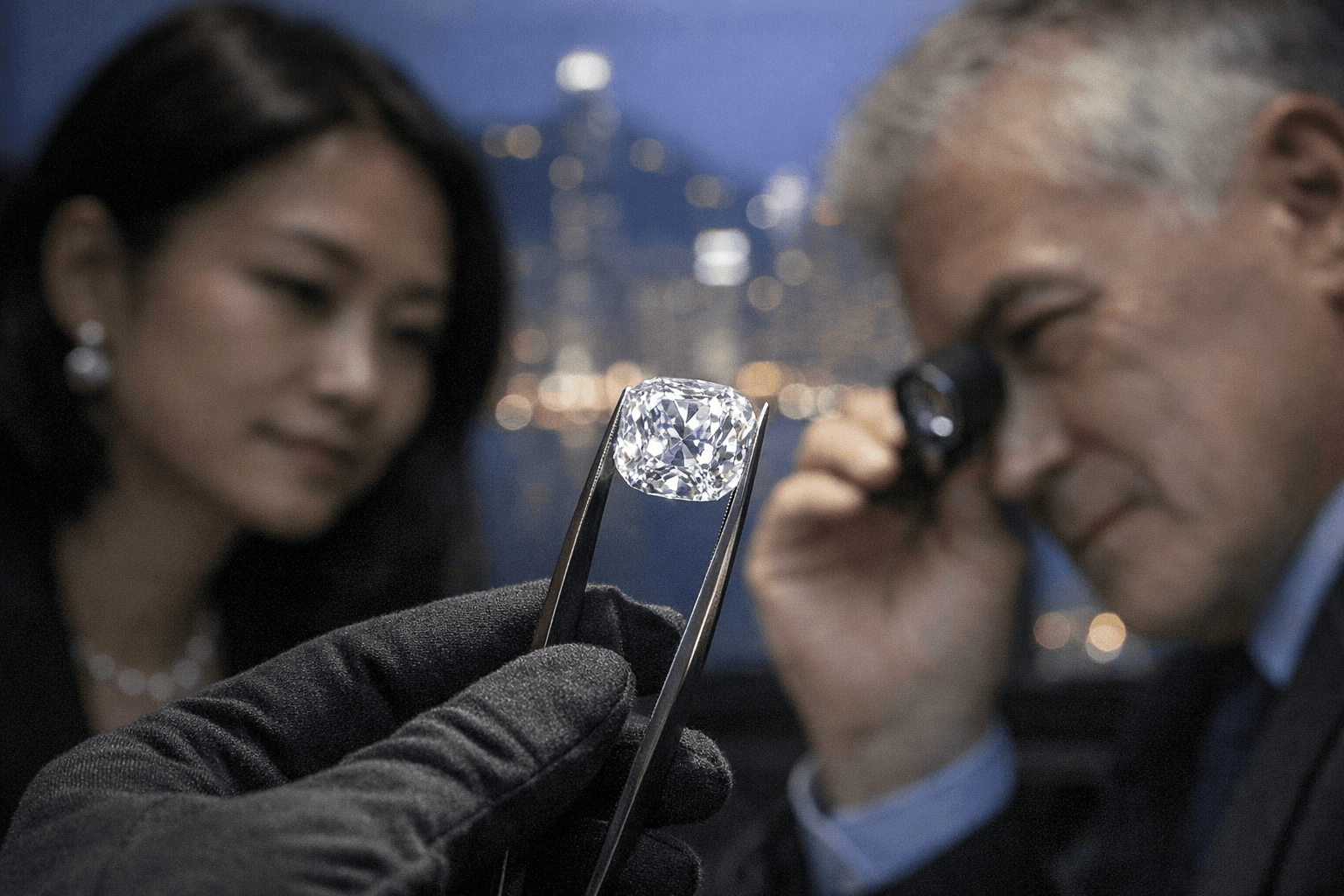
When a 28.88-carat round brilliant lands at auction with a $2.2 million to $2.8 million estimate, the grading report tells you almost everything. De Beers and Sotheby's will offer The Jwaneng 28.88 at Sotheby's Live High Jewelry Sale in Hong Kong on April 23, alongside additional stones from the same Botswana mine. The stone carries three top-tier credentials: D-color, internally flawless clarity, and Type IIa classification. Reading those grades correctly is the difference between understanding what you're bidding on and simply watching a number climb.
D-color sits at the absolute top of the GIA color scale, which runs from D, colorless, to Z, light yellow or brown. The visual difference between D and F is undetectable without a laboratory standard and master comparison stones. What D-color signals is the complete absence of any trace of warmth, yellow, or brown in the crystal.
"Internally flawless" is the second-highest clarity grade in the GIA system. Under 10x magnification, a skilled gemologist finds no inclusions inside the crystal; only the possibility of minor surface blemishes separates this tier from flawless. At 28.88 carats, maintaining that across the full volume of a finished round brilliant is genuinely unusual.
Type IIa classification goes beyond the 4Cs entirely. Fewer than 2% of all natural diamonds carry it, and it describes chemical purity: a Type IIa diamond contains no measurable nitrogen in its crystal lattice. Nitrogen is what gives most diamonds their yellow tint, and its absence at this scale is the geological rarity underlying every other grade. The Jwaneng 28.88 was cut from a 114.83-carat rough recovered at Botswana's Jwaneng mine, operated by Debswana, a joint venture between De Beers and the Government of Botswana. Jwaneng translates as "a place of small stones" in Setswana, a name that carries a certain irony for a nearly 29-carat finished stone. "It's at once a vanishingly rare feat of nature, combined with a master class in diamond cutting and polishing," said Quig Bruning, head of jewels at Sotheby's.
That documented provenance chain is precisely what separates stones like this from the softening market for smaller naturals, where lab-grown alternatives have compressed prices. For large, top-quality natural diamonds with clear origin records, auction results continue to function as public price references for comparable estate and dealer inventory.
None of this grading framework applies cleanly to antique diamonds, and that matters for vintage buyers. Old mine cut and old European cut diamonds predate the GIA system entirely. They were shaped by hand for candlelight, not the standardized daylight-equivalent lighting that gem graders use today. Their larger facets produce less scintillation than a modern brilliant but considerably more fire. Many survive in original form grading J, K, or L on today's color scale, not because they are low-quality stones, but because so many whiter antique diamonds were recut into modern brilliants across the 20th century. Strong blue fluorescence in an antique stone can offset residual yellow in daylight without altering the certificate grade; in estate pieces, that optical behavior is worth knowing even when the grading report does not flag it as an asset.
The practical decision rule: chase D-color and internally flawless when a stone will be sold unset, set in a modern mounting, or stacked against contemporary diamonds at auction. For an old mine cushion in its original Victorian collet, or an old European cut in a platinum Edwardian frame, the certificate is a baseline, not a verdict. Proportion, period integrity, and cutting character determine the premium. The Jwaneng 28.88 represents one end of that spectrum precisely, and its estimate reflects exactly what the grading system was designed to reward.
This article was produced by Prism’s automated news system from verified source data, official records, and press releases, then run through automated quality and moderation checks before publishing. The system is built and supervised by the people who set the standards it runs under. Read our full AI policy.
Did this article answer your question?