Victorian mourning jewelry turned grief into wearable memory
Victorian mourning jewels are decoded through hairwork, Whitby jet, black enamel, and inscriptions that can reveal date, sentiment, and value.
The Metropolitan Museum of Art’s 1894 to 1895 mourning dress, worn by Queen Victoria 33 years after Prince Albert’s death, uses white trim and minimal crinkled crepe to signal half mourning. A black brooch can be a memorial, a love token, or a later pastiche, and the difference changes both collecting confidence and price. Victorian mourning jewelry turned grief into something legible through materials, motifs, and tiny clues hidden in the finish.
How mourning became a visual language
Queen Victoria wore mourning from Prince Albert’s death in 1861 until her own death in 1901, and black mourning dress peaked during her reign. Formal mourning could last from three months to two and a half years, with full mourning in solid black and half mourning allowing small accents of white or purple.
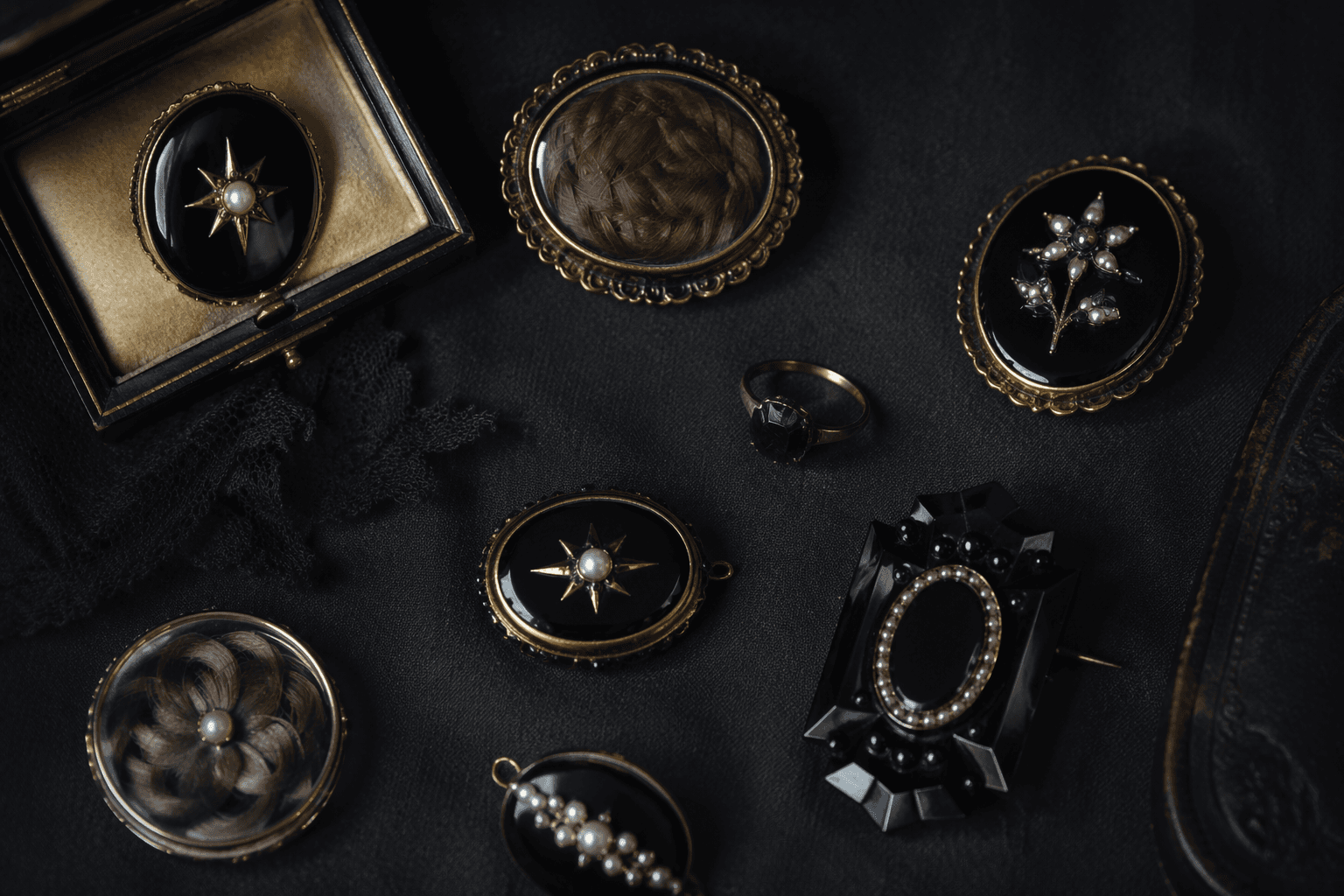
The same code shaped jewelry. A brooch or ring carrying the right combination of black material, hair, inscription, or funerary motif was part of mourning dress. The quickest mistake in a listing is treating all black antique jewelry as the same thing, when the details often decide whether you are looking at memorial wear, sentimental jewelry, or a later imitation of both.
Hairwork: grief, affection, and the problem of context
Hairwork began appearing in jewelry in the second half of the eighteenth century, and by the mid-nineteenth century it was being woven into brooches, lockets, bracelets, rings, earrings, charms, and watch chains. Hair jewelry was a recognized craft with a long life and a wide range of forms. A piece with plaited human hair is not automatically mourning jewelry, because hair could commemorate grief or affection depending on context.
Engraved inscriptions often reveal which story the object was meant to tell. A lock of hair exchanged between friends or lovers could be a token of affection, while the same material paired with mourning symbols and a memorial inscription becomes something else entirely. In later eighteenth-century rings, hair was sometimes hidden in a compartment at the back, making the jewel feel private and uniquely personal rather than openly ornamental.
Hairwork also carries dating clues. Lyres and harps were favorite subjects of Victorian hairwork, and the motifs tied an art form associated with death to images of resurrection and angels. By the end of the nineteenth century, hairwork had fallen out of fashion, and by around 1925 it was widely viewed as old-fashioned, morbid, and vulgar.
Jet, the black stone collectors keep misreading
Jet is a dense, fine-grained form of subbituminous coal, or lignite, that occurs near Whitby, Yorkshire. It was used for ornaments and buttons in Bronze Age burial sites in Britain, then prized again from prehistoric times until the early twentieth century because it takes a high glossy polish, even though it scratches easily.
Jet can look almost like black glass at a glance, but its origin and working history make it a different object entirely, one with a long connection to mourning dress and funerary display. A ca. 1850 American brooch in the Metropolitan Museum of Art combines gold, jet, pearls, crystal, and hair, while an 1848 mourning ring pairs gold, jet, glass, and hair.
Enamel, pearls, and the symbols that confirm mourning
Black enamel and white enamel are among the most revealing details in mourning jewelry. White enamel was often used, though not universally, to commemorate children and unmarried adults. Color was coded, but never absolute. A piece that uses white enamel without other supporting signs may still belong to mourning, yet the context has to do the work.
Pearls are another signal with a specific reading. In a Tiffany mourning brooch in the Metropolitan Museum of Art, pearls symbolize tears, and pearls, black enamel, and an obituary inscription together confirm the piece’s mourning intent.
Motifs that point to date and meaning
Earlier mourning rings often used neo-classical motifs such as urns and broken pillars, both of which echo funerary monuments.
Floral or neo-classical forms that appear in hairwork and memorial jewelry also carry specific meanings. A ring or brooch with an urn, a broken column, a lyre, or a harp is often trying to say something specific, not simply look “Victorian.”
What to look for before you buy
The safest way to read mourning jewelry is to examine the object as a combination of clues, not a single trait. Look for hairwork, but ask whether it is visible, woven, or hidden in a compartment. Check whether the black element is jet, enamel, or another material, and note whether pearls, obituary inscriptions, or funerary motifs support a mourning reading.
- Hairwork suggests intimate memorial or sentimental use, especially when paired with inscriptions.
- Whitby jet points to a long material tradition and a real nineteenth-century mourning vocabulary.
- Black enamel and pearls strengthen a mourning identification, especially in combination.
- White enamel may indicate children or unmarried adults, but it is not a universal rule.
- Urns, broken pillars, lyres, and harps help place the jewel in the iconography of loss and remembrance.
This article was produced by Prism’s automated news system from verified source data, official records, and press releases, then run through automated quality and moderation checks before publishing. The system is built and supervised by the people who set the standards it runs under. Read our full AI policy.
Did this article answer your question?